Stacking 1031 Exchanges With Cost Segregation Across Multiple Properties
Combining these tools multiplies tax benefits across a real estate portfolio.

A 1031 exchange and a cost segregation study solve two different problems, but run together across a portfolio, they reinforce each other rather than simply sitting side by side. The exchange keeps the full sale proceeds working by deferring the tax bill, and cost segregation then front-loads depreciation on whatever gets bought with that larger capital base. Each cycle of sell, defer, buy, and accelerate leaves the investor with more capital deployed and more current deductions to offset income than either tool would produce running alone. That compounding effect, not the mechanics of either instrument in isolation, is the actual subject of this piece, and the rest of this article works through the mechanics and the exceptions that shape whether it holds up in practice.
How a 1031 exchange works and what it defers
A 1031 exchange operates through basis replacement, not tax elimination. The gain on the relinquished property doesn't disappear. It carries forward into the replacement property as a reduced tax basis, and that carried basis becomes the figure cost segregation will later operate on. When the exchange is structured correctly, it defers federal capital gains tax, depreciation recapture, the 3.8% net investment income tax, and, in most cases, state capital gains tax as well.
A single structural requirement governs the transaction: the investor can never receive or control the sale proceeds at any point in it. A Qualified Intermediary holds the full amount under an exchange agreement that must be signed before the relinquished property closes.
Two deadlines govern the process, and both start running on the closing date of the relinquished property. An investor who sells late in the calendar year and doesn't file a tax extension can lose real days off that 180-day clock. For exchanges started on or after October 17, 2025, the window closes at the April 15, 2026 return due date unless an extension is filed, a clear illustration of how the tax-return cap can compress an exchange that starts late in the year.
Reg. §1.1031(k)-1(c). The most commonly used approach is the Three-Property Rule, which allows the investor to identify up to three potential replacement properties regardless of their value. Only real property held for investment or business use qualifies for exchange treatment; primary residences, dealer inventory, and personal property fall outside the statute. Boot, meaning cash or debt relief received instead of like-kind property, is taxable in the year of the exchange, and mortgage relief boot, where the debt on the replacement property is lower than the debt on the relinquished property, is a common and often overlooked trigger, particularly across a multi-property stack where leverage varies from deal to deal. The exchange is reported on Form 8824.
Cost Segregation and the Carryover Basis
Cost segregation is an engineering-based study, typically performed through a site-tour walkthrough conducted by an engineer, that separates a building's components into categories with different depreciable lives. The result reclassifies a portion of the building's cost into 5-year, 7-year, or 15-year land-improvement categories instead of leaving the entire basis on the standard 27.5-year or 39-year straight-line schedule. Studies tend to produce the most value when performed early in ownership, either at acquisition or immediately after major improvements, because that timing captures the largest share of accelerated depreciation over the remaining holding period.
Deferring federal capital gains, depreciation recapture, the 3.8% net investment income tax, and applicable state taxes in a 1031 exchange lets the investor deploy a larger capital base into the next acquisition. It does not receive a fresh basis tied to the new purchase price. A cost segregation study performed on an exchanged property applies to the carried-over basis, the amount the investor just paid for the asset. Investors who model the depreciation benefit using the purchase price instead of the carried-over basis will consistently overstate the near-term deduction, and that error compounds across a portfolio if it isn't caught early.
There's a meaningful offset to this constraint. Where the replacement property costs more than the carried-over basis, which is common when an investor trades up into a larger or higher-value asset, the incremental amount above that carried basis is treated as excess basis. The portion of that excess basis attributable to qualifying personal property identified in the cost segregation study can qualify for bonus depreciation in the year the asset is placed in service. Bonus depreciation under the One Big Beautiful Bill Act, enacted in 2025, has been restored to its full rate for qualifying assets, and the prior phase-down schedule has been permanently eliminated. The shorter asset lives that cost segregation produces, the 5-year and 7-year personal property and the 15-year land improvements, stay advantageous over time regardless of how the bonus rate applied to any given asset class shifts in future years. The carried-over basis limits what a cost segregation study can accelerate on the original purchase amount, but the excess basis on an upgraded acquisition gives the tool real room to work.
Stacking These Tools Across Multiple Properties
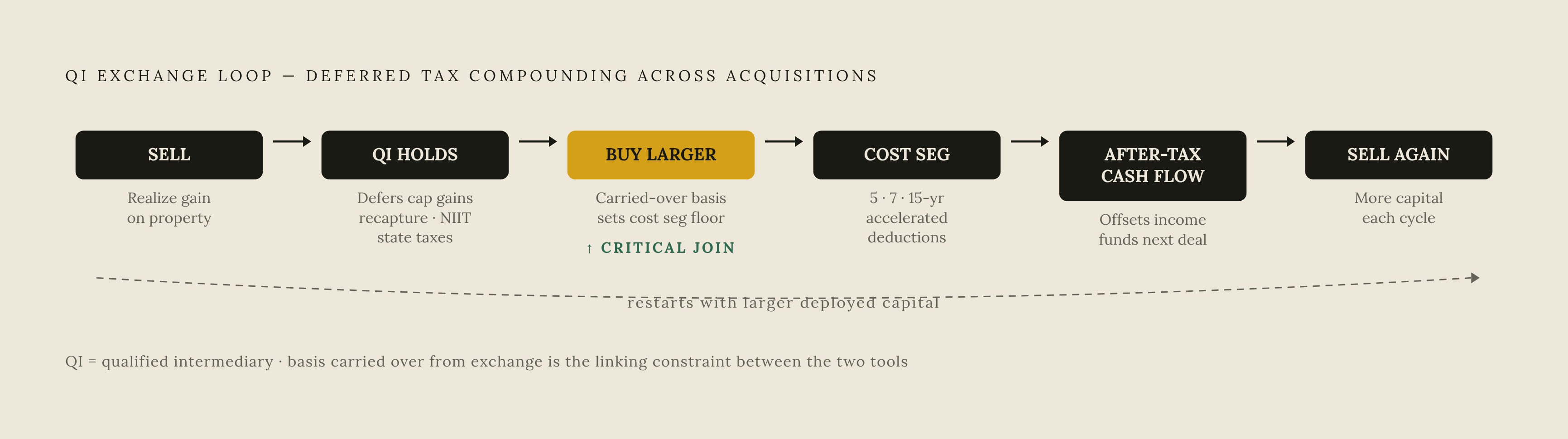
The exchange carries the deferred gain forward into the replacement property as a reduced, carried-over tax basis, and cost segregation operates on that basis figure. Neither side of that loop does much on its own. Together, they turn a single transaction into a repeatable cycle: exchange, acquire, run the cost segregation study, generate the deductions, improve after-tax cash flow, and use that improved cash flow to fund the next acquisition. Each pass through that cycle leaves the investor with more deployable capital than a single application of either the exchange or the cost segregation study would have produced by itself.
The benefit extends across the full portfolio, beyond the property where the study was performed. Losses generated by cost segregation on one replacement property can offset ordinary income from other properties in the portfolio, including rental income, provided the investor qualifies as a real estate professional or holds enough passive income elsewhere to absorb the losses. That portfolio-wide offset is where the strategy earns its full value, because it means the benefit of any single cost segregation study isn't capped by the performance of the one property it was run on.
Carried to its logical endpoint, the strategy becomes a generational planning tool rather than a short-term tax play. Because the step-up in basis at death eliminates the deferred gain entirely for heirs, an investor who exchanges consistently across a portfolio, property after property, can defer gain recognition indefinitely while compounding equity across the holding period. That's the "swap till you drop" outcome, and it only works if each exchange in the sequence is executed correctly.
The obvious objection deserves a direct answer. If the carryover basis limits how much a cost segregation study can accelerate on an exchanged property, doesn't that undercut the compounding argument? It does, partially, on any single deal. But the excess basis captured when trading up into a larger property, combined with the portfolio-wide offset of losses against income from other assets, combined with the larger capital base preserved by each successive exchange, together outweigh the drag that the carryover basis places on any one transaction. The constraint applies to any single deal, but it isn't the whole picture.
When stacking does not make sense
The combined strategy isn't the right call in every situation, and treating it as a default choice rather than a modeled decision is where investors get into trouble. In some cases, accepting a taxable sale, buying a better-suited replacement property outright, and running a cost segregation study on a full stepped-up basis produces more useful after-tax flexibility than exchanging and inheriting a carried-over basis.
A handful of scenarios tend to favor skipping the exchange. A high-basis property where the taxable gain is small relative to the flexibility gained by not being bound to exchange timelines or replacement requirements is one. An older rental with significant unclaimed depreciation is another, since a catch-up cost segregation study on a fresh, full basis will often be more valuable than the same study run on a stepped-down carried basis. A replacement property that is unusually rich in short-life components, such as a newer building with substantial personal property, is a third case, because the excess-basis bonus depreciation opportunity there can be large enough that starting from a fresh basis outperforms the carryover scenario by a wide margin. And an investor without passive activity income or real estate professional status faces a real constraint of a different kind: large cost segregation deductions may simply be suspended and unusable against current income, regardless of how the basis is structured.
The practical standard is to model both paths before committing to anything: exchange plus cost segregation on the carryover basis, against a taxable sale plus cost segregation on the full stepped-up basis. That comparison has to happen before the relinquished property closes, because once it closes and the exchange agreement is in motion, the decision can't be undone. Getting this modeling right shows whether the compounding benefit described above materializes or gets eaten by a basis limitation nobody checked in advance.
Once an investor has done that modeling and decided an exchange is the right move, the next question is who holds the money while the exchange is in progress.
What a Qualified Intermediary does
The Qualified Intermediary is the structural spine of the entire exchange, not an administrative convenience layered on top of it. Without a QI that satisfies the safe harbor set out in Treasury Regulation 1.1031(k)-1(g)(4), the IRS treats the investor as having received the sale proceeds directly, the exchange fails outright, and the full deferred gain generally becomes taxable in the year of the sale, though the installment method may allow some deferral across years in certain circumstances. Every deduction planned through cost segregation, every basis calculation built around the exchange, depends on this structure holding.
On Day 45, a written identification of replacement property must be delivered to the QI, with no extensions available and three identification methods to choose from, covered below. That list includes anyone who has acted as the investor's agent within the prior two years, such as a CPA, attorney, real estate broker, or employee, along with family members including a spouse, siblings, ancestors, and descendants, and any entity the investor or their family controls beyond a defined ownership threshold.
The regulatory environment around QIs is thinner than most investors assume. Qualified Intermediaries are not regulated by the federal government or by most states, and in practice, almost anyone can set up a QI business with no testing and no approval process. Most states have no laws at all governing how exchange funds must be deposited, invested, or secured. That gap has produced real losses. During the 2007-2009 recession, a number of investors lost their exchange funds outright through misappropriation or through poor investment decisions made by their QI, and more recently at least one QI lost client funds by investing them in cryptocurrency. If the QI goes bankrupt or absconds with funds, the investor loses both the money and the tax deferral, a double loss.
A handful of requirements should be non-negotiable when selecting a QI. Exchange funds need to sit in segregated, FDIC-insured accounts, kept apart from other clients' funds and from the QI's own operating accounts. Fee terms should be disclosed clearly before engagement, with nothing left to be discovered later in the process. The exchange agreement itself must be executed before the relinquished property closes, never after the fact. And credentials matter: the Federation of Exchange Accommodators is the only national trade association representing QIs and the legal and tax professionals who work alongside them, and the Certified Exchange Specialist designation signals a practitioner-level depth of expertise worth looking for.
QI Fees, Interest Income, and Fund Security in a Multi-Exchange Strategy
For an investor running several exchanges across a portfolio over time, those same fees compound the same way the tax benefits do, just in the opposite direction. A standard delayed exchange typically carries a fee in a modest range, but more complex structures, such as reverse exchanges or improvement exchanges, run materially higher, and added charges for wire transfers, document preparation, and additional properties are common on top of the base fee. Across a multi-exchange strategy, those charges accumulate into a real cost that deserves the same scrutiny as any other line item in the portfolio's financial model.
Interest income is the piece of this equation that gets the least attention, and it shouldn't. A QI holds exchange funds, sometimes a substantial sum, for up to 180 days at a stretch. Traditional QIs commonly retain all or part of the interest earned on those held funds as compensation beyond their stated exchange fee, and an investor who never asks how that interest is being handled is quietly transferring real value to the intermediary without realizing it.
Some firms have moved to a different structure. Deferred charges no fee for a standard 1031 exchange and instead shares a portion of the interest earned on funds above a set threshold balance directly with the client, with those funds held in a segregated, FDIC-insured account and the applicable interest rate published openly in a rate table rather than negotiated deal by deal. For an investor running one exchange, that model costs less and returns more than a traditional fee-plus-retained-interest structure. For an investor running several exchanges across a growing portfolio, the cumulative difference in cost paid out and interest returned becomes a material factor in the overall return of the strategy.
Technology matters here too, particularly for an investor coordinating several exchanges at once. Platforms that give real-time visibility into transaction status let the investor and the advisors, brokers, and title companies involved in a multi-property exchange track exactly where funds and documents stand at any given moment. Automated banking workflows and logged fund transfers also reduce the kind of manual-process error that, in the worst cases, has provided cover for the fund misappropriation described earlier in this piece.
Before signing an exchange agreement, an investor can ask a QI whether a single experienced Exchange Officer handles the file from the first call through closing, or whether the file gets passed between different staff at different stages. Are funds held in a segregated, FDIC-insured account, and is that verifiable rather than simply asserted? Is the interest-sharing arrangement disclosed in writing, with a published rate, or negotiated privately on a case-by-case basis? The answers to those questions decide whether the capital preservation built into the 1031 exchange, and the deductions built into the cost segregation study that follows it, survive the mechanics of the transaction that connects them.