Serial 1031 Exchange Laddering Over a 30-Year Hold
Deferring taxes indefinitely through chained exchanges beats paying millions to the IRS.
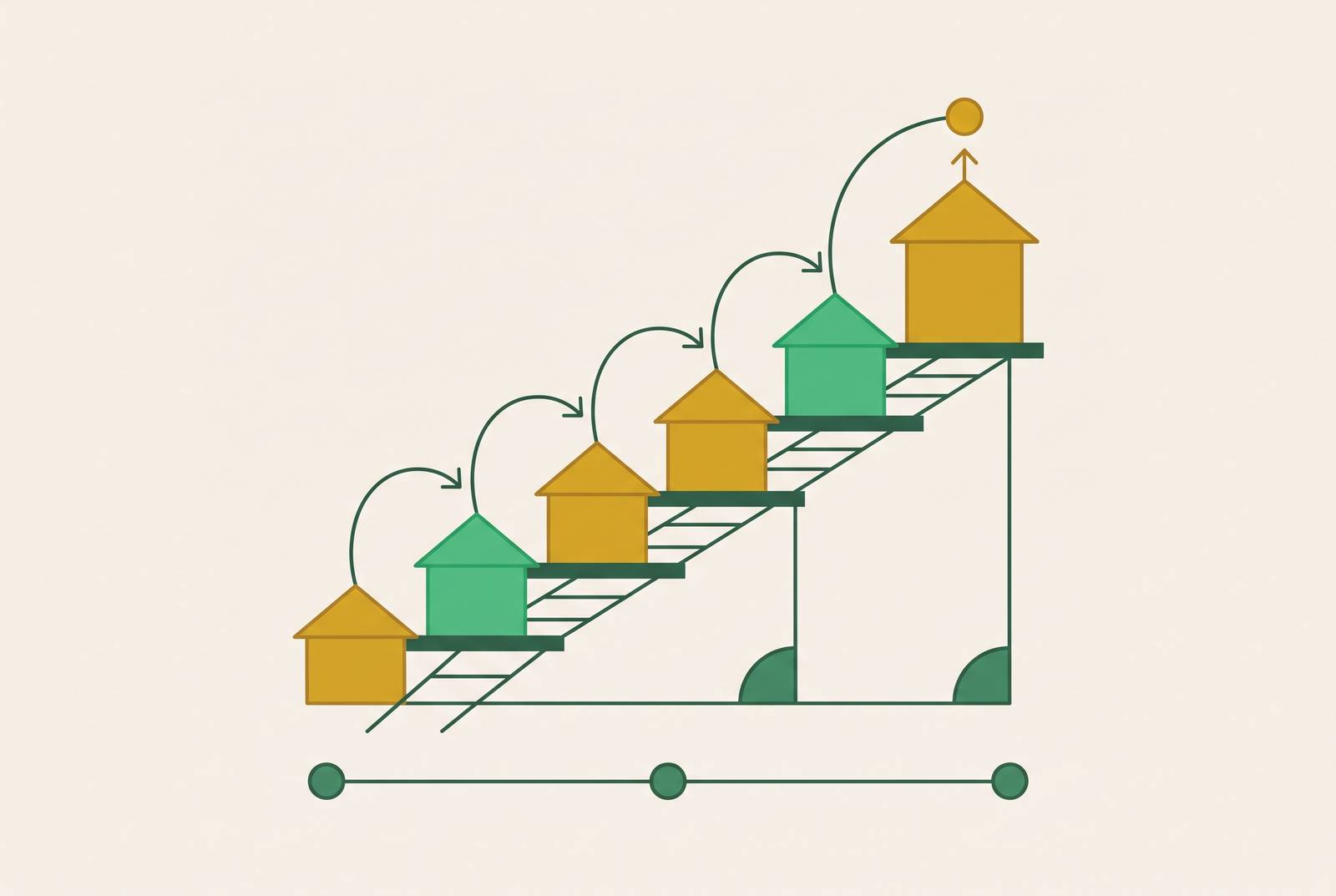
A serial 1031 exchange ladder does not treat tax deferral as a one-time event. It treats each exchange as a link in a chain that can run thirty years, where every sale funds the next purchase and no transaction along the way triggers a tax bill. A tactical investor uses a single 1031 exchange, defers one gain, and stops there. A strategic investor chains exchanges together so the deferred dollar keeps working, growing into a larger base for the next property, and the one after that. Practitioners call the endgame "swap till you drop": keep exchanging, hold until death, and let heirs inherit at a stepped-up basis that erases decades of tax liability in a single stroke.
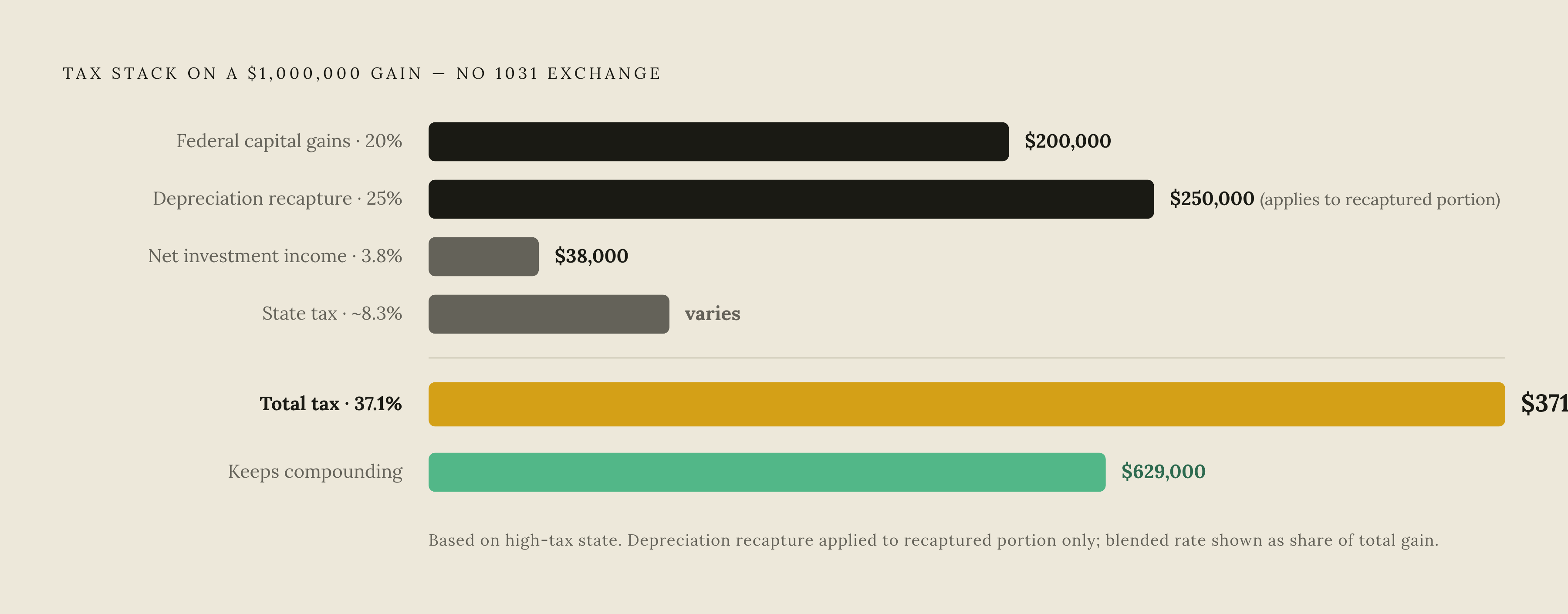
The strategy survives intact under current law, and that matters more than most investors realize. A proposed cap on 1031 deferrals did not survive the federal tax overhaul in recent years; Section 1031 came through unchanged. If an investor skips an exchange even once, the tax bill stacks federal capital gains at 15 to 20%, depreciation recapture at 25%, the 3.8% net investment income tax, and state tax on top. In high-tax states the combined rate is near 37.1%, turning a $1 million gain into a $371,000 check to the IRS. That $371,000 either goes to the government or stays in the deal, compounding right alongside the equity that generated it.
Keeping that money invested instead of paying it out changes the entire trajectory of a portfolio. Take a large tax bill avoided through an exchange. Left invested and compounding over two decades, even at a modest appreciation rate, that sum can grow to a substantially larger figure. The investor who paid that $300,000 at the time of sale never got the chance to compound it, and the loss runs deeper than the $300,000 itself: every dollar of appreciation, income, and reinvestment that sum would have generated over two decades disappears with it. That asymmetry is the entire argument for building a ladder in the first place.
Extend that logic across a full 30-year sequence and the effect stacks. Each exchange defers a larger accumulated gain than the one before it, because the base keeps growing with every cycle, and the tax savings compound in step with the equity rather than sitting alongside it as some separate perk. The exact multiple depends on market and on how disciplined the investor stays at each rung, so treat any specific number as directional. What holds regardless is the mechanism: it rewards patience and punishes interruption without exception. None of that math survives a sloppily executed exchange. The IRS does not grade on effort, and it does not care how many prior exchanges went well.
The mechanics every exchange in the ladder must satisfy
Every exchange in a 30-year ladder answers to the same statute, IRC Section 1031, and the same IRS guidance, regardless of how many times an investor has done this before. If anything, the stakes rise with each repetition, since a failure late in the ladder puts a far larger accumulated gain at risk than a failure early on.
Two deadlines govern every exchange, and both start the moment the relinquished property closes, not when it's listed and not when a contract gets signed. The investor has 45 calendar days to identify replacement property in writing, delivered to the Qualified Intermediary, then a 180-day window to close on the replacement, or the tax-return due date for that year, whichever comes first. Neither deadline bends. Financing falls through, a seller defaults, a title problem surfaces, a hurricane hits, and none of it buys extra time, short of formal disaster relief under a federal revenue procedure. Late-year sales carry their own trap: anything closing on or after mid-October forces a choice between filing a tax extension or losing the tail end of the 180-day window. Investors have lost six-figure deferrals to exactly that miscalculation.
Identification follows one of three rules, and an investor picks exactly one. The Three-Property Rule lets someone identify up to three properties of any value, and it's the one most investors use. The 200% Rule allows identifying any number of properties as long as their combined fair market value doesn't exceed 200% of what the relinquished property sold for. The 95% Exception permits unlimited properties at unlimited value but requires closing on at least 95% of the identified total, a bar high enough that almost nobody chooses it.
Like-kind, within real estate, is far more permissive than the phrase suggests. Raw land in Montana can exchange into a multifamily building in Atlanta. A warehouse can become a retail strip center. Property type and improvement level don't need to match, so long as both sides sit within the same country and both qualify as investment or business real property. Where investors actually get tripped up is boot: if the replacement property comes in at a lower value or carries less debt than what was sold, the shortfall gets taxed in the year of the exchange, no matter how small it looks on paper.
Certain properties are disqualified outright: primary residences, vacation homes used mostly for personal enjoyment, dealer or inventory property, and, since the tax law took effect that year, all personal property. There's no statutory minimum holding period, but the IRS looks for investment intent, and most practitioners treat 12 to 24 months as the practical floor. Related-party exchanges carry a hard two-year holding requirement. Every exchange gets reported on IRS Form 8824, filed with the return for the year the relinquished property sold, even if the replacement closing spills into the following year.
Sequencing the ladder over 30 years: property selection, timing, and repositioning decisions
Executing the exchange correctly is necessary, but it settles nothing about whether the ladder actually works. The property chosen at each rung either accelerates the compounding or leaves it treading water, and a technically flawless exchange into a mediocre asset still produces a mediocre outcome. Investors who treat the mechanics as the finish line, rather than the entry fee, end up with a ladder full of properties nobody would buy twice. That's the mistake to avoid above nearly all others in this strategy: getting the paperwork right while getting the asset wrong.
Repositioning follows a recognizable arc as the portfolio matures. Investors move from lower-maintenance, smaller assets toward institutional-grade holdings, Class C into Class A, for instance, often shifting geography too, toward markets with stronger appreciation trends. Asset type evolves with conditions and with an investor's changing appetite for risk: land into multifamily, multifamily into industrial. There's no cap on how many times an investor can exchange over the life of the ladder, and the 45-day identification window remains the single most dangerous constraint in the entire sequence. Missing it doesn't just fail one transaction; it forces an immediate taxable event on the full accumulated gain, undoing years of compounding on account of one missed deadline.
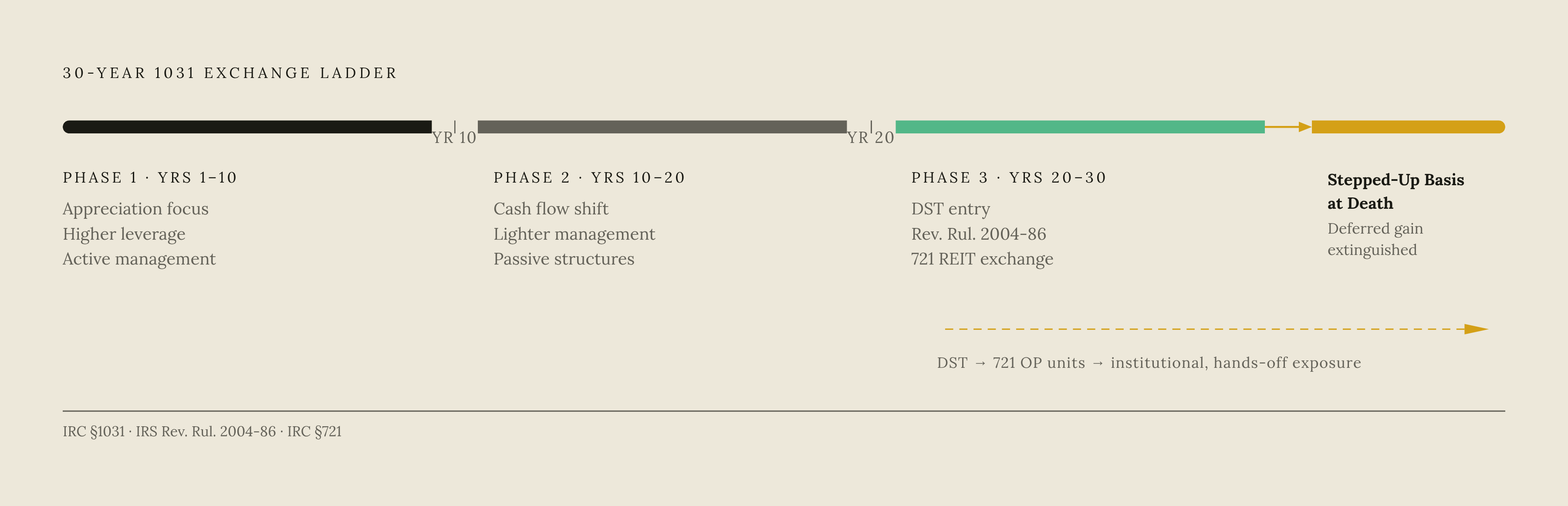
Sequencing tends to track life stage. In the early phase, roughly years one through ten, the priority is appreciation, and investors generally accept a heavier management burden and use leverage to scale faster. The mid phase, years ten through twenty, usually brings a shift toward cash flow, lighter management, and early consideration of passive ownership structures. By the late phase, years twenty through thirty, many investors move into a passive real estate ownership vehicle, reducing operating risk and setting the portfolio up for the step-up at death.
DSTs serve a specific function late in the ladder. IRS Revenue Ruling 2004-86 confirmed that a beneficial interest in a properly structured DST counts as direct ownership of real property for 1031 purposes, so an investor can exchange into passive income without taking on landlord duties, and the exchange still qualifies. From there, a 721 exchange offers a terminal move: contributing DST interests, or direct real estate, into a REIT operating partnership on a tax-deferred basis. That shifts an investor from illiquid, single-asset real estate into diversified REIT exposure without triggering a taxable event. The 1031-into-DST, followed later by a 721, functions as the recognized bridge from active ownership to something closer to institutional, hands-off exposure, and it's the sequence most late-stage ladders are built to reach.
Market conditions shape how this plays out. Observers of the current market note that after a stretch of elevated borrowing costs and thin inventory, many investors are returning more selectively and weighing tax efficiency more heavily than availability. That selectivity matters, because letting the 180-day clock dictate the purchase, buying an overpriced property just to beat the deadline, destroys more wealth than simply paying the tax would have. Treat the deadline as a constraint to plan around, never as a reason to lower the bar on the asset itself.
How the step-up in basis at death resolves the accumulated deferred liability
The tax liability built up across a 30-year ladder doesn't vanish during the investor's lifetime. It accumulates with every exchange, growing in step with the portfolio itself, sitting there as a deferred obligation that never shrinks on its own. Death is what actually resolves it, and nothing short of death does.
Under current tax law, heirs inherit a property at its fair market value as of the date of death, and their cost basis resets to that figure. For an investor who spent three decades deferring gains through a chain of exchanges, that step-up eliminates the entire accumulated liability in one motion. An heir who sells shortly after inheriting owes no capital gains tax on any of the appreciation that built up during the decedent's lifetime.
Section 1031 and the step-up rule have coexisted for decades and both survived recent tax legislation without alteration, which is part of why the ladder makes sense as a multi-decade plan rather than a short-term trick built on rules that might not hold.
The step-up also gives the final asset in the ladder, frequently a DST or some other passive, institutional-grade holding, a natural role as the anchor of an estate plan. At that point the sequence of exchanges stops centering purely on the investor's own return and starts shaping what actually transfers to the next generation. Selling outright late in life forfeits all of it: the investor gives up the step-up on decades of appreciation just to convert real estate into cash, and there's rarely a good reason to make that trade in the final years of a ladder. A tax advisor and an estate attorney belong in any ladder running this long, since how the step-up interacts with an individual estate plan varies considerably from one family to the next.
Failure points in 30-year ladders that compound against the investor
A failed exchange late in a long ladder does not just cost the gain from that one transaction. It triggers recognition of the entire accumulated deferred gain built up over every prior exchange. The stakes at step seven or eight run categorically higher than the stakes at step one.
Missing the 45-day identification deadline is the most common failure, and the least forgivable. The IRS grants no extensions, full stop, and a missed deadline forces recognition of everything deferred to that point. Boot exposure is the other frequent trap. If the replacement property comes in lower in value or carries less debt than the property sold, the shortfall becomes taxable immediately, and in a mature ladder that shortfall can represent a decade or more of compounded appreciation taxed in a single year. The late-year timing trap resurfaces here too. Investors who sell in the fall without filing a tax extension watch the back half of their 180-day window disappear without ever realizing it was shrinking.
Activity level creates its own risk. An investor who's too hands-on, buying, renovating, and flipping quickly, risks having the IRS reclassify those properties as dealer inventory, which disqualifies the exchange after the fact. Letting the 180-day clock dictate the purchase decision, rather than sound underwriting, ranks among the most expensive mistakes an investor can make across a multi-decade ladder.
Then there's a risk that has nothing to do with the investor's own conduct: the solvency of the Qualified Intermediary holding the funds. The collapse of LandAmerica Exchange Services is the clearest cautionary example on record. LES, the QI subsidiary of one of the country's largest title insurance companies, filed for bankruptcy while holding substantial exchange funds belonging to hundreds of investors. Investors whose funds sat in segregated accounts fared better than those whose agreements placed funds in commingled accounts, and it was the latter group that bore losses segregation would have prevented.
That gap exists because QIs operate in a genuine regulatory vacuum. Unlike a bank or a broker-dealer, a QI faces no federal licensing requirement and no federal oversight of how it holds client funds. Most states don't regulate QIs meaningfully either. California, Nevada, Idaho, Colorado, Oregon, Virginia, and Washington are among the exceptions that impose registration or insurance requirements. Everywhere else, an investor is trusting the QI's internal policies and nothing more, which is a strange amount of faith to place in an intermediary holding a decade's worth of deferred gain.
Two other failure points round things out. Using a disqualified person as QI, an attorney, CPA, or real estate agent who worked for the investor within the prior two years, invalidates the exchange. And documentation errors on Form 8824 remain a persistent cause of failed exchanges, even in cases where the property and the timing were both handled correctly.
Choosing a Qualified Intermediary for a multi-decade strategy
Across a 30-year ladder, an investor might work with a QI on five exchanges, ten, or more. That relationship is not interchangeable the way a single transaction might suggest, and treating it that way is the second mistake. The fund-protection model and the quality of service compound over time in exactly the same way the portfolio does, and picking a QI the way one might pick a title company for a single closing sets up the same vulnerability LES's commingled clients discovered too late.
Fund security has to be addressed first, not as an afterthought. Given what happened with LES and the near-total absence of federal oversight, investors need to know upfront whether exchange proceeds are in segregated or commingled accounts. Segregated accounts, held in the investor's own name and FDIC-insured, eliminate the exact exposure that cost LES's commingled-account clients their money. An investor won't know which model they're getting unless they ask directly: are funds segregated, and what's the FDIC coverage level? Deferred holds exchange funds in segregated, FDIC-insured accounts with substantial coverage, a level of protection commingled structures simply cannot match.
Interest income is another place where models diverge sharply. Traditional QIs typically keep the interest earned on held exchange funds as extra revenue, on top of fees that generally run $600 to $1,500 or more per exchange. Across a 30-year ladder with multiple exchanges, that retained interest adds up to a real transfer of wealth from client to intermediary, even if no single instance feels significant on its own. Deferred runs the opposite model: no fee, and the interest earned on held funds is shared directly with the client, even if the exchange ends up getting cancelled. Rates are posted in a public table, with no negotiation and no fine print to catch anyone off guard.
Who actually handles the file affects how well errors get caught and how well incentives stay aligned over the life of a multi-decade ladder. Commissioned salespeople and frequent handoffs between team members introduce errors and misaligned incentives, and a ladder running three decades needs continuity more than almost anything else it needs. Deferred assigns one senior Exchange Officer, each with at least a decade of experience, to a file from the first phone call through closing, with no handoffs and no salespeople in the loop.
The 45-day identification clock does not pause for slow onboarding, so delays in opening an exchange can cost the investor the identification window itself before the exchange has even really started. Opening an exchange should take minutes, not days, and support needs to be there when a deadline is closing in, not just during business hours. Deferred can open an exchange in minutes, including same-day and even at the closing table itself, with support available seven days a week from 8 a.m. to midnight ET. A strategy built to run three decades, and to hold up at every single rung along the way, needs exactly that kind of responsiveness built into its infrastructure, not bolted on after the first mistake.