Deferred Capital Gains as an Interest-Free Government Loan
The unpaid tax bill becomes interest-free capital that compounds while the government waits.
The 1031 exchange doesn't dodge a tax bill. It manufactures a loan: an interest-free advance from the federal government, sized to whatever tax liability would otherwise come due, that keeps running for as long as the exchange chain does. Most investors treat the mechanism as paperwork, a way to avoid writing a check to the IRS. That framing gets it backward, and it costs them money. The unpaid tax is capital, and capital left deployed in real property compounds while the government collects nothing in carrying costs. Once an investor sees the exchange as a loan rather than an exemption, the questions that matter change: how to reinvest, how to time it, and who gets trusted to hold the money in between.
The like-kind exchange provision has sat in the tax code since 1921, originally as Section 202(c), and took its current name, Section 1031, with the 1954 Amendment to the Federal Tax Code. A century of continuous use is what separates a deliberate policy tool from a loophole, and this is the former.
The full size of the loan: federal capital gains, depreciation recapture, and NIIT
The loan runs bigger than most investors assume, because three separate taxes stack on top of each other, and most people only ever budget for one.
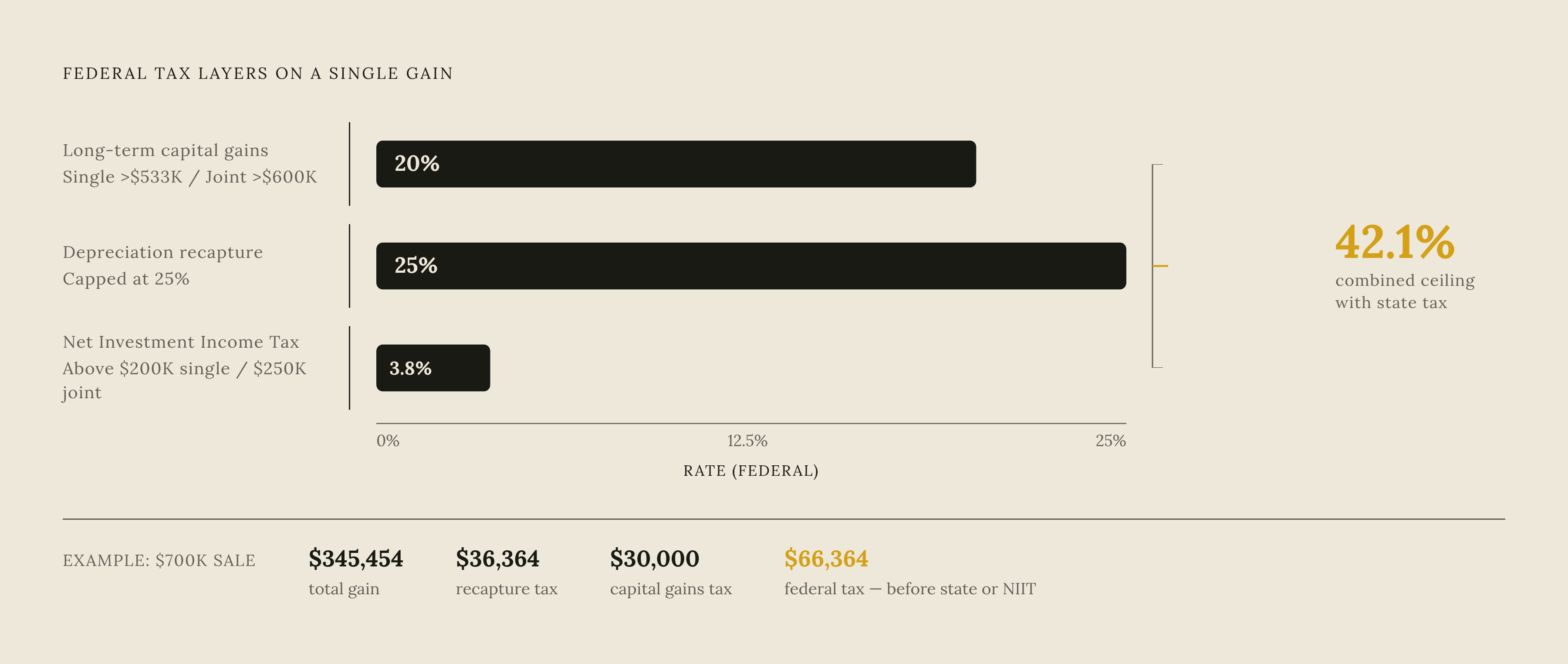
Under 2025 thresholds, federal long-term capital gains is 20% for single filers with taxable income above $533,400, and married couples filing jointly above $600,050. Everyone knows about that layer. Depreciation recapture is the one that catches people off guard, and it's often the largest piece of the stack: capped at 25% federally, applied to every dollar of depreciation claimed or claimable over the holding period. The Net Investment Income Tax adds another 3.8% on investment income above $200,000 for single filers, $250,000 for joint filers.
State taxes pile on further, from zero in Texas, Florida, and Nevada to 13.3% in California. An investor in a high-tax state can face a combined liability near 42.1% of the gain, more than double the 20% headline rate most people carry around in their heads. That gap between the number people plan around and the number they actually owe is where the deferral decision gets made or lost.
Run the numbers on an actual deal. A property bought for $500,000, with $400,000 allocated to the building and $100,000 to land, generates about $145,454 in depreciation over ten years. Sell it for $700,000 and the gain totals $345,454. The $145,454 tied to depreciation gets taxed at 25%, or $36,364. The remaining $200,000 of long-term gain, at an assumed 15%, adds $30,000 more. That's $66,364 in federal tax alone, before state taxes or NIIT enter the picture. A 1031 exchange defers every dollar of it, and that $66,364 keeps working in real estate instead of leaving the balance sheet.
The deferred recapture doesn't disappear. It travels. It attaches to the replacement property and follows the investor into the next deal, and the one after that. Nothing gets forgiven mid-chain. It just moves.
Weigh that $66,364 against what deferring it actually costs. A properly structured exchange typically runs under 1% of the property's value in intermediary and exchange-related fees. Paying under 1% to defer a liability north of 25% of the gain is the whole argument for doing this at all, and anyone treating the exchange as optional paperwork is leaving that spread on the table.
Exchange mechanics protecting the loan from day one
The loan collapses the moment the investor touches the sale proceeds. This is constructive receipt, and it's absolute: wire the funds to a personal account, even briefly, or hold an uncashed check, and the capital becomes taxable on the spot. There's no fixing it after the fact.
A Qualified Intermediary is structural, required to complete a valid exchange. It's structural. The QI holds the exchange funds in the gap between the sale of the relinquished property and the purchase of the replacement, standing between the investor and constructive receipt. The QI also drafts the exchange agreement that legally converts what would otherwise be a sale followed by a purchase into a single, continuous exchange. If that paperwork is skipped, reinvesting the proceeds quickly doesn't save the deferral. The exchange has to exist on paper before it exists in practice.
Like-kind, under current law, covers a wide range. Nearly any real property held for investment or business purposes qualifies against nearly any other: an apartment building for a commercial strip center, raw land for a rental house, a single-family rental for a Delaware Statutory Trust interest in a storage facility. Personal property no longer qualifies under Section 1031. Real estate is the only category left standing. Individuals, business owners, and trusts can all use it.
Two mechanical rules trip people up more than any tax nuance ever does. Titleholder continuity between the relinquished and replacement property is a core structural requirement of a valid exchange. Proper sequencing of the QI engagement relative to the closing is critical; getting it wrong is one of the most common and consequential mistakes in the process.
The two clocks running simultaneously
Two deadlines start the moment the relinquished property transfers, and they run in parallel, not in sequence. Every calendar day counts from the transfer date, weekends and holidays included, so there's no pausing for a long weekend.
The first clock is the identification period: 45 calendar days to deliver written identification of replacement property to the QI or another permissible party. The notice must go to the QI or another permissible party, not a disqualified person. It has to be signed by the exchanger and describe the property specifically: a legal description, a street address, or a clearly distinguishable name. "A single-family rental somewhere in Austin" won't hold up. Best practice puts the notice in by close of business on Day 44, leaving a buffer before the midnight deadline on Day 45. Properties on the list can be swapped or dropped freely before then; after Day 45, the list locks for good.
Investors have to pick one of three identification rules, and the rules are mutually exclusive. The Three-Property Rule allows identifying up to three properties regardless of value. The 200% Rule allows any number of properties, as long as their combined fair market value doesn't exceed 200% of what the relinquished property sold for. The 95% Exception exists for investors who blow past both limits, but it requires actually acquiring 95% of the aggregate value of everything identified, a bar high enough that it's rarely the right plan.
The second clock, the exchange period, gives the investor 180 calendar days from the transfer date to receive the replacement property, or the due date of that year's tax return, whichever comes first. That "whichever comes first" clause is where the next section lives, and it catches more investors than any other part of the process.
Partial exchanges deserve a mention. Pull cash out of the deal, or reduce net mortgage debt without covering the difference in cash, and that shortfall, known as boot, becomes taxable. Deferral doesn't have to be all-or-nothing, but it has to be structured deliberately to be complete.
Disaster relief can extend both clocks, though only in the jurisdiction covered. The 2025 Los Angeles County disaster relief extended qualifying 45-day and 180-day deadlines for affected exchangers, with the specific terms depending on when the exchange began and the nature of the relief granted. Relief like that exists, but nobody should assume it applies anywhere else.
The year-end trap that silently shortens the exchange window
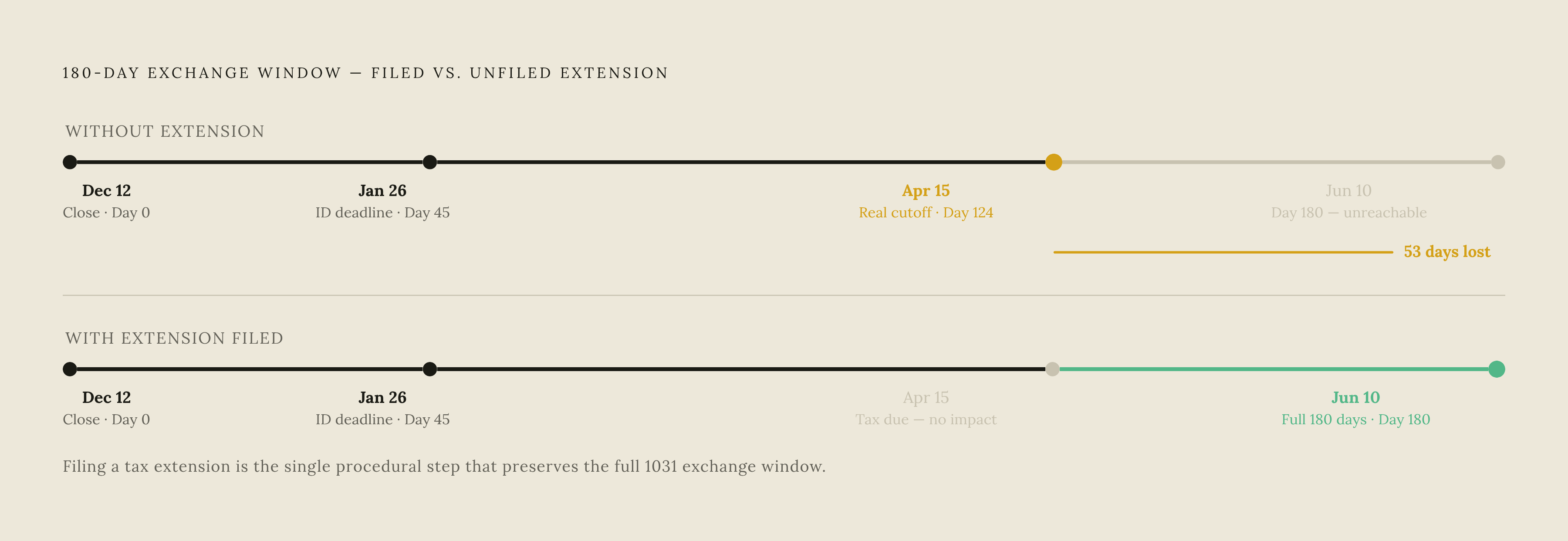
The 180-day period is subject to an earlier cutoff, and it catches even experienced investors off guard. It's capped by the due date of the investor's tax return for the year of sale, whichever comes first. Sell late enough in the year, and the tax filing deadline arrives before Day 180 does.
For any exchange starting between October 17, 2025, and December 31, 2025, the tax return deadline governs, cutting short the 180-day count most investors assume they have. Take a sale that closes December 12, 2025. The 45-day identification deadline lands on January 26, 2026, no surprise there. The investor might expect a full 180 days, landing on June 10, 2026. Absent an extension, though, the actual deadline is April 15, 2026, the standard filing date, 53 calendar days earlier than expected.
The fix is procedural, and almost entirely avoidable: file a tax extension covering the full 2025 return. That restores the full 180-day window and pushes the real deadline back to June 10, 2026. If the extension is skipped, the investor isn't just working with a shorter runway. They risk a rushed acquisition under pressure, or worse, full recognition of the very tax liability the exchange was meant to defer. This is the exact spot where a QI's experience and proactive communication stop being a courtesy and start deciding whether the investor ends up with a deferred loan or a due tax bill.
Compounding the loan: how repeated exchanges build long-term wealth
Nobody pays this loan off through a 1031 exchange. They carry it forward into a bigger position. Each exchange rolls the deferred liability into the replacement property, and the capital that would have gone to taxes stays in the deal, earning returns alongside everything else.
Those returns get reinvested in the next exchange, and the one after that. The gap between an investor who keeps exchanging and one who sells and pays the tax bill doesn't grow in a straight line. It compounds with every cycle. Each round the exchanging investor skips a tax payment is a round where that capital keeps generating returns instead of leaving the table.
The breadth of "like-kind" makes this more than a buy-and-hold play. An investor holding a portfolio of single-family rentals can exchange into commercial property, into a Delaware Statutory Trust, or into one consolidated position, all without breaking the deferral chain. That flexibility means exchanges can serve diversification, better cash flow, simplification, or scale.
Section 1031 has remained a durable part of the tax code, and proposals to limit or cap it have historically not advanced. Proposals to limit it have circulated in the legislature over the years and gone nowhere. The One Big Beautiful Bill Act left Section 1031 untouched, though it added a separate provision, IRC Section 1062, allowing installment payment of tax on certain qualified farmland gains, effective for tax years beginning after July 4, 2025. That's a narrow, distinct mechanism, and it leaves the exchange rules covered here exactly as they were.
Loan forgiveness: the stepped-up basis at death
Investors and advisors call the endgame "swap 'til you drop," and the phrase means what it sounds like: keep exchanging for the rest of one's life, and never trigger recognition of the accumulated deferred gain.
At death, the property passes to heirs with a stepped-up basis equal to its fair market value at that point. Every dollar of deferred capital gains and depreciation recapture, accumulated across however many exchanges, simply disappears. Heirs can sell at that stepped-up basis with little or no tax owed.
That's the forgiveness mechanism. The government never collects on the loan, as long as the investor never triggers recognition during their lifetime. A deferral strategy, used consistently and held to death, becomes an elimination strategy instead. The condition is strict but simple: no cashing out, ever, along the way.
For estate planning, this changes what actually matters. The property's value at death, not its original cost basis, becomes the number heirs work from going forward, because that valuation replaces the pile of deferred gain that would otherwise have come due.
The QI choice and its effect on the value of the loan
Choosing a Qualified Intermediary is a risk decision, not an administrative one, and most investors get this backward by shopping on price alone. Banks, brokerages, and insurance companies operate under federal licensing and bonding requirements. QIs do not. Most states impose no requirements either. An investor handing over a six- or seven-figure sum is often handing it to an entity with no regulatory floor underneath it at all.
The disqualified person rule narrows the field somewhat: an investor's own attorney, accountant, real estate agent, or investment banker or broker who has represented them in the prior two years cannot serve as their QI. That's a legal restriction, not a suggestion, and it exists because the role requires independence from the transaction.
Given the absence of outside regulation, the vetting job falls entirely on the investor. Fund segregation matters most: each exchanger's money should sit in its own account, not commingled with other clients' funds, because a commingled account puts every exchanger at risk the moment the QI runs into financial trouble. Beyond that, look for FDIC-insured qualified trust or escrow accounts, direct investor access to view the account, fidelity bonding to cover intentional wrongdoing like fraud or theft, and errors and omissions insurance to cover honest mistakes. Documented internal audit controls, membership in the Federation of Exchange Accommodators, and staff holding credentials like Certified Exchange Specialist® all signal an operation built to handle other people's money carefully.
The field has its cautionary tale already written. The collapse of LandAmerica, once a major national QI, left exchangers' funds exposed and stands as the clearest argument for scrutinizing counterparty risk before signing anything. Choosing a QI on price alone means underwriting that risk with someone else's tax liability on the line, which is a bad trade.
The timing rule bears repeating here, because it's the one people miss most: the QI has to be engaged before the relinquished property closes. Engage one after the fact, and the proceeds are taxable no matter how fast the investor reinvests them afterward.
Traditional QI fees eroding the loan's value (and a different model)
QI fee structures vary, and investors should review both the upfront exchange fee and how interest earned on held funds is handled before signing. Depending on the intermediary, the investor may see little or none of that interest themselves.
Once the loan framing is taken seriously, that detail decides who actually captures the interest the capital earns as it passes through the intermediary. The investor secures a zero-interest loan from the government, then turns around and pays a private party to hold that capital, often surrendering the interest it earns along the way. The loan isn't free once those costs are counted. On a large exchange, or in a higher-rate environment, interest sitting in escrow for weeks or months can add up to a real sum, and the investor is entitled to know what rate applies to the funds and to receive that income directly.
A different model exists, and it should be the default, not the exception: no exchange fee charged to the client, interest on the held funds shared directly with the investor instead of kept by the intermediary, the applicable rate published openly rather than negotiated deal by deal, and funds held in segregated, FDIC-insured accounts throughout. Deferred runs on exactly this structure: no fee to open or complete an exchange, and interest shared with the client even if the exchange ends up cancelled.
Set against the size of the loan itself, the QI's fee structure looks like a small line item. But small line items compound too, and an investor who has already done the work of understanding what the government lends at zero interest has no reason to hand part of that value back to an intermediary for the simple act of holding the funds along the way.
Sources
- 1031 Exchange Timeline: Critical Deadlines Beyond 45 & 180 Days - Bonaventure
- Your In-Depth Guide to 1031 Exchange Rules and Tax Deferral - SDO CPA LLC
- security1st.com
- reihub.net
- accountingtoday.com
- 1031 Exchange Funds - Are They Safe and Secure?
- 1031 Exchange Fraud & Qualified Intermediary Safety
- deferred.com