Cost Segregation Studies Before a 1031 Exchange
Timing a cost segregation study before exchanging property reshapes your recapture liability.

Cost segregation and a 1031 exchange get filed under different mental folders by most investors, and that filing habit is the mistake. Cost segregation pulls depreciation forward into early years of ownership; a 1031 exchange pushes recognition of gain into the future. Both are valuable tax-planning strategies available to commercial real estate owners, and viewing them in isolation is a precision engineering mistake that leaves significant capital on the table and creates unnecessary risk. But a cost segregation study performed before a sale changes the property's basis, changes the character of the gain sitting inside it, and sets the recapture amount the exchange has to carry forward, whether or not anyone accounted for it. Combining the two strategies means tracking how IRC Sec. 1245 personal property and IRC Sec. 1250 real property behave across the exchange boundary, a technical requirement that most investors only discover after it has already cost them money. The mechanics behind that requirement need working through in order, starting with what a cost segregation study actually does to a property before any exchange enters the picture.
Cost segregation's effect on a property's tax profile before a sale
A cost segregation study doesn't invent new deductions. It reclassifies pieces of a building's basis, moving them out of the long-lived real property bucket and into shorter-lived personal property categories, which front-loads deductions that would otherwise trickle out over decades. Engineers walk the property and separate components like carpet, specialty lighting, parking lots and other land improvements into 5-, 7-, or 15-year recovery periods, distinct from the 27.5-year or 39-year schedule that governs the structural shell. On a typical commercial property, a study reclassifies a meaningful share of total basis into those shorter categories.
The 2025 policy shift matters here. The One Big Beautiful Bill Act, signed in July 2025, permanently restored full bonus depreciation for qualifying property placed in service after January 19, 2025. An owner who commissions a study pulls years of future deductions into the present, lowers the property's basis in the process, and ends up holding a larger pool of low-basis assets that will owe recapture whenever the property sells.
One detail gets missed by owners who assume they've forfeited the opportunity because they never ran a study when they bought the property. IRS Form 3115, filed as a §481(a) adjustment, lets an owner capture missed prior-year depreciation in the current tax year without amending past returns. The deductions aren't lost just because the study happened late. A multifamily investor who closed on a $4.5 million apartment building in early 2026 walked away with $306,250 in federal tax savings in the very first year, using a cost segregation study paired with newly restored 100% bonus depreciation.
Accelerated Depreciation and Recapture Liability in a 1031 Exchange
Every dollar of depreciation claimed through a cost segregation study lowers the investor's basis in the property. When that property sells, even through a 1031 exchange, the depreciation already taken doesn't disappear. It converts into recapture exposure embedded in the replacement property.
The rates involved are what make this worth taking seriously. Combining the two strategies requires observers to track how IRC Sec. 1245 personal property, the personal property reclassified by the study, gets taxed as ordinary income, up to the top bracket. 1250, the structural portion, tops out at a 25% federal rate. Both rates run higher than long-term capital gains rates, a gap the exchange is supposed to help manage. The concern that depreciation recapture taxes at a fixed 25% rate might claw back gains when an owner finally trades up is a valid one that often keeps even sophisticated owners from moving forward with a replacement property.
A rule that catches investors off guard: the IRS calculates recapture based on depreciation that was allowed or allowable, not merely what got claimed on a return. If an owner skips the deductions, the recapture bill still shows up, calculated as though the deductions had been taken.
A 1031 exchange defers this liability rather than erasing it. String together enough exchanges and the recapture keeps moving forward with the property, disappearing for good only if the owner holds until death and an heir inherits at a stepped-up basis. Sell instead of exchange, or exchange into a mismatched replacement, and the liability comes due. Specifically, if the relinquished property carried IRC Sec. 1245 personal property from an earlier cost segregation study and the replacement property doesn't carry a comparable amount, the investor can be forced to recognize the prior depreciation as ordinary income right then. The exchange doesn't automatically protect that depreciation. It only protects the portion that gets structured to survive the swap.
The carryover basis and excess basis split
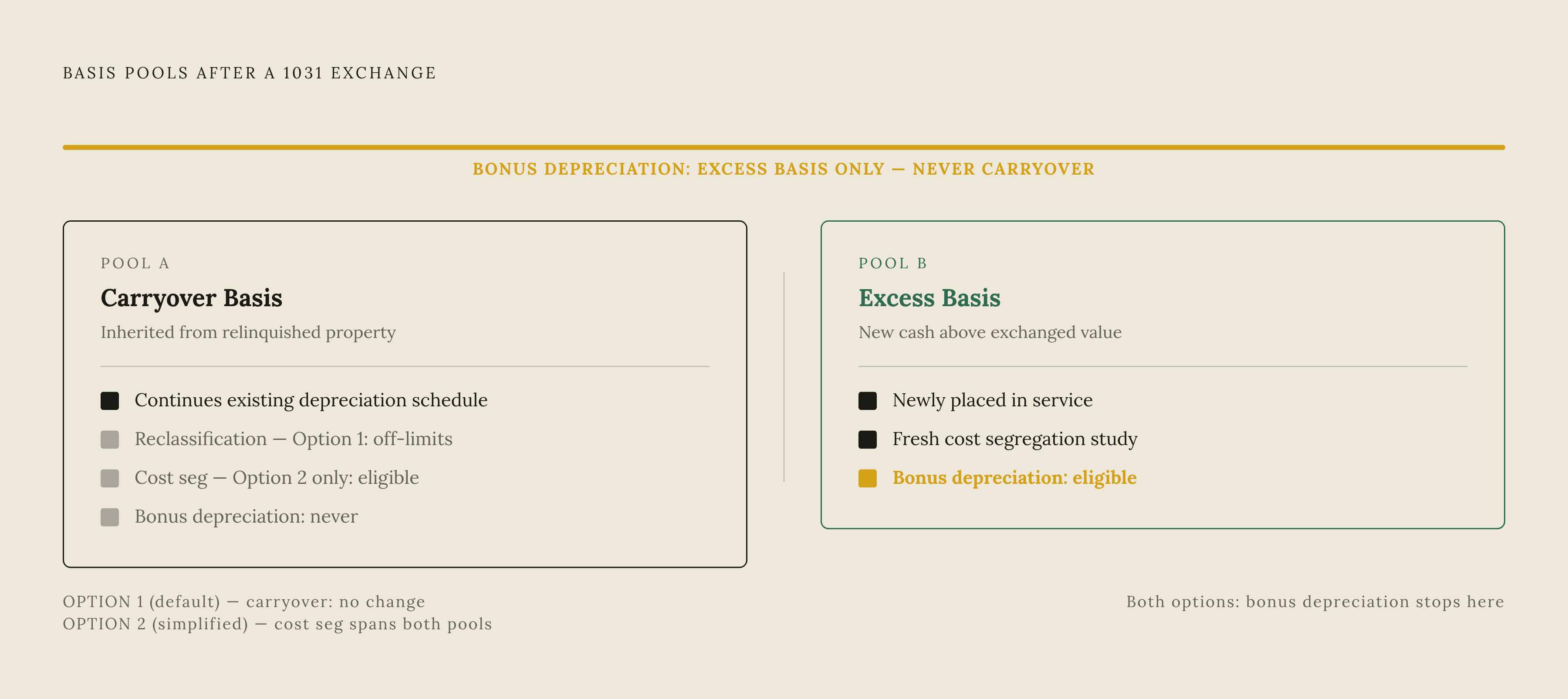
Once a replacement property closes, the IRS splits its tax basis into two separate pools, carryover basis and excess basis, and each pool depreciates under different rules. That split determines how much of the replacement property a new cost segregation study can actually touch.
Carryover basis is the adjusted basis inherited from the relinquished property. It keeps depreciating on its original schedule, using the original method and convention, and it does not restart the clock. Excess basis is whatever additional cash the investor put in to acquire the replacement property above the value of what was exchanged. That portion counts as newly placed in service, so it qualifies for bonus depreciation and a fresh cost segregation study.
A cost segregation study on the replacement property applies only to the excess basis under Option 1, the default method, while the carryover basis is off limits for reclassification. The carryover basis stays off limits for reclassification. Under Option 2, the Simplified Method, the investor can elect to treat the property's entire adjusted basis as newly placed in service, which opens both carryover and excess basis to cost segregation and can meaningfully increase the benefit.
One constraint holds regardless of which option gets chosen: bonus depreciation applies only to the excess basis, never to the carryover basis. An investor who added no cash above the exchanged value gets no bonus depreciation benefit, even under the Simplified Method. Picture a replacement property acquired through a partial exchange, carrying a carryover basis from the relinquished property alongside an excess basis representing new money paid at closing. Under Option 1, the study applies to the excess basis alone. Under Option 2, it applies to a larger combined basis. But bonus depreciation still touches only the excess basis under either option. Exchange basis calculation and cost segregation scope have to be tracked together. Running one without the other produces a study that either overreaches or leaves money on the table.
The recapture trap on the relinquished property and replacement property selection
An investor who ran cost segregation on the relinquished property carries a specific recapture profile into the exchange, and that profile should shape which replacement property gets selected, beyond its price tag or asset class. If the replacement property holds less IRC Sec. 1245 personal property than the relinquished one did, the exchanger has to recognize the difference in prior depreciation as ordinary income, which undercuts the point of doing the exchange in the first place.
One resolution is to find a replacement property that has already had a valid cost segregation study performed, so its personal property content is documented and can be compared to the relinquished property's profile before the exchange closes. Or commission a study on the replacement property ahead of closing, which documents the personal property content and can generate new deductions on the excess basis at the same time. Either approach turns the recapture profile of the relinquished property into an input for replacement property selection, decided before the 45-day identification window closes, not reconciled by an accountant months after the deal is done.
Boot adds a second layer of risk: any shortfall in replacement value, any debt left unreplaced, or any cash pulled from proceeds counts as boot, and boot is taxable, with the gain that flows through it frequently carrying Section 1250 recapture, taxed above the long-term capital gains rate. Refinancing shortly before an exchange carries its own version of this risk: the IRS can apply the step transaction doctrine to treat that refinancing as a disguised cash-out, creating boot retroactively even though the refinance and the exchange were structured as separate events.
Sequencing the study and the exchange
Run the cost segregation study on the relinquished property as early in the ownership period as practical. The earlier it happens relative to a sale, the more value gets extracted before the exchange clock starts running. Owners who never ran a study on a property they already hold can still file Form 3115 to capture a catch-up §481(a) adjustment in the current year, ahead of the sale, without amending prior returns.
Before closing on the relinquished property, model the recapture profile, the Section 1245 and 1250 depreciation already taken, and use that number to set the terms for replacement property selection. That modeling is an input into the 45-day identification strategy, done before the window opens.
Once the exchange closes and the carryover-versus-excess basis split is known, decide if the Simplified Method under Option 2 makes sense, and design the replacement property's cost segregation study to match the correct basis pool. That analysis has to happen before the study gets commissioned, not after the engineers have already walked the site.
One caution belongs in this sequence and deserves a direct mention rather than a full detour: investors without Real Estate Professional Status, or without material participation in a short-term rental, may find that a large first-year deduction from a post-exchange cost segregation study gets suspended as a passive loss instead of immediately offsetting ordinary income. That constraint gets overlooked constantly, and it shapes whether the timing benefit an investor is counting on actually appears on the return.
None of this fits comfortably into the 45-day identification window once it has already started. Investors who enter that window without a recapture profile already modeled and a replacement property framework already built end up making decisions under pressure that they would not have made with more room to think.
Coordinating Professionals for This Strategy
Cost segregation and a 1031 exchange are handled by different professionals under different bodies of law, and the space between them, where basis calculations, recapture profiles, and replacement property selection actually live, is where poorly coordinated teams cause the most expensive mistakes.
Start with the cost segregation provider. Following Hospital Corporation of America v. Commissioner, IRS guidance calls for an actual engineering-based study, prepared by professionals who combine knowledge of accounting, tax law, and construction. A software estimate or a desk review built from generic pricing tables isn't the same thing. The study has to hold up at audit, and that means an engineering report built on site-specific data. Providers who skip the site visit or lean on generic cost guides produce reports that fall apart under scrutiny.
The Qualified Intermediary, the other member of the team, is bound by legal restrictions on who can serve in the role. The QI holds exchange funds, enforces the exchange timeline, and cannot be a disqualified person: an employee, attorney, accountant, investment banker or broker, or real estate agent who has worked with the investor in the past two years, or any family member regardless of that two-year window. But a QI is a facilitator, not a strategist. QIs don't model recapture consequences, don't advise on which replacement property to pick, and don't weigh in on whether the exchange makes sense in the first place; that work belongs to a CPA or financial advisor with real estate expertise.
Picking a QI on price alone ranks among the most common mistakes investors make. Service quality, fund security, and experience with complicated exchange structures matter independently of what the QI charges. The LandAmerica 1031 Exchange Services failure, which left client funds frozen when the firm went bankrupt in November 2008, is the industry's most prominent example of what happens when fund security is not independently verified.
Look for segregated, FDIC-insured exchange accounts with coverage limits spelled out in writing, published interest rates on held funds instead of rates negotiated case by case, and a dedicated senior Exchange Officer who stays on the file from opening through closing rather than handing it off between salespeople. Coordinating cost segregation with a 1031 exchange takes more than picking competent professionals in each discipline separately, it takes a team that understands how the two disciplines interact.
Sources
- Cost Segregation and 1031 Exchange: Maximizing Tax Efficiency in 2026
- Cost Segregation and 1031 Exchanges: The Perfect Tax Deferral Combo | R.E. Cost Seg
- Cost Segregation & 1031 Exchanges: Combining Tax Strategies for Real Estate
- Cost Segregation Studies: How Real Estate Investors Turn a Building Into Five-Figure Tax Savings | Beancount.io
- KBKG | Cost Segregation & 1031 Exchange
- Maximizing Tax Strategies: 1031 Exchanges & Cost Segregation
- 1031 Knowledge Cost Segregation & 1031 Exchanges
- IRS 1031 Exchange Rules for 2026: Everything You Need to Know