IRS Dealer Status Risk for Active Investors Using Depreciation and Exchanges
Misclassified dealers lose capital gains treatment, depreciation, and 1031 exchanges permanently.

The IRS classifies a portion of active real estate investors as dealers, not investors, and that single word swaps out capital gains treatment, 1031 eligibility, and depreciation benefits all at once. The determination isn't something an investor elects or avoids by incorporating properly; it gets made after the fact, based on a pattern of conduct the investor may not even recognize as risky until an audit reveals itc2.
What dealer status means to the IRS
A dealer, in the IRS's own framing, is someone who holds real estate primarily for sale in the ordinary course of business. The property functions as inventory rather than as a long-term asset generating rental income or appreciation. Investors sit on the other side of that line: they hold property for income or for value growth over time, and that distinction is what opens the door to capital gains rates, 1031 exchanges, and depreciation treatment. Nobody applies for dealer status and nobody signs up for investor status either. The IRS assigns the label retroactively, based on facts, activity, and the intent it infers from both.
A common misread of the rule assumes dealer status requires a formal marker, such as a real estate license, a storefront, or an LLC set up for flipping. None of that matters to the IRS. What matters is the nature and pattern of the activity itself, regardless of how the taxpayer structured the business on paper. That's a meaningfully different test than most investors expect, and it's why the classification catches people who never thought of themselves as running a resale business.
The framework the IRS uses to make this call traces back to case law from the 1960s, generally cited as Klarkowski, which established a nine-factor test still used today. The nine factors are the purpose for which the property was acquired, the purpose for which it was subsequently held, the extent of improvements made to it, the frequency, number, and continuity of sales, the extent and nature of the taxpayer's transactions in the property, the taxpayer's general business activities, the extent of advertising and promotion for sale, the property was listed with a broker or other outlets, and the purpose for which the property was held at the time of sale as opposed to the time of acquisition. None of these factors decides the outcome alone. The IRS reads them together, as a pattern of conduct, and that collective standard is why the risk is so easy to underestimate: an investor can point to any single factor and argue it looks fine in isolation, while the full pattern tells a different story.
The behaviors that push an investor toward dealer classification
Intent at the moment of purchase carries the most weight in this analysis. The IRS's first question is this: was the plan, from day one, to hold the property or to resell it? Everything else builds from that starting point.
Some behaviors read as obvious red flags once you see them laid out. Buying a property with a flip in mind, even if the renovation runs long and the resale takes longer than planned, still signals dealer intent at acquisition. Subdividing a tract of land and selling off lots over several years does too, even when the land sat untouched and passive for a long stretch beforehand. Making improvements aimed specifically at boosting resale value, rather than at improving rental performance or long-term utility, points the same direction. So does treating properties as inventory in the books, rather than as capital assets.
Frequency and continuity of sales matter as well, though there's no bright-line count that trips the wire. The IRS looks at volume and regularity over time rather than counting past some fixed number of transactions.
The trickiest scenario involves a shift in intent partway through a hold. Picture an investor who buys undeveloped land purely as a long-term store of value, sits on it for a decade, and then decides to subdivide and sell the lots individually. That mid-hold pivot changes the character of the property in the IRS's eyes, because the agency evaluates purpose at the time of sale, not just at the moment of acquisition. Years of passive holding don't insulate a taxpayer from dealer treatment if the final chapter of that property's life looks like inventory liquidation.
Occupation matters here too, in a way that compounds the risk for some investors more than others. And the way a property gets marketed says a lot: an investor who rents a unit out for years and eventually sells it looks nothing like someone who lists properties across multiple platforms as a routine, ongoing sales operation.
What dealer reclassification strips away, financially
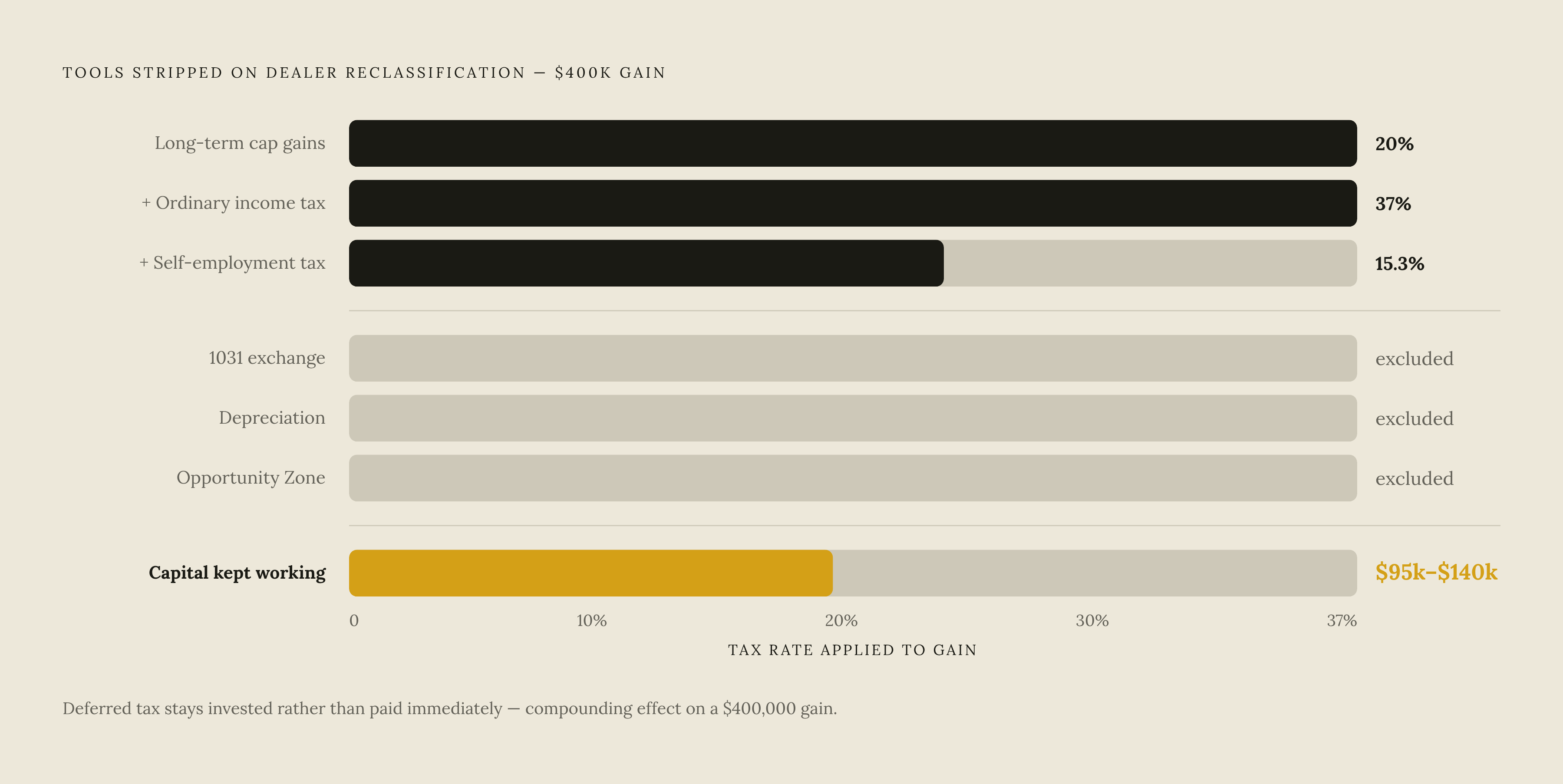
The rate gap alone should stop any active investor in their tracks. Dealer status converts every dollar of gain from capital treatment into ordinary income, taxed at federal rates running up to 37% in 2026, no matter how long the property sat on the books before the sale. Investors, by contrast, get access to the long-term capital gains brackets, a combined federal maximum sitting well under what dealers pay. On top of the ordinary income hit, dealers also owe 15.3% in self-employment tax on their net profits from property sales, a cost investors never see at all. Guidance published for 2026 lays out the mechanics: the top ordinary bracket kicks in above a high income threshold for single filers and a higher one for joint filers, the Social Security piece of that self-employment tax applies only up to a wage base cap, the Medicare piece has no ceiling at all, and an additional Medicare surtax layers on above thresholds that shift by filing status.
The rate difference makes up only the first layer of the loss. Dealer status also closes off a set of tools that investors use to actively manage their tax exposure over time, and each one disappears the moment the classification flips. Depreciation stops applying too, since inventory doesn't depreciate the way an income-producing asset does. Installment sale treatment gets significantly restricted. Opportunity Zone deferrals require capital gains treatment to begin with, so dealers are locked out of that strategy as well.
Stack all of it together, the higher ordinary rate, the self-employment tax, the lost exchange eligibility, the lost depreciation, the lost deferral options, and the loss compounds rather than simply adding up. Losing one tool might be tolerable. Losing all of them at once, on every transaction going forward, changes the entire economics of an active real estate business. The 1031 loss in particular deserves its own explanation, because of how much value a single exchange typically protects. 1031 like-kind exchange eligibility: dealer property is explicitly excluded by statute.
Why Section 1031 is closed to dealers by statute
Section 1031(a)(2) of the tax code draws a hard line: property held primarily for sale doesn't qualify for like-kind exchange treatment, full stop. This isn't a judgment call the IRS makes case by case. House flippers and dealers are excluded by the statute's own language, which permits exchange treatment only for property held for productive use in a trade or business or for investment. Inventory doesn't meet that bar no matter how the transaction gets structured afterward.
A completed 1031 exchange defers several tax burdens simultaneously, not just one. It pushes off federal capital gains tax on the appreciation itself. It defers Section 1250 depreciation recapture, which gets taxed at a maximum rate of 25% the moment it's triggered outside of an exchange. It defers the net investment income tax, and, where applicable, state capital gains tax too.
The exchange process itself runs on two fixed deadlines: 45 days to identify replacement property in writing, and 180 days to close on it. Missing either one unwinds the whole deferral. But dealer status is worse than a missed deadline, because it disqualifies the investor before the clock even starts running, cutting off the entire mechanism at the root.
Consider what a genuine 1031 exchange protects for an eligible investor: someone who bought a property years ago, claimed depreciation against it every year since, and sold at a gain has a realized gain made up partly of that accumulated depreciation recapture. A completed exchange into a qualifying replacement property defers the entire realized gain, recapture included, not just the appreciation portion. None of that deferral exists for a dealer. The gain is ordinary income the moment the sale closes, recapture and appreciation both, with no mechanism available to push any part of it into the future. On a $400,000 gain, deferring taxes typically keeps $95,000–$140,000 working inside the portfolio rather than going to the IRS immediately.
Mixed portfolios: holding investor and dealer property at the same time
Dealer status doesn't spread across a person's entire portfolio like a stain. The IRS is capable of distinguishing between a taxpayer's dealer inventory and their legitimate long-term holdings, and it does so routinely. A real estate professional can run a flipping operation and hold long-term rentals or commercial property at the same time, with each bucket taxed on its own terms, as long as the separation between them is credible.
Credible is the operative word, and it's where most of these arrangements fall apart. Making the distinction stick under IRS scrutiny takes consistent conduct over time, strong documentation, and clear separation of business activities. An investor who exchanges out of a long-held rental into a replacement property intended for a quick flip can retroactively undo the exchange entirely, because the intent behind the replacement acquisition matters just as much as the intent behind the original sale.
Structuring dealer activity inside a separate legal entity, a corporation or LLC set apart from the investment holdings, can help create that operational and accounting separation. When both activities run through the same entity, the paper trail is the only line of defense available, and it's a much harder case to make. None of this is a do-it-yourself decision: entity structuring carries its own legal and tax consequences, and it calls for qualified counsel before any transaction, not after.
Documentation is what actually carries the argument in front of the IRS. Lease agreements and rental history support an investment purpose in a way that's hard to argue with. Internal records showing why a property was acquired reinforce the same story. How the property is booked, as inventory or as a capital asset on the books, sends its own signal about how the owner actually views the asset. And tax advice sought before a transaction closes carries far more weight than an explanation constructed after the IRS has already asked the question.
The behaviors and documentation habits that preserve investor status
There's no warning shot before a reclassification lands. The determination is made retroactively, usually appearing in an audit triggered by a pattern of activity that quietly crossed a line the investor never saw coming. By the time the IRS raises the question, the transactions in dispute already happened, and the only defense available is whatever record already exists.
Building that record starts at acquisition, not at sale. Writing down the intent behind a purchase at the time it happens, the expected holding period, the planned use, rental income or long-term appreciation, creates a contemporaneous record that's far more persuasive than a reconstructed explanation years later. Lease agreements, rent rolls, and tenant correspondence back up the claim that a property generated income as an investment rather than sitting vacant while waiting for a buyer. Improvements should track toward rental performance or long-term asset quality, with the reasoning behind each one documented as it happens. The manner and timing of listing a property for sale is a factor the IRS weighs explicitly, so aggressive pre-sale promotion right after a purchase works against the investor's own case.
One persistent myth deserves correction here. Investors often assume there's a minimum holding period required before a property qualifies for 1031 treatment, some number of months or years they need to clear first. No such rule exists, apart from the two-year holding requirement that applies specifically to related-party transactions under Section 1031(f). Intent and conduct decide the outcome. A property can be exchanged shortly after purchase if the facts genuinely support an investment purpose, and a property held for a decade can still fail the test if the conduct around the sale looks like a resale operation dressed up as a long hold.
A change in plans partway through ownership isn't automatically fatal to investor status either, provided it's documented honestly. Selling because a genuinely unexpected market opportunity arose, after years of legitimate rental use, reads very differently from a property that was flipped according to plan from day one.
Procedure matters just as much as intent once a sale is actually underway. Opening the exchange with a qualified intermediary before the relinquished property closes is non-negotiable, and that intermediary needs to be genuinely independent of the investor's existing professional relationships. No amount of good-faith planning survives a missed deadline or the wrong QI chosen for convenience rather than for competence. The industry itself isn't regulated in a way that screens out unqualified players, since any individual or company can technically act as a QI, which puts the vetting burden squarely on the investor, and the investor needs to check experience, how exchange funds are secured, and accounts are properly segregated before money moves. Some exchange structures can open in a matter of minutes, even same-day at the closing table. The requirement to have a QI in place before the sale closes doesn't have to slow down a fast-moving deal. Funds should be held in segregated, FDIC-insured accounts with published interest rates, shared back with the client even if the exchange later falls through.
Investor status is defensible. The protections built into the tax code reward the investor who documents intent before the fact, keeps activity separated where it needs to be separated, and lines up the right procedural steps before a transaction closes.
Sources
- 9 Key Factors That Shift the IRS's View: From Real Estate Investor to Dealer - 1031 Exchange Experts Equity Advantage
- Real Estate Investors: This IRS Classification Could Cost You 32% More in Taxes
- Investment Grade 1031 Exchange: The Complete 2026 Guide
- Determining Dealer Status in a 1031 Exchange - Provident1031
- Dealer status 1031 exchange restrictions explained for investors
- The Tax Impact of Dealer vs. Investor Status in Real Estate
- Real Estate Dealer vs. Investor: IRS Tax Rules | Cherry Bekaert
- The dilemma of dealer or investor classifications for real estate