1031 Exchange Returns Versus Taxable Real Estate Sales
Deferring taxes on property sales lets investors compound wealth across multiple cycles.
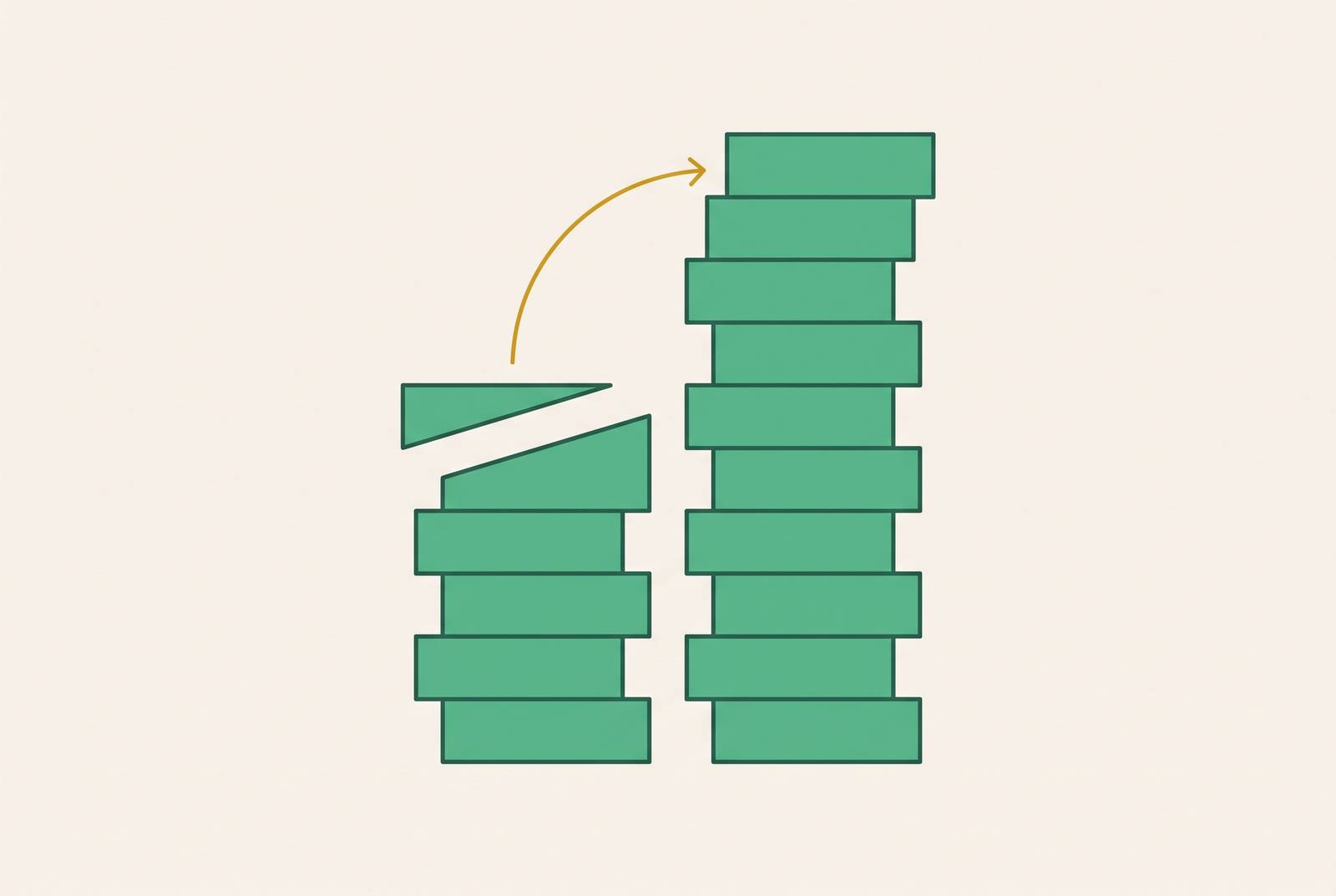
A provision of the federal tax code governing property exchanges doesn't cancel a tax bill. It postpones one, and that postponement is the entire mechanism by which an investor's equity keeps compounding instead of shrinking with every sale. The gap between an investor who exchanges and one who sells outright widens with every cycle, and most people who choose the outright sale never realize how much of that widening happens in the very first transaction.
The statute is old, and its logic was deliberate from the start. Its roots trace to 1921, when lawmakers established a framework allowing investors who roll proceeds from one piece of investment or business real property into another to defer the resulting tax. The gain carries forward into the replacement property's adjusted tax basis, and depreciation on that replacement property doesn't restart from zero. It continues from where the old schedule left off. The mechanism only works under a strict set of rules: proceeds have to pass through a Qualified Intermediary, never through the investor's own hands, and the replacement property has to be "like-kind," meaning real property held for investment or business use. Since a federal tax reform law overhauled the rules, personal property no longer qualifies at all, and the exchange never covered primary residences or flips to begin with.
What gets deferred is a stack, not a single line item. Federal long-term capital gains at 15% to 20%, depreciation recapture at 25%, the 3.8% Net Investment Income Tax, and, depending on the state, another layer of state capital gains tax on top. Missing any piece of the exchange's mechanics, even by touching the proceeds for a day, triggers the constructive receipt rule, which makes the entire bill due in the year of sale. Understanding what sits in that stack is the starting point for understanding why the exchange changes an investor's trajectory, not just its timing.
The immediate wealth gap created at the moment of sale
Take a straightforward case. A property sells for $2,000,000, with an adjusted basis, after depreciation, of $900,000. That leaves a substantial share of gain on the table, and how that gain gets treated determines how much capital moves into the next deal.
A taxable seller owes long-term capital gains on the appreciation portion at 15% to 20%, and owes depreciation recapture, a flat 25%, on whatever portion of the gain corresponds to depreciation already claimed. The 3.8% NIIT sits on top of both, and a state capital gains tax may apply as well, zero in some states, close to the federal rate in others. None of these apply in isolation. They stack on the same underlying gain, one after another, each one shaving off another slice before the seller ever sees the money.
A 1031 exchanger facing the identical sale owes none of it, not yet. The full $2,000,000 moves into the replacement property. The gap arises because the taxable seller, after settling the stack above, reinvests a meaningfully smaller number, and it appears in reduced buying power, in a smaller base against which to apply leverage, and in a smaller asset entering the next holding period than the one the exchanger now owns.
How the wealth gap compounds across multiple exchange cycles
The first sale is the smallest version of this problem. What happens by the third or fourth sale is what actually separates these two investors, and it is not a modest difference.
The exchanger's full equity base buys a larger replacement property. That larger property appreciates on a larger footing, throws off larger depreciation deductions because there's more basis to depreciate against, and, when it's time to exchange again, rolls its full value forward into an even bigger acquisition. Nothing caps how many times this can happen. Each cycle compounds on the equity preserved in the one before it.
The taxable investor's position degrades in the mirror image of that sequence. Each sale shrinks the reinvestable base before the next property is even under contract, leaving a smaller asset, less available leverage, less appreciation in dollar terms, and less depreciation to shelter income, all before that smaller asset gets sold and taxed again. Depreciation recapture at 25% applies to all accumulated depreciation every time a taxable sale occurs. The exchanger simply carries that recapture liability forward and keeps depreciating on a bigger number instead.
A second mechanism can turn the deferral permanent rather than merely long-term. The step-up in basis at death gives heirs who inherit exchanged property a stepped-up cost basis, which can eliminate the accumulated deferred tax. An investor who exchanges for decades and holds until death may never actually pay the bill that started accruing back at that first $2,000,000 sale.
Recent tax law adds another amplifier. Bonus depreciation, restored at 100% permanently for qualifying property acquired and placed in service after January 19, 2025, means replacement property bought after that date can generate outsized depreciation deductions in the early years of ownership, stacked on top of the basis the exchanger already carried forward. After three or four cycles, the two investors are no longer occupying nearby positions on a spectrum. They are playing different games at different scales, and the taxable seller does not catch up.
The exchange mechanics and deadlines that determine whether equity is preserved or lost
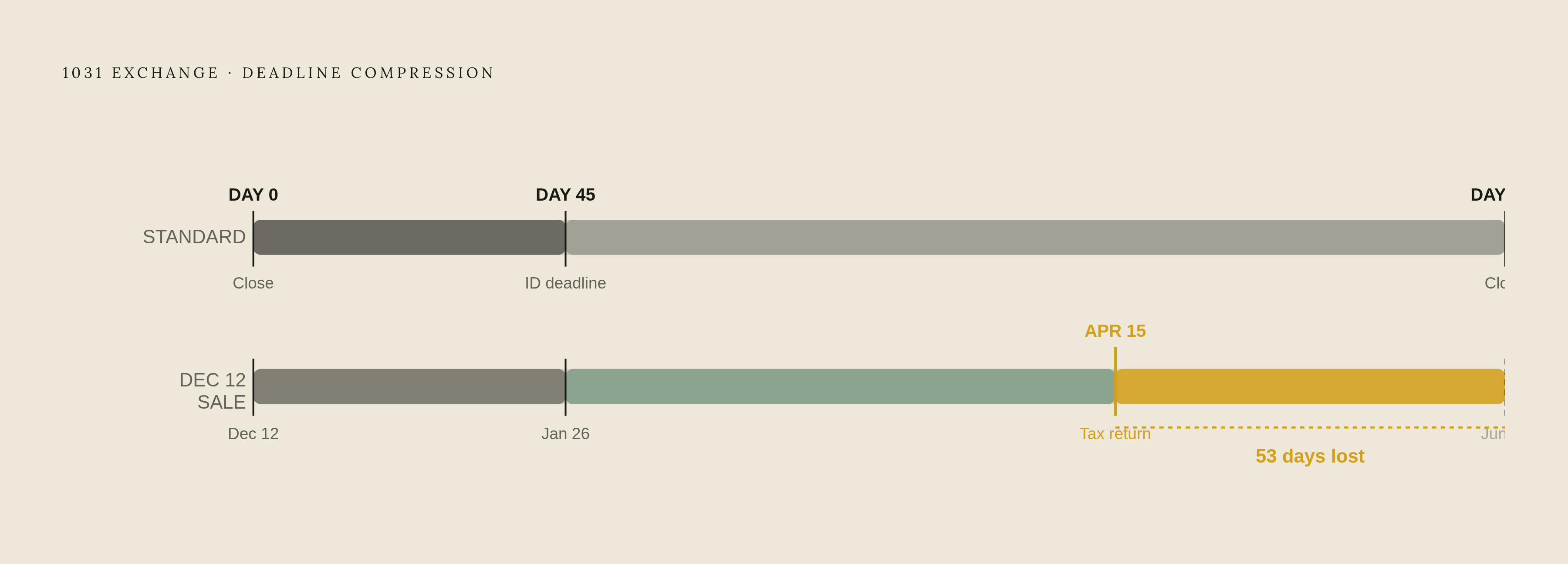
None of the compounding above happens automatically. It depends on execution, and execution runs on a clock that starts the moment the relinquished property closes, not when it's listed and not when a contract is signed.
Two deadlines govern everything. The investor has 45 calendar days to identify replacement property in writing to the Qualified Intermediary, and 180 calendar days to close on it, or the due date of that year's tax return, whichever comes first. That "earlier of" clause is where a lot of exchanges get quietly strangled. An investor who sells on December 12, 2025 has until January 26, 2026 to identify property, and would ordinarily expect a closing window running to June 10, 2026. Without a tax filing extension, though, the April 15, 2026 return deadline cuts in first, chopping 53 calendar days out of the window the investor assumed they had. Filing an extension restores the full 180 days. Anyone starting an exchange in the fourth quarter, roughly between October 17 and December 31, 2025, is exposed to exactly this compression and should file the extension before it becomes a problem, not after. The IRS doesn't grant relief for financing falling through, a seller defaulting, a title defect, or a deal simply running long. Only narrow disaster-related postponements under existing IRS guidance apply, and those are the exception, not something to plan around.
Identification follows one of three rules, and the investor has to pick one before the clock runs out. The Three Property Rule lets an investor name up to three properties regardless of value, and it's the one most exchanges use. The 200% Rule allows naming any number of properties as long as their combined fair market value doesn't exceed twice the sale price of the relinquished property. The 95% Exception permits naming any number at any value, but only if the investor actually closes on 95% of what was identified, a bar high enough that it's rarely the practical choice. Identify more properties than the chosen rule allows, and the IRS treats the exchange as though nothing was ever identified. No partial credit.
The same taxpayer has to appear on both sides of the transaction, the one who sold and the one who buys. Exchanges between related parties carry a two-year holding requirement on both sides; break it, and the deferred tax comes due immediately. Any point at which the investor could touch or direct the funds, even through an intermediary acting on their behalf, disqualifies the whole exchange under the constructive receipt rule. That's why the QI has to be engaged before the relinquished property closes, not after. The exchange gets reported on Form 8824, the last mechanical step in a chain where every earlier step has to hold.
How the Qualified Intermediary's role affects the investor's equity and QI quality evaluation.
Every dollar of the compounding advantage described above passes through the Qualified Intermediary's hands at some point. If that intermediary mishandles the funds, commingles them, or triggers a disqualification through some procedural failure, the entire thesis collapses instantly, not gradually.
That risk is compounded by a regulatory gap most investors don't expect. Banks, brokers, and insurance companies operate under federal licensing regimes. QIs, as a category, do not. Nevada is the only state that requires one to be licensed. That leaves due diligence sitting almost entirely with the investor, and it starts with knowing who's disqualified from serving in the role in the first place: an attorney, CPA, real estate broker, investment banker, or employee who's acted as the investor's agent in the prior two years, along with family members and any entity the investor or their family controls more than 10% of.
Fund security is where the real diligence needs to happen, past the eligibility check. Segregated accounts should be non-negotiable; commingled accounts have historically been the setup where QI fund losses actually occurred. Standard FDIC coverage has a per-depositor limit that offers meaningless protection on a multi-million-dollar exchange unless the QI uses a structure that spreads coverage across enough institutions to matter. A Qualified Escrow Account, a three-way agreement between investor, QI, and bank with a debit lock so funds can't move without both the investor's and the QI's sign-off, is recognized in California, Oregon, Washington, Colorado, Virginia, Nevada as an accepted alternative to carrying a fidelity bond. A fidelity bond and errors-and-omissions insurance are the baseline markers of a QI running a real operation. Dual authorization on disbursements is worth asking about directly.
Service model matters just as much as the paperwork behind it. Some QIs onboard investors through commissioned sales staff, then hand the file to a processing team the investor has never spoken with, right in the middle of a transaction running on hard, unforgiving deadlines. A dedicated Exchange Officer who owns the file from the first phone call through closing removes that handoff risk. Once the relinquished property closes, the 45-day clock doesn't pause for paperwork, so speed matters too. A QI that can't open the exchange and issue wire instructions same-day is manufacturing deadline risk that didn't need to exist. A trade association's Certified Exchange Specialist designation is a real credential worth checking for when vetting a provider.
Deferred, as one option in the space, shows what several of these controls look like when they're actually combined: no exchange fee, segregated FDIC-insured accounts, exchanges that can open in a few minutes including same-day and at the closing table itself, a single Exchange Officer (with experience levels that vary, some carrying substantial tenure) handling the file start to finish, support seven days a week until midnight ET, and a transparent interest rate arrangement rather than a rate negotiated behind closed doors.
Interest earned on held funds (the compounding variable most investors overlook)
Money sitting with a QI for up to 180 days between sale and purchase doesn't sit idle. It earns interest, and the question that rarely gets asked is who actually receives it.
Under standard industry practice, the QI keeps it. Industry observers note that for many QIs, interest on client funds can represent a significant share of total revenue, with upfront fees making up a smaller portion. On a $5,000,000 exchange, that interest can run past $100,000, and under the conventional model, all of it goes to the intermediary, leaving the investor whose capital generated it with nothing.
That gap is a direct drag on the return of the transaction, not a footnote. In a higher-rate environment, retained interest on a large exchange quietly eats into the very compounding advantage the investor exchanged in order to capture. Add the fee structure on top: standard QI fees run $600 to $1,200 for a typical exchange (or $750 to $1,500 for a delayed exchange), and that's before closing costs, title fees, and professional fees push the all-in cost of a straightforward exchange to somewhere between $1,500 and $5,000, with complex exchanges running $2,000 to $5,000 or higher.
Some providers have made a structural choice out of returning that capital to the investor instead of routing it to the intermediary. Deferred's model, for one, carries no exchange fee at all, shares interest on held funds with the client rather than retaining it, and applies that interest-sharing even if the exchange ultimately falls through.
The exchange-versus-sale decision as a return calculation, not just a tax question.
This is a comparison between two compounding trajectories, one built on a shrinking equity base, the other on a preserved one. The size of the gap between them depends on a handful of variables specific to the investor doing the math, not on some fixed advantage that applies equally to everyone.
The investor's combined marginal rate on the gain, federal capital gains plus the 25% recapture plus the 3.8% NIIT plus whatever the state adds, sets the baseline cost of not exchanging. The size of the gain relative to the total amount being reinvested determines how much of the base survives a taxable sale versus an exchange. How many more transactions the investor plans to execute matters enormously: one exchange produces a single deferral event, while five exchanges produce five compounding cycles stacked on top of each other. The step-up in basis at death can eliminate the deferred liability so it is never paid. None of the math matters, though, if the replacement property is a materially worse investment than what the after-tax proceeds of a straight sale could have bought. Deferring tax into a mediocre asset doesn't offset the mediocrity, and no amount of compounding fixes a bad deal.
The legislative backdrop, as of the most recent changes, leaves Section 1031 untouched. The One Big Beautiful Bill Act didn't alter the exchange rules. Separately, a new provision, IRC Section 1062, was added for certain qualified farmland gain, allowing the resulting tax to be paid in four equal annual installments even though the gain itself is recognized in full in the year of sale, effective for tax years beginning after July 4, 2025. That's a narrow provision, relevant mainly to that one asset class. The permanent restoration of 100% bonus depreciation for qualifying property placed in service after January 19, 2025 remains the more broadly relevant change, since it can meaningfully boost after-tax cash flow on replacement property in its early years of ownership.
A 1031 exchange isn't free money, and treating it that way misses the mechanism. The deferred tax stays attached to the property and comes due unless the investor holds until death or otherwise disposes of it in a way that resets the basis. Deploying what would have been tax as working capital, for years or decades at a stretch, produces compounding that dwarfs the eventual cost of settling that liability. That is what makes the exchange worth the friction, not some illusion of a bill that never arrives.
Before any sale closes, the practical checklist is short but unforgiving: a Qualified Intermediary engaged before the closing, since the exchange agreement has to predate it, replacement candidates already identified or well into that process, and a clear number attached to the equity gap that exchanging closes instead of a straight sale.
The value in a 1031 exchange was never the deferral by itself. It was always the compounding that a fully preserved, pre-tax equity base makes possible across every cycle that follows. That is why the choice of how to run the exchange, the QI's fund security, its fee structure, how it treats interest on held funds, functions as a return variable in its own right. It is not a commodity decision to make on convenience alone.