Effective Tax Rate Reduction Through Perpetual Deferral
A step-up in basis at death can erase decades of deferred capital gains entirely.
Section 1031 does not forgive capital gains tax on real estate. It defers the liability by folding it into the basis of whatever property comes next, and the bill grows on paper with every trade even as it stays dormant in practice. Chain enough of those exchanges together, and pair the last one with a step-up in basis at death, and the effective tax rate on decades of appreciation can be zero. That's two provisions in the tax code doing what they were written to do. It's two provisions in the tax code doing what they were written to do, and most investors who use Section 1031 never let them finish the job.
How "swap till you drop" converts deferral into permanent elimination
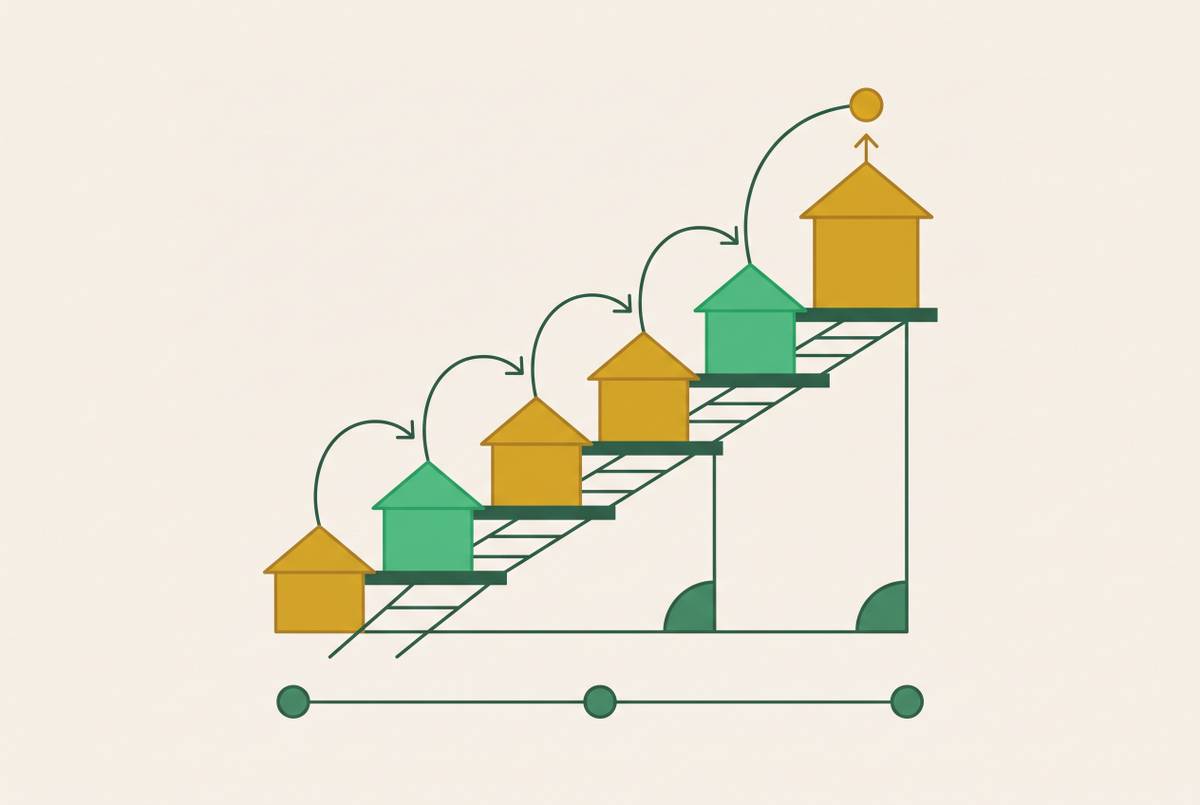
The mechanics are almost deceptively simple. An investor sells a property, exchanges into another one under Section 1031, and carries the deferred gain forward into the new asset's basis instead of paying tax on it. Do that again a decade later, and again after that, and the liability keeps compounding, larger with each cycle, but never due. At death, heirs inherit the final property at a stepped-up basis equal to fair market value on the date of death. Every dollar of gain built up across the entire chain simply disappears, and if the heirs sell soon after inheriting, there's often little or nothing owed on appreciation that took place during the investor's lifetime.
The industry calls this "swap till you drop." It sounds like a gimmick someone dreamed up at a seminar, but it's just the foreseeable interaction of Section 1031 and the basis step-up rules under current law, both intact heading into 2026. Section 1031 survived the One Big Beautiful Bill Act, signed in 2025, with no dollar cap on deferral, despite years of periodic proposals from lawmakers to limit it. None of those proposals have stuck, and there's no serious sign that's about to change.
Most people treat the 1031 as a one-off escape hatch, useful for dodging a tax hit on a single sale, rather than as the repeatable engine it's built to be. Research from JTC Group found that fewer than 20% of 1031 exchanges are followed by a subsequent like-kind exchange, evidence that most investors use it only once. That's the real story. The tax code hands investors a compounding mechanism, and four out of five walk away after using it once.
The rules governing every exchange in the chain
Every link in the chain has to satisfy the same requirements, no matter how many times an investor has done this before. Both properties must be real property held for investment or business use; personal property no longer qualifies under current law. "Like-kind" is looser than most people assume, though: a single-family rental can trade into multifamily, industrial, raw land, mini storage, or farmland anywhere in the country, as long as the underlying nature of the asset stays the same.
The taxpayer who sells has to be the same one who buys. Routing it through a related entity to dodge that rule causes the exchange to fall apart. To defer the full gain, the replacement property needs equal or greater value, with equal or greater debt replaced; any shortfall gets taxed as "boot."
Then come the two deadlines that define the whole structure. Day 45 is when written identification of replacement property has to reach the Qualified Intermediary, and there's no flexibility for financing delays, a seller backing out, or a title problem. The IRS grants extensions only for a federally declared disaster, under a specific revenue procedure. Proc. 2018-58. Day 180 is when the investor has to close on the replacement property, or the due date of that year's tax return with extensions, whichever comes first.
Identification follows one of three mutually exclusive rules. The Three-Property Rule allows naming up to three properties regardless of value. The 200% Rule allows four or more, as long as their combined fair market value doesn't exceed 200% of what was sold. The 95% Exception kicks in if an investor blows past both limits: identification is treated as invalid unless the investor ends up acquiring 95% of the identified value. Descriptions have to be unambiguous, a legal description, street address, or clearly distinguishable name, and the list can be revised right up until Day 45 closes, after which it locks. Every exchange gets reported to the IRS on Form 8824.
The Q4 trap that silently shortens the exchange window
The 180-day window isn't always actually 180 days, and this is where a lot of otherwise careful investors get caught. The code sets the deadline as the earlier of 180 days after the relinquished property transfers, or the due date, with extensions, of that year's tax return. For most of the calendar year those two dates don't conflict. Late in the year, they do, and the gap can quietly eat weeks off the clock.
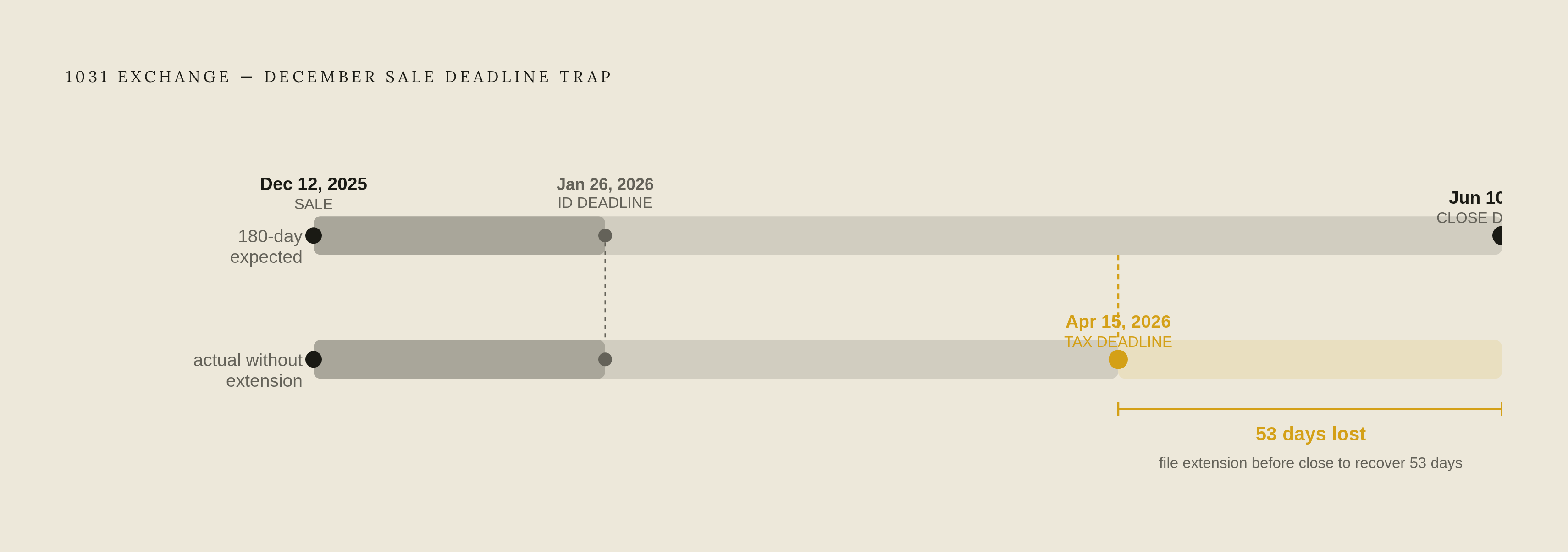
Guidance from IPX1031, updated in December 2025, spells out the trap directly: exchanges that start between October 17, 2025 and December 31, 2025 have to close on replacement property by April 15, 2026, not whatever the 180-day math suggests, unless the investor files a tax extension. Take the example in that guidance. An investor sells on December 12, 2025. Standard math puts the 45-day identification deadline at January 26, 2026, and the close-out deadline at June 10, 2026. Without a filed extension, the real deadline is April 15, 2026, a loss of 53 calendar days that can catch investors off guard if they haven't planned for it.
Filing an extension restores the full 180 days. That's a simple fix, but it has to be planned before the sale closes, not discovered afterward when the calendar has already turned.
For someone running a perpetual deferral chain across decades, this isn't a scheduling footnote. A missed Q4 deadline doesn't just fail one exchange in isolation, it can collapse the entire compounding structure built up over prior cycles, triggering every dollar of accumulated deferred gain as taxable income in a single year. In a multi-exchange strategy, the weakest link is usually the one exchange where somebody assumed the standard 180 days applied and failed to check that it landed in the fourth quarter.
What the tax math looks like across multiple exchanges
Set two investors side by side. One sells a property, pays the tax, and reinvests what's left. The other exchanges, defers, and reinvests the full amount. The gap between them doesn't hold steady, it widens with every cycle, because the investor who deferred is putting the government's share of the gain to work instead of handing it over.
On a $400,000 gain, a properly structured exchange typically defers something in the range of $95,000 to $140,000 in combined taxes, capital that stays inside the portfolio instead of going to the tax authorities. That capital gets deployed in the next property, generating its own returns, its own depreciation, its own appreciation. Running that dynamic across five exchanges over 30 years makes the compounding multiplicative rather than additive: each deferral preserves purchasing power a taxable sale would have destroyed for good, and that preserved capital earns its own returns in the next cycle.
Depreciation recapture, taxed at 25%, defers right alongside capital gains at every exchange, and on long-held, heavily depreciated properties, recapture can end up larger than the capital gains liability itself. Federal capital gains at 15% to 20%, state tax where it applies, and the 3.8% Net Investment Income Tax combine so the total rate an investor is deferring can approach or exceed 40% in high-tax states. That's the number sitting embedded in the basis, growing, at every step of the chain.
Run the strategy across a full lifetime, five exchanges over 30 years, ending with the investor holding the final property at death, and the nominal tax rate that applied at any individual sale never actually gets triggered. The effective rate on all of that appreciation, assessed at death, is near zero. One caveat: depreciation taken during each holding period reduces the basis carried into the next property, which reshapes the depreciation schedule available going forward. Any serious cash flow model of this strategy has to account for that blended depreciation and the headline deferral number.
Exchange structures available at each step
Not every exchange in the chain looks the same, and picking the wrong structure at the wrong moment is its own risk to the long-term plan.
The forward, or delayed, exchange is the default, the structure most investors use for most links in the chain. Proceeds go to the Qualified Intermediary, the investor identifies within 45 days, and closes within 180.
A reverse exchange flips that order, used when the investor needs to close on the replacement property before the relinquished one sells. Because an investor can't hold title to both properties at once under this structure, an Exchange Accommodation Titleholder parks one of them temporarily. It costs more and takes more coordination than a forward exchange, but it solves a timing problem a forward exchange simply can't.
An improvement, or build-to-suit, exchange has the Qualified Intermediary hold title to the replacement property while improvements get made, before the investor takes ownership. That fits an investor who wants to build additional equity or customize a property before acquiring it outright, though it adds its own layer of cost and complexity.
Delaware Statutory Trusts solve a different problem. A DST lets multiple investors hold fractional interests in institutional-grade real estate, and closings can happen in days rather than the 30 to 45 days typical of a direct purchase, a real advantage when the 45-day identification clock is running out. DSTs are limited to accredited investors, they're illiquid, with typical holding periods of five to ten years, and fees can run 7% to 15%, a cost that has to be weighed against the alternative of a failed exchange. Used as a backup or partial replacement when a direct property can't be sourced in time, a DST keeps an exchange alive instead of letting it collapse into a taxable event. Reaching for one as a first choice rather than a fallback is a mistake: the illiquidity and fee load only make sense as the price of avoiding a blown deadline.
Choosing among these isn't a tactical detail buried in the paperwork. A failed exchange because the wrong structure got used, or a DST that locks up capital for a decade at the wrong point in an investor's timeline, can disrupt a chain that took years to build.
The role of the Qualified Intermediary in a multi-exchange lifetime plan
None of this works without a Qualified Intermediary standing between the investor and the sale proceeds. That's a legal requirement. The IRS disqualifies an exchange the moment the investor has constructive receipt of the funds, even briefly, even if the money passes through an attorney or escrow agent rather than the investor directly. The exchange agreement has to be signed before the relinquished property closes, not after. Investors who call a QI at closing, or afterward, have usually already missed their window.
What makes this riskier than it should be: the QI industry is largely unregulated at the federal level. There's no national licensing standard and no federal supervision. Nevada and Maine are among the small number of states that require QI licensure; most states require nothing. In a strategy built to run for decades, a QI failure, whether from fraud, insolvency, or plain error, can wipe out years of accumulated deferral in a single event.
Fund security is a question to ask directly, not assume. Funds should sit in FDIC-insured, segregated accounts, kept separate from the QI's own operating capital and from other clients' money. Standard FDIC coverage caps out per account, so investors with large sale proceeds should ask specifically how coverage above that limit gets structured. Dual-control escrow, requiring signatures from both the investor and the QI to release funds, adds another layer, as does a fidelity bond and Errors & Omissions insurance on the QI's side.
The dollar volume moving through this system isn't small. One title insurance provider reported like-kind exchange funds administered of $2.7 billion as of December 31, 2025, up from $2.3 billion a year earlier. Investors Title Exchange Corporation reported like-kind exchange deposits of roughly $427.1 million as of September 30, 2025, compared to $323.5 million at the end of 2024. At that scale, fund security is a central part of choosing a QI.
One more question investors routinely skip: what happens to the interest earned while funds sit with the QI for up to 180 days? Many QIs simply keep it. On a large exchange, that interest adds up to a real sum, and it belongs to the investor whose capital generated it. Ask before signing anything, not after.
What separates a QI built for a one-time exchange from one suited to a long-term strategy
A QI that handles a single transaction well isn't automatically fit to be a partner across a decades-long chain of exchanges. The differences appear in specific, checkable details about the QI's track record and infrastructure, not in a sales pitch.
Experience is the first filter. A QI who has run hundreds of exchanges across forward, reverse, improvement, and DST structures spots deadline pressure and identification problems before they become emergencies, in a way a generalist escrow or title office won't. Ten-plus years of dedicated exchange experience is a reasonable bar. General real estate experience dressed up as exchange expertise is not the same thing, and investors who don't ask the difference find out the hard way.
Structure inside the firm matters too. Some QIs route intake through commissioned salespeople and hand the file to back-office staff for processing after the sale. A single, dedicated senior Exchange Officer who owns the file from the first phone call through closing cuts down on error and gives an investor running multiple exchanges over years the same point of contact each time.
Accessibility hours affect deadline risk directly, because real estate closings don't run on a nine-to-five schedule; they happen at the end of business days and on weekends. A QI reachable only during standard business hours is quietly adding risk to every closing on the calendar.
Speed of opening an exchange counts for something concrete, too: the exchange agreement has to be signed before the relinquished property closes, so a QI that can open an exchange same-day protects an investor who gets an accelerated closing date sprung on them with no warning. Transparency on interest is worth checking against a published rate table rather than a number disclosed only on request. Over a multi-decade string of exchanges, opaque interest practices add up to real foregone income.
Deferred, as one example in this space, runs on a no-fee model and shares interest income directly with clients, even on a cancelled exchange, holds funds in segregated, FDIC-insured accounts with coverage well beyond the standard limit, publishes its interest rates openly, opens exchanges in minutes, and assigns each file to a single senior Exchange Officer with more than a decade of experience, backed by support seven days a week from 8am to midnight EST. It's a structure built around the client's interest rather than the QI's own revenue. Membership in the Federation of Exchange Accommodators, the national trade group for QIs, isn't legally required, but it signals a baseline commitment to industry standards. So does a real-time portal that keeps brokers, wealth managers, title companies, and tax advisors looking at the same information as a closing approaches, since coordination failures between those parties are a common way exchanges break down.
The execution discipline required to keep the chain intact across decades
Perpetual deferral is a series of decisions made correctly, one exchange at a time, for as long as the strategy runs. A missed identification deadline, a Q4 closing where the tax-return deadline falls before the 180-day mark, a DST chosen in a rush that locks capital for ten years at the wrong moment, a QI whose fund security nobody actually checked: any one of these can break a chain that took decades to build.
The tax math rewards patience and precision in equal measure, and it punishes neither generosity nor bad luck so much as sloppiness. The strategy asks for nothing exotic, no aggressive position, no gray area to exploit, just the same rules followed correctly, exchange after exchange, until the day the step-up in basis makes the whole deferred liability disappear.