Interest Income on 1031 Exchange Funds During the Hold Period
Most qualified intermediaries pocket interest on your exchange funds instead of returning it to you.

The 180-day exchange window is a period during which real money, often hundreds of thousands of dollars, earns real interest in a bank account. Where that interest ends up when the exchange closes tells an investor more about their qualified intermediary than any fee schedule ever could, and most investors never ask the question until it's too late to matter.
The mechanics behind the window exist to keep the investor from ever touching the money. Constructive receipt at any point disqualifies the exchange, so when a relinquished property sells, the proceeds go straight to the qualified intermediary, never to the investor's hands. From there, the investor has 45 calendar days to identify replacement property and 180 calendar days total to close on it, though the exchange period actually ends on the earlier of that 180-day mark or the taxpayer's federal tax return due date, extensions included. These are calendar days, not business days, and there's no negotiating them. Most investors don't close in a week. They spend a meaningful stretch of that window identifying property, negotiating, waiting on financing, and the whole time, their exchange funds sit somewhere, generating a return. Who collects that return, and whether any of it comes back to the investor, is the question that matters here, and the standard industry answer is worse than most investors assume.
How interest accrues on held exchange funds
Exchange funds sit in bank accounts, and the type of account determines how much they earn. Some qualified intermediaries use segregated accounts, held in the exchanger's name with their taxpayer ID. Others commingle client funds into a single pooled account. That distinction isn't just about safety, though it matters there too: it also decides whether interest can be tracked and attributed to a specific client. Commingled funds make that attribution murky by design. Segregated accounts make it exact, and any qualified intermediary that commingles funds has made interest attribution difficult, regardless of whether that's the stated reason.
Beyond structure, yield comes down to a short list of variables: prevailing interest rates, the account type (a basic demand deposit account behaves very differently from a money market account or an insured cash sweep arrangement), the size of the balance, and how long the funds sit before disbursement. Larger exchanges held longer generate more interest. That's not a complicated calculation, though the dollar amount swings widely depending on the rate environment at the time.
What matters most is what federal exchange rules leave unaddressed. No regulation compels a qualified intermediary to disclose how it handles interest on held funds, and that gap is the white space the traditional QI model has built its business around.
What the traditional QI model does with that interest
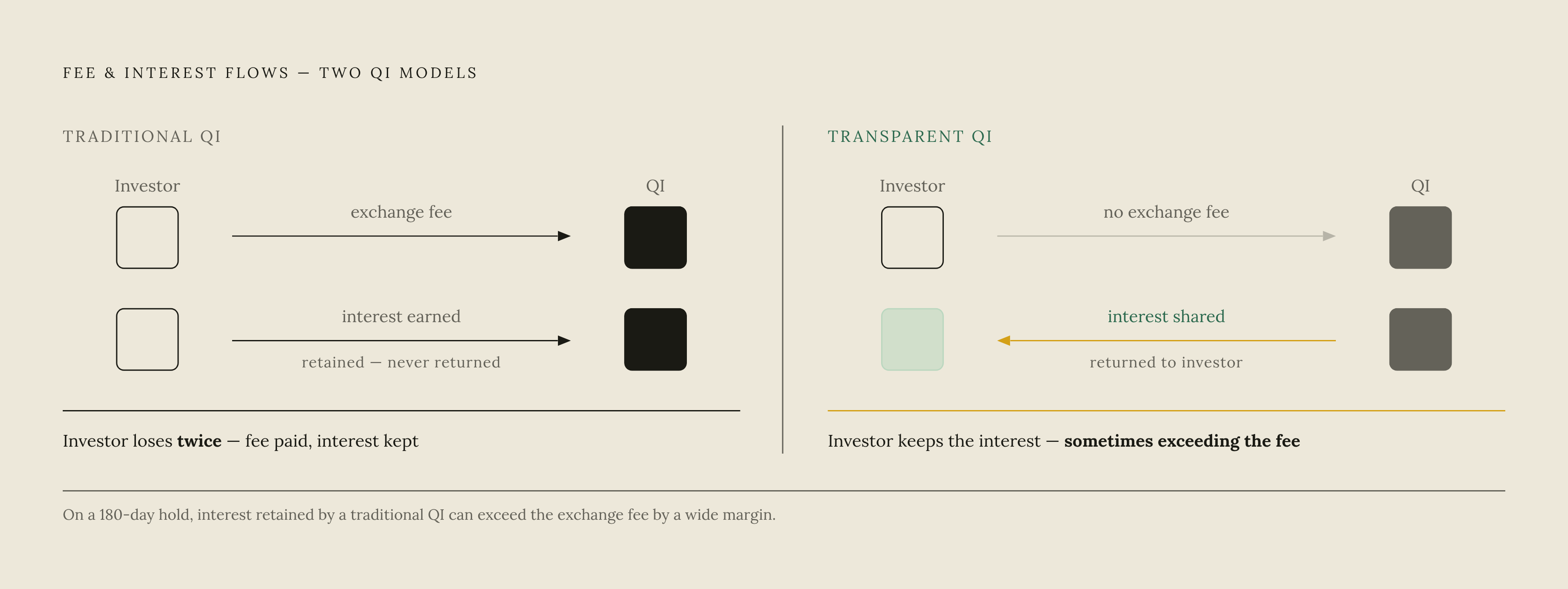
Standard practice in the industry is straightforward, and it should trouble anyone reading an exchange agreement for the first time: the qualified intermediary keeps all or a portion of the interest earned on held funds. That interest becomes a second revenue stream sitting on top of whatever exchange fee the investor already paid. Nobody hides it, exactly. It just never comes up at the point where an investor chooses who to work with, and it becomes visible only if the investor goes looking for it in the agreement itself.
That compounds a fee structure that already asks a lot. Investors typically pay a meaningful exchange fee, depending on how complex the exchange is, and on top of that, they may receive little or none of the interest their own money generated while sitting in someone else's account. For a qualified intermediary holding balances across dozens or hundreds of clients at once, that float adds up to real aggregate interest income, even in a modest rate environment. Calling this a side benefit understates it. It is the business model, full stop, and the exchange fee is almost incidental to it.
Some intermediaries say outright that every dollar sitting in an exchange account should work for the investor, not sit idle collecting float for somebody else. That principle is easy to state and rare to see practiced, because the dominant model runs in exactly the opposite direction. A qualified intermediary that charges no fee and relies entirely on interest income has a structural incentive to want funds parked as long as possible, and that tension deserves a direct answer rather than a shrug. Later sections take that up directly. For now, the exchange agreement is where the truth lives: does it name an interest rate, does it specify the account type, does it say what happens to the earnings? If it doesn't, the silence is the answer, and the silence favors the intermediary every time.
What determines how much interest an investor's funds earn
Four things drive the number, and none of them are mysterious. The exchange balance matters most directly: a larger sale means more money sitting on deposit, full stop. Hold duration matters just as much, since an investor who closes on replacement property near day 60 accrues a fraction of what an investor closing near day 180 does. Account type and rate matter too. Money market accounts and insured cash sweep networks typically yield more than a basic demand deposit account, and a qualified intermediary that defaults to the lower-yielding option is, functionally, choosing to capture more of the spread for itself. The dollar amount at stake is a rounding error in a low-rate environment, but a higher-rate environment turns that same amount into real money, since the ambient rate environment sets the ceiling on all of it.
FDIC coverage belongs in this conversation too, not just as a safety footnote. Accounts holding balances above standard FDIC limits are often placed into insured cash sweep networks that spread deposits across multiple banks to extend coverage. Deferred, for instance, holds funds in segregated, FDIC-insured accounts, with coverage options that can extend well beyond standard limits. The account structure a qualified intermediary chooses is a safety decision and an interest-rate decision at the same time, and the two don't really separate. Investors are entitled to ask what account type is being used, what the current rate is, and whether that rate is published anywhere they can check for themselves. If the answer to that last question is no, that alone should end the conversation.
Why most investors never think to ask about interest and how that changes the economics of QI selection
Fee comparison is where most investors stop, and that's the mistake that costs them the most money. The exchange fee is listed, visible, and easy to put side by side with a competitor's number. Interest retention is none of those things. It's invisible by design, it scales with the size and duration of the exchange, and it never appears on any comparison chart because nobody's forcing it to appear there.
On a sizable exchange held for a good chunk of the 180-day window, the interest an investor never sees can exceed the exchange fee itself, sometimes by a wide margin. Comparing intermediaries on fees alone misses the larger cost sitting in that gap. It's the wrong comparison, and it's the one almost everyone makes.
Part of why this goes unnoticed is structural. There's no federal licensing requirement for qualified intermediaries, no federal oversight of how they hold client funds, and no mandated disclosure of interest arrangements anywhere in the exchange agreement. Investors are, in a very literal sense, on their own here, with the exchange agreement standing as the only document that governs what happens to their money. Most people sign it without reading the interest provisions closely, and often there are no provisions there to read in the first place.
The right comparison looks at net position, not sticker price: after fees paid and interest received, what does the investor actually walk away with when the exchange closes? That's a different number than the one on the fee schedule, and usually a much bigger one.
What a transparent interest model looks like in practice
A genuinely transparent model has three visible parts, and all three need to be checkable before an investor signs anything. Rates need to be published openly, in a public rate table, not negotiated privately or disclosed only when someone asks the right question. Accounts need to be segregated, held under the client's own name and taxpayer ID, so attribution isn't a matter of guesswork. And the exchange agreement itself needs to say, in plain language, what rate applies, what kind of account holds the money, and what happens to the earnings when the exchange closes.
Deferred operates this way: no exchange fee, interest shared directly with the client, and rates listed openly in a public table. A model that shares interest only on successful exchanges is still holding the investor's money hostage to outcome, which defeats the purpose of calling it aligned. The terms governing what happens to interest if a deal falls apart are among the clearest signals of where an intermediary's incentive actually sits. Deferred's funds are held in segregated, FDIC-insured accounts, with coverage options that can extend well beyond standard limits, which supports both the safety of the funds and the precision needed to attribute interest correctly to each client.
None of this happens by accident. A no-fee, interest-sharing structure is only possible because software-driven processes have stripped out much of the manual overhead that once justified higher fees industry-wide. The efficiency gain gets passed to the client instead of absorbed as margin. Disbursement controls matter here too: funds should require written authorization from the exchanger along with dual sign-off internally, with sales staff and administrative staff carrying no ability to move money on their own. Any investor evaluating a qualified intermediary should ask four questions without much hesitation: is the rate published or negotiated, are funds segregated by client, does interest come back to the exchanger, and what happens to that interest if the exchange falls apart?
How to read an exchange agreement before signing
The agreement has to be in place before the relinquished property closes. There's no fixing this after the fact, and investors who engage a qualified intermediary at the closing table have already lost the leverage to negotiate anything. The timing of when an investor brings in a qualified intermediary is the first real decision in the whole process, made before the choices that actually matter get locked in.
A handful of clauses deserve close reading. The interest provision should state who earns it, at what rate, and on what type of account. The fee schedule should itemize the base fee, wire fees, additional property fees, and any rush fees separately, rather than bundling them into a single opaque number. The account section should say whether funds are segregated or commingled and what FDIC coverage level applies. The cancellation terms should say what happens to accrued interest if the exchange fails or gets abandoned, since that's often the moment an investor discovers, too late, that they were never entitled to any of it. And the disbursement section should spell out what authorization is required to move funds and who holds that authority.
Red flags include no mention of interest treatment anywhere in the document, language describing commingled funds, wire or processing fees with no stated cap, and no dual-authorization requirement on disbursements. Nevada and Maine are among the few states that require qualified intermediary licensing. Everywhere else, the exchange agreement is the only protection an investor has, since no regulator stands behind it. That makes engaging a qualified intermediary before the property is even listed, rather than at the closing table, the only sensible sequence: it leaves time to actually read the terms rather than skim them under deadline pressure. Advisors, brokers, CPAs, and wealth managers who refer clients to qualified intermediaries carry some of this responsibility too. Interest is a planning issue. It's a planning issue that affects the client's actual, final return.
The question every investor should ask their QI before the exchange begins
What happens to the interest earned on the funds while you're holding them? Nothing about that question is complicated, but the answer, or the absence of one, says more about a qualified intermediary's business model than any fee schedule ever will.
A qualified intermediary that charges a fee and retains the interest is being paid twice for the same service, and that arrangement deserves to be named for what it is rather than accepted as standard practice. One that minimizes fees and shares the interest has built its revenue to align more directly with the investor's outcome, rather than sitting alongside it as a separate, competing interest.
If a qualified intermediary hedges on the answer, points to a rate that isn't published anywhere, or can't say clearly what account type holds the funds, treat that as a disclosure risk and move on. Deferred's structure, no exchange fee, interest shared with the client, rates published openly, comes close to what a fully aligned answer to this question actually looks like, and it's a fair benchmark to hold any alternative against.
The 1031 exchange has survived more than a century of tax law because the deferral it offers is real and substantial. But that benefit erodes, dollar by dollar, every time a qualified intermediary quietly keeps interest income that belonged to the investor from the start. Transparency about interest sits at the center of the exchange process, not at its margins. It signals, as clearly as anything available, whether a qualified intermediary works for the investor or merely works alongside them while collecting twice.