Bonus Depreciation on Replacement Property After a 1031 Exchange
Bonus depreciation applies only to excess basis, not carryover basis, after a 1031 exchange.
When an investor acquires replacement property through a 1031 exchange, bonus depreciation can still apply, but split-basis rules and carryover mechanics require careful planning to capture the full benefit. Section 70301 of the One Big Beautiful Bill Act (OBBBA), enacted July 4, 2025, changed what it changed per S1 and S3. Bonus depreciation applies to property with a tax life of 20 years or less; it does not apply to the building structure itself (27.5-year residential, 39-year commercial). Cost segregation enters at that point.
Basis as the Thing to Watch When a 1031 Exchange Defers Taxes
A 1031 exchange lets an investor sell business or investment real estate, roll proceeds into a like-kind replacement property, and defer federal capital gains tax (15-20%), depreciation recapture (25%), and the 3.8% net investment income tax Strategic 1031 Exchange: 2026 Wealth Optimization Guide Bonus Depreciation and 1031 Exchanges: A Hidden Opportunity - Evergre…. The operative word is defer: the liability moves into the replacement property's basis and waits there until a taxable sale eventually triggers it. A qualified intermediary must hold the full proceeds throughout; if the investor touches that money even briefly, the exchange is void and the deferred tax bill comes due immediately Strategic 1031 Exchange: 2026 Wealth Optimization Guide Real Estate Investors: Bonus Depreciation, 1031s & Opportunity Zones. Two deadlines govern the transaction and run at the same time from the closing date: 45 calendar days to identify replacement property in writing, and 180 calendar days to close on it Strategic 1031 Exchange: 2026 Wealth Optimization Guide. Neither can be extended, for any reason Strategic 1031 Exchange: 2026 Wealth Optimization Guide.
Consider a property bought for $500,000 and sold for $900,000 Real Estate Investors: Bonus Depreciation, 1031s & Opportunity Zones 1031 Exchange Guide: Rules, Timeline, Boot & Strategies Bonus Depreciation and 1031 Exchanges: A Hidden Opportunity - Evergre…. Without an exchange, tax on that $400,000 gain can run $120,000-$160,000 depending on bracket and state, but a 1031 exchange keeps the full $900,000 working in the next asset Real Estate Investors: Bonus Depreciation, 1031s & Opportunity Zones 1031 Exchange Guide: Rules, Timeline, Boot & Strategies Bonus Depreciation and 1031 Exchanges: A Hidden Opportunity - Evergre…. That's the headline benefit, and it's the one most investors already understand.
What happens to basis underneath the deferral is the thing that gets missed. An exchange doesn't reset cost basis to the new property's purchase price; it carries the old basis forward. That carryover constrains how much bonus depreciation the replacement property can generate, making or breaking the strategy depending on structure.
How bonus depreciation works in 2026 under the OBBBA
That phasedown was the thing every real estate investor with a cost segregation study on the calendar had to plan around.
It removed the placed-in-service deadline entirely, which prior law set at before January 1, 2027 for most property (or January 1, 2028 for long-production-period property and certain aircraft), replacing all phase-down percentages with a single, permanent 100% rate for property acquired after January 19, 2025. There's no more sunset to plan around. That's a meaningful shift from a law that was designed, by its own terms, to expire.
The acquisition date carries a nuance that trips people up. The law treats an asset as acquired on the binding-contract date, not the closing date, so a contract signed before January 19, 2025 may only qualify for the older 40% rate even if closing came later. Investors shouldn't assume every 2025 purchase automatically gets the full 100% treatment. For constructed property, components finished before January 19, 2025 may be capped at 40%, while later-completed components on the same project qualify at 100%.
None of this touches the building shell itself. That's the gap cost segregation exists to close, by finding the shorter-lived components buried inside the purchase price. With the rate now permanent and the acquisition-date rule settled, the key question after a 1031 exchange is which slice of the replacement property's basis actually qualifies.
The split-basis rule: why not all of your replacement property's basis qualifies for bonus depreciation
A common assumption holds accelerated depreciation is unavailable on 1031-exchanged property. That's wrong, but the correction comes with a catch: the eligible portion is not the whole property.
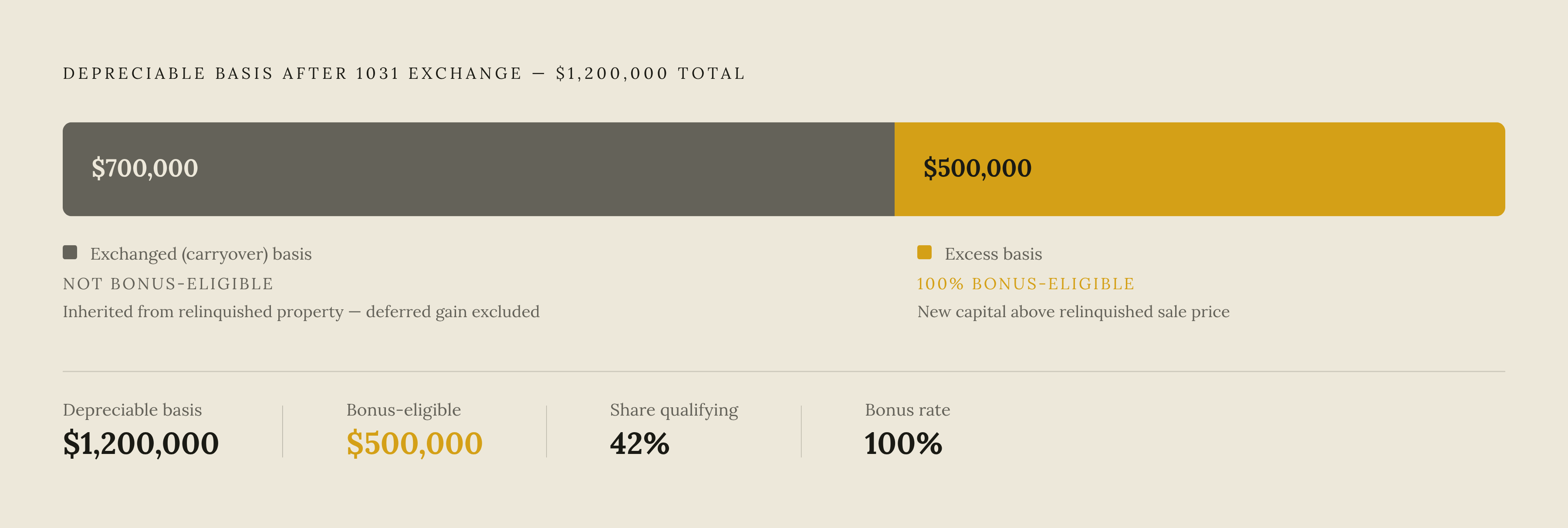
Treasury regulation 1.168(i)-6 splits the replacement property's basis into two distinct buckets. The first is exchanged basis, carried forward from the relinquished property, which keeps its old depreciation method, convention, and remaining recovery life, and generally isn't eligible for new bonus depreciation. The second is excess basis: new cash or debt layered on top to acquire the replacement property. That excess basis is treated as newly placed-in-service property, and it's fully eligible for the 100% bonus rate.
An example from KBKG lays out the arithmetic cleanly. Say a relinquished property sold for $1,000,000, with $700,000 of depreciation remaining at the exchange, becoming the carryover basis KBKG. The replacement property costs $1,500,000, and after the $300,000 deferred gain, the depreciable basis is $1,200,000 KBKG. Subtracting the $1,000,000 sale price from the $1,500,000 purchase price leaves excess basis of $500,000, eligible for bonus depreciation KBKG 1031 Exchange Guide: Rules, Timeline, Boot & Strategies. The remaining $700,000 of carryover basis is not.
The implication scales directly with how much new capital enters the deal. More cash or debt stacked on top of the relinquished property's value means bigger excess basis and bigger bonus depreciation opportunity. An investor trading into a property of equal value, adding no new capital, generates zero excess basis and nothing new to depreciate on accelerated terms. A meaningful strategic fork exists here: how big to size the replacement property depends on it. Once the split between exchanged and excess basis is clear, the next question is how it gets depreciated going forward, and there are two ways to handle that.
The two depreciation options after a 1031 exchange and their interaction with cost segregation
The general rule, Option 1, keeps carryover basis on its existing depreciation method and convention, running out over the relinquished property's remaining recovery period, while excess basis is treated as newly placed in service. Under this option, a cost segregation study can only be run against the excess basis. In the KBKG example, the study applies to the $500,000 excess basis, while $700,000 sits in carryover 1031 Exchange Guide: Rules, Timeline, Boot & Strategies. This fits best when the relinquished property was near the end of its depreciable life, since carryover deductions were ending soon anyway.
Option 2 works differently. It's a simplified method, elected under regulation 1.168(i)-6(i), treating the entire combined basis as placed in service on the replacement property's acquisition date. Under this election, a cost segregation study applies to the full combined depreciable basis. Going back to the same example, that's $1,200,000 rather than just the $500,000 excess portion. The election is made by attaching a statement to the tax return reading "Election made under Regs. 1.168(i)-6(i)," with a description of the property. Choosing this method doesn't change how like-kind exchange or depreciation recapture rules apply to the relinquished property, KBKG confirms. It's purely a depreciation election, not a change to the exchange's tax treatment.
Bonus depreciation only reaches excess basis under either option, so the Option 1/2 choice is about how much total basis gets accelerated (non-bonus) depreciation via cost segregation, not about expanding 100% bonus eligibility Strategic 1031 Exchange: 2026 Wealth Optimization Guide Real Estate Investors: Bonus Depreciation, 1031s & Opportunity Zones. That distinction matters, and it's easy to blur in a quick pitch. Running the numbers before committing to either election isn't optional: without the 1031 basis calculations done first, a cost segregation proposal can significantly overstate or understate what's achievable. Once that sequencing is respected, the combined strategy starts to show its real shape across the life of a property.
Cost Segregation and Bonus Depreciation from the Eligible Portion of Replacement Property Basis
Cost segregation is an engineering-based analysis. It reclassifies components out of the 27.5- or 39-year building category into 5-, 7-, or 15-year categories for personal property or land improvements, and those shorter-lived components qualify for bonus depreciation. On a typical commercial property, a study can reclassify 20%–40% of the building's cost into shorter-life categories, potentially generating first-year tax savings between $40,000 and $200,000 per $1,000,000 of eligible basis.
Investors sometimes worry a cost segregation study might jeopardize the exchange itself. It doesn't. The two questions are legally separate; accelerating depreciation on the replacement property doesn't put the exchange at risk.
A compounding dynamic applies for investors who exchange repeatedly over a career. Each cycle shrinks the eligible carryover basis somewhat, since more of the original basis is already depreciated out, but the mechanics stay the same, and each new exchange preserves the ability to run cost segregation against that cycle's excess basis. Strung together across several exchanges, that produces a sequence of accelerating deductions rather than a single one-time benefit. The strategy rewards investors who add meaningful new capital or debt at each step, hold long enough to satisfy exchange rules, and have real estate professional status or a self-rental/short-term rental structure to use the resulting losses. Passive activity loss rules can otherwise trap deductions on paper without letting the investor use them the year they're created, so that constraint must be modeled honestly. With the mechanics of the combined strategy established, it's worth addressing what happens when the exchange itself doesn't come together. IRS PLR 200450005 (per S1) holds that depreciation-related positions, including cost segregation, are irrelevant to like-kind qualification under Section 1031, so a study can't disqualify the exchange.
Using cost segregation to offset gain in the same tax year when a 1031 exchange falls through
Not every planned exchange closes. An investor might fail to identify or close on a replacement within the 45- and 180-day windows, or simply decide against exchanging. If the sale and the new purchase fall in the same tax year, a cost segregation study on the new property can generate deductions large enough to offset the gain recognized on the sale.
That's a fundamentally different use of the same tool. It's not layered on top of a 1031 deferral, it's deployed in place of one. Timing is everything: the sale and purchase must land in the same tax year, or the gain is recognized before any offsetting deduction exists. The same passive loss limitations and real estate professional status questions apply here too, requiring the same honest modeling before treating the offset as guaranteed.
This fallback shouldn't be mistaken for an equivalent substitute. A 1031 exchange defers the entire tax obligation, including the 25% depreciation recapture, and a same-year offset is unlikely to match that scale unless the replacement property is substantially larger. It's a real option when the exchange doesn't happen, not a reason to treat the exchange as optional.
The settled and at-risk elements of the current legislative landscape for planning
Section 1031 itself came through the OBBBA untouched. Exchanges remain fully intact with no dollar cap as of 2026. According to Latham and Watkins's real estate tax outlook, that proposal hadn't advanced beyond Treasury as of mid-2026. It's dormant, not dead, and it belongs on the list of things worth watching rather than the list of settled law.
Bonus depreciation, by contrast, is about as stable as it has been since the TCJA first introduced it Bonus Depreciation and 1031 Exchanges: A Hidden Opportunity - Evergre…. The 100% rate is now permanent under the OBBBA for qualifying property acquired after January 19, 2025, and the eroding phasedown is gone. The planning window before the 2027 transition is narrow, so investors weighing a similar tax-incentive program need to move with that deadline in mind Strategic 1031 Exchange: 2026 Wealth Optimization Guide Real Estate Investors: Bonus Depreciation, 1031s & Opportunity Zones.
The old estate planning maneuver known informally as "swap till you drop" also remains fully intact. For investors building a long-horizon exchange strategy with the intent to hold until death, that mechanism hasn't moved.
State conformity isn't automatic just because federal law allows the exchange. Anyone moving capital across state lines needs to check the destination state's rules, rather than assume federal treatment carries over.
Taken together, the picture for planning is genuinely more stable than it has been in years. Under "swap till you drop," the step-up in basis at death under IRC §1014 still eliminates deferred 1031 gain for heirs (Tax Foundation's 2025 estimate: roughly $9 billion annually), and this estate strategy remains intact. Most states follow federal Section 1031, but California, for example, conforms under Cal Rev and Tax Code Section 18031 while requiring Form 3840 reporting for out-of-state replacement properties acquired on or after January 1, 2014, so investors must verify conformity. Bonus depreciation permanence and 1031 continuity provide genuine planning stability, and the $500,000 cap proposal is real legislative risk, even if it has not advanced.
Timing and sequencing to get right before closing
Sequence is not a minor detail here, and getting it right separates a study that delivers what it promises from one that doesn't. The 1031 basis calculations, splitting exchanged from excess basis, must be finished before commissioning a cost segregation study, or its scope and projected savings are guesswork. Once the replacement property closes, cost segregation work should be ordered right away, since the placed-in-service date determines which tax year the deduction lands in.
Given the OBBBA's binding-contract standard for determining acquisition date, documentation becomes its own small discipline Bonus Depreciation and 1031 Exchanges: A Hidden Opportunity - Evergre…. Investors should keep clear records of exactly when purchase agreements were signed relative to January 19, 2025, especially for deals under contract before that date but closed afterward. That paper trail is what settles a dispute over whether a property qualifies at 100% or gets stuck at the older 40% rate Bonus Depreciation and 1031 Exchanges: A Hidden Opportunity - Evergre….
A valid exchange depends entirely on the qualified intermediary chosen to run the transaction, and nothing here works without one. The QI must hold exchange funds in segregated accounts, since commingling or intermediary bankruptcy exposes the investor's proceeds. Every calculation here, the split basis, the excess basis, the compounding structure across future exchanges, rests on the exchange having been done correctly. Get the QI and the sequencing right, and the rest is arithmetic Strategic 1031 Exchange: 2026 Wealth Optimization Guide Real Estate Investors: Bonus Depreciation, 1031s & Opportunity Zones. Get either wrong, and there's no basis calculation left to argue about. The party is not a disqualified person (not the investor's CPA, attorney, real estate agent, employee, family member, or entity they control more than 10%).
Sources
- Strategic 1031 Exchange: 2026 Wealth Optimization Guide
- Real Estate Investors: Bonus Depreciation, 1031s & Opportunity Zones
- 1031 Exchange Guide: Rules, Timeline, Boot & Strategies
- Bonus Depreciation and 1031 Exchanges: A Hidden Opportunity - Evergreen Small Business
- KBKG | Cost Segregation & 1031 Exchange