Depreciation Recapture Tax in a 1031 Exchange
How proper exchanges defer recapture tax by carrying it forward into replacement property basis.

A 1031 exchange, when properly executed, defers the tax liability entirely by carrying it forward into the replacement property's basis rather than triggering it at sale. Depreciation Recapture Tax in a 1031 Exchange.
Depreciation recapture and why it surprises investors at sale
Depreciation is the annual deduction that lets an owner write down the cost of a building's improvements, not the land beneath it, on the theory that the structure wears out over time. Every year those deductions lower taxable income, and by the time the property sells, the cumulative effect can be substantial.
At sale, the IRS claws it back. Recapture pulls proceeds, up to the total depreciation claimed, out of the capital gains bucket and taxes them separately. The rate is where the surprise lives: recapture on real property is taxed at a flat 25%, while the long-term capital gains rate tops out at 20%⟧ 1031 Exchange and Depreciation Recapture: What Investors Need to Know First American Exchange Company Accruit. Investors tend to fixate on the appreciation gain, the number that feels like the "real" profit, and forget that years of depreciation deductions were quietly building a second, separately taxed liability the whole time.
Recapture applies to depreciation "allowed or allowable," not just depreciation actually claimed. An investor who never bothered to depreciate the property, from neglect or bad advice, owes the recapture tax anyway, calculated as if the deductions had been taken.
Section 1250 covers improved real property, the building structure itself, and unrecaptured gain there is capped at the 25% rate 1031 Exchange and Depreciation Recapture: What Investors Need to Know First American Exchange Company Accruit. Section 1245 covers depreciable personal property, and recapture under that section is taxed as ordinary income with no cap at all 1031 Exchange Guide: Rules, Timeline, Boot & Strategies. Most investment property sales involve some mix of both. The next few sections cover that mix. Section 1250 vs. Section 1245 (the distinction is introduced here because it matters later).
1031 exchange deferral of recapture: the mechanics of carrying the liability forward
A 1031 exchange works by changing how the IRS classifies the transaction. Instead of a sale, it's treated as an exchange, so recapture isn't recognized at closing at all; it gets carried forward into the replacement property's basis. The replacement property inherits the relinquished property's adjusted, lower basis, and that's the thread by which the deferred recapture stays attached to the asset rather than disappearing.
The IRS doesn't let the investor reset the clock on this carried-over basis to squeeze out extra depreciation benefit First American Exchange Company Accruit. The deferral doesn't let the investor reset the clock on this carried-over basis to squeeze out extra depreciation benefit.
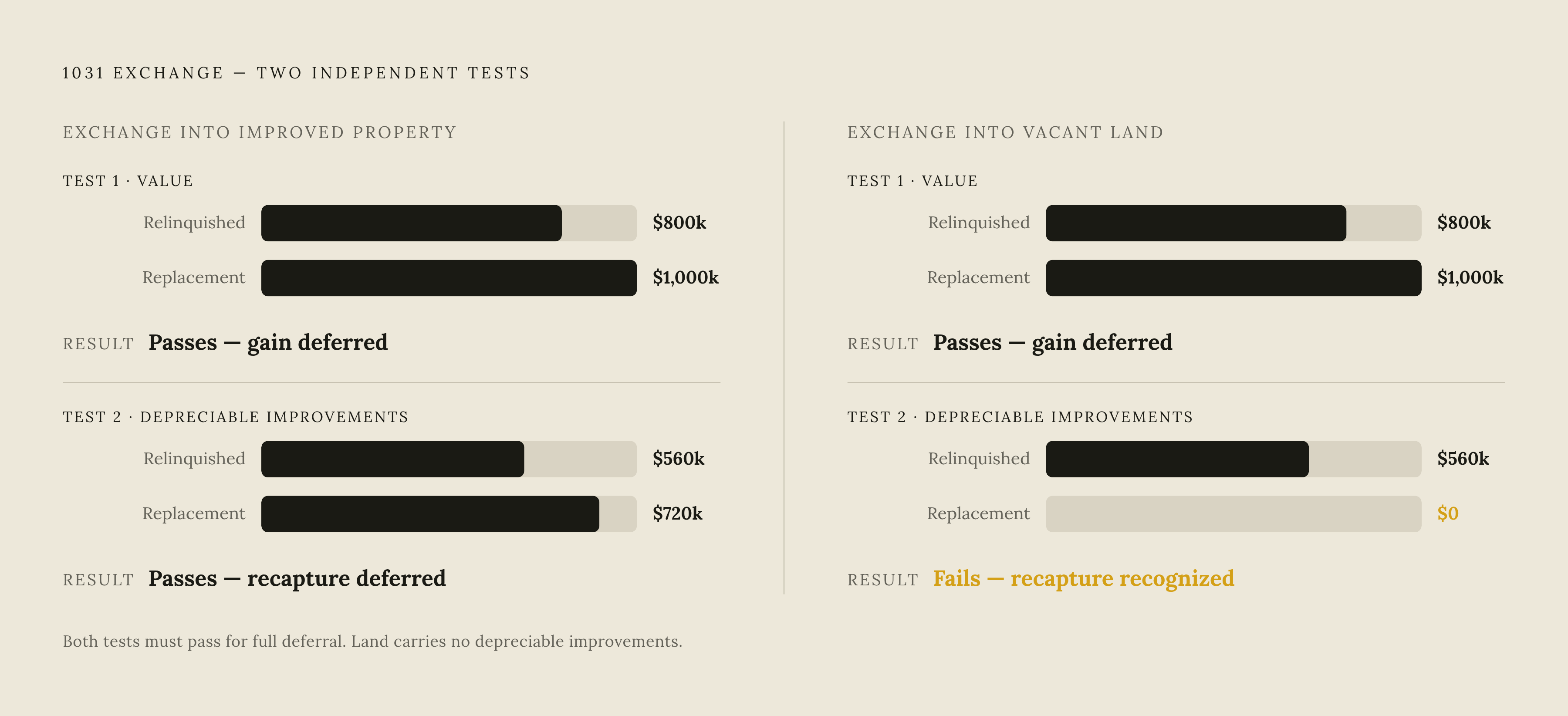
Full deferral depends on two separate conditions. The replacement property has to be equal to or greater in value than the relinquished property, and it also has to contain depreciable improvements of equal or greater value. Those are not the same test, and conflating them is where investors get burned. Sell an improved building and exchange into vacant land of identical price, and the capital gain might defer cleanly, but the depreciation recapture won't, because there's no depreciable property on the other side to absorb it.
Done right, the deferral is wide. It covers the unrecaptured Section 1250 gain at 25%, the applicable capital gains rate on appreciation, the Net Investment Income Tax, and state capital gains tax where it applies 1031 Exchange and Depreciation Recapture: What Investors Need to Know First American Exchange Company Accruit. None of that is erased, though. It's carried forward, embedded in the replacement property's basis, traveling with the investor into whatever transaction comes next. Treasury Reg. §1.168(i)-6T governs how the exchanged basis is depreciated on the replacement property, requiring the IRS to have it recovered over the remaining life of the relinquished property using whichever method is least advantageous to the taxpayer, so the exchanger cannot reset the depreciation clock to gain a fresh benefit.
The cost segregation complication: when Section 1245 recapture survives an otherwise complete exchange
Cost segregation studies have become a standard tool for accelerating depreciation, with an engineering study able to reclassify components like carpeting, fixtures, HVAC systems, and site improvements out of the 27.5- or 39-year bucket and into 5-, 7-, or 15-year property First American Exchange Company Accruit. That acceleration is valuable during ownership. It creates a real cost at exit.
Reclassified components become Section 1245 property, and Section 1245 recapture is ordinary income with no 25% ceiling 1031 Exchange and Depreciation Recapture: What Investors Need to Know 1031 Exchange Guide: Rules, Timeline, Boot & Strategies First American Exchange Company Accruit. Inside a 1031 exchange, that recapture only defers to the extent the replacement property contains enough Section 1245 property of its own to absorb it 1031 Exchange Guide: Rules, Timeline, Boot & Strategies. A cost-segregated shopping center exchanged into vacant land is the textbook failure case: no depreciable personal property on the replacement side means the Section 1245 recapture gets recognized even though the exchange otherwise qualifies 1031 Exchange Guide: Rules, Timeline, Boot & Strategies.
The dollar exposure here is not trivial. At top ordinary-income rates, layered with state tax, a large Section 1245 balance can generate a serious bill even inside a transaction that everyone involved believed was a clean exchange 1031 Exchange Guide: Rules, Timeline, Boot & Strategies. Investors who leaned hard on 100% bonus depreciation, which was available through 2026 before phasing down 20% a year, carry the largest exposure of all, since they front-loaded the deductions that now sit waiting to be recaptured 1031 Exchange and Depreciation Recapture: What Investors Need to Know 1031 Exchange Guide: Rules, Timeline, Boot & Strategies.
The planning fix is straightforward to state and easy to miss in practice: investors with a cost segregation study behind them need to hunt for replacement properties with comparable or greater Section 1245 components, not just comparable total price 1031 Exchange Guide: Rules, Timeline, Boot & Strategies. That's a conversation to have with a CPA or tax advisor before the relinquished property goes to market, not after closing, when the options for fixing it have already evaporated.
The value of deferral: keeping deferred capital at work vs. sending it to the IRS
Money not paid in tax keeps compounding. At 80% loan-to-value, preserving that equity base rather than shrinking it by a tax bill dramatically expands what the investor can borrow against and buy next.
The 25% recapture rate is what makes this so consequential 1031 Exchange and Depreciation Recapture: What Investors Need to Know First American Exchange Company Accruit. On a property carrying substantial accumulated depreciation, the recapture tax alone, before capital gains even enter the picture, can consume a large share of net proceeds 1031 Exchange and Depreciation Recapture: What Investors Need to Know First American Exchange Company Accruit. Keeping that money deployed instead of remitting it changes the investor's leverage capacity, and this becomes visible in the next purchase.
WCG CPA calls the arrangement an interest-free loan from the IRS, and the phrase holds up: the deferred tax is capital the investor gets to use, rent-free, until a taxable sale finally closes the loop, or until death closes it permanently. Under current law, heirs receive a stepped-up basis at death, which wipes out the accumulated deferred gain entirely. That's the mechanism, largely underappreciated, by which a great many investors who exchange repeatedly over a lifetime never actually pay the deferred recapture tax.
The legislative ground under this hasn't shifted. The One Big Beautiful Bill Act, signed July 4, 2025, left Section 1031 untouched: no dollar cap, no income limit, no transaction limit. Prior proposals to cap the benefit didn't survive the legislative process, though it would be careless to call the risk zero going forward.
The rules an exchange must satisfy to defer recapture in full
None of the benefit above materializes without hitting every procedural requirement, and the requirements interlock rather than stack as a simple checklist. The clock starts the moment the relinquished property closes: the investor has exactly 45 calendar days to identify replacement property in writing, signed and delivered to the qualified intermediary, with no extension for weekends or holidays 1031 Exchange Guide: Rules, Timeline, Boot & Strategies.
Identification has to satisfy one of three formats. The Three-Property Rule allows up to three properties regardless of value and is the version most investors use 1031 Exchange Guide: Rules, Timeline, Boot & Strategies. The 200% Rule allows unlimited properties as long as their combined fair market value doesn't exceed twice the value of the relinquished property 1031 Exchange Guide: Rules, Timeline, Boot & Strategies. The 95% Exception allows unlimited properties at any value, but only if the investor actually closes on at least 95% of the total identified value 1031 Exchange Guide: Rules, Timeline, Boot & Strategies. Picking the wrong format for the situation can cause the identification itself to fail, independent of anything else going right.
Closing has to happen within 180 calendar days of the original sale, and this window runs concurrently with the 45-day identification period, not after it ends 1031 Exchange Guide: Rules, Timeline, Boot & Strategies. Value has to match or exceed the relinquished property's price to defer the capital gain, and separately, the depreciable improvements have to match or exceed as well to defer the recapture, two distinct tests that don't automatically satisfy each other.
The rule that makes a qualified intermediary mandatory rather than optional is that the investor can never touch the sale proceeds, not even briefly, or the exchange is void on constructive receipt grounds. Like-kind is broader than most people assume. Any U.S. investment real property qualifies as like-kind to any other, a single-family rental into a multifamily building, commercial space into raw land, a duplex into a portfolio of short-term rentals, though the scope has been domestic-only since the 2017 tax reform. The completed exchange gets reported on IRS Form 8824 with the return for the year of sale. Miss any one piece, the deadline, the value test, the intermediary custody requirement, and recapture along with capital gains tax comes due in full for that tax year.
Triggers of partial recapture inside a valid exchange ("boot")
Boot is any value received in the exchange that is not like-kind replacement property, such as leftover cash proceeds or a reduction in mortgage debt. It's taxable to the extent of gain, recapture included, in the year of the exchange, even when the rest of the transaction is structured perfectly.
It appears in a few recognizable ways. An investor who buys down in price ends up with unreinvested proceeds sitting as cash boot. An investor who carries less debt on the replacement property than on the relinquished one has effectively received the difference as boot, since debt relief counts as value received. And a replacement property with lower total improvement value than the one sold triggers recapture on that shortfall even when the overall purchase price lines up.
None of this makes the exchange a failure. Tax applies only to the boot amount, not to the full gain, and treating a partial exchange as some kind of defeat misreads what's actually happening. What does matter is the order in which the IRS applies the tax: recapture gets taxed before capital gains whenever boot is present. Investors sitting on large accumulated depreciation take the recapture hit first, which is worth knowing before deciding to pull any cash out of a transaction. Taking boot deliberately, with the tax consequence understood in advance, is a legitimate option.
Dependence of the deferral on the QI holding exchange funds
Constructive receipt is the legal hinge the entire structure turns on, and the moment the exchanger has any control over the sale proceeds, the IRS treats the transaction as a completed sale, and full recapture plus capital gains tax comes due immediately. That's why the qualified intermediary exists as a legal requirement rather than a convenience.
The QI's job at closing is procedural and exacting 1031 Exchange Guide: Rules, Timeline, Boot & Strategies. It prepares the Exchange Agreement, the Assignments of Agreements of Sale, and the Acknowledgements, coordinates with the closing agent so the transaction is documented as an exchange rather than a sale, and provides written instructions along with closing statements reviewed in advance. The funds themselves have to sit in a segregated qualified trust or escrow account, never commingled with the QI's own operating funds or with other clients' proceeds.
The clearest cautionary example of what happens when that segregation fails is the collapse of LandAmerica 1031 Exchange Services, which filed for bankruptcy in November 2008 1031 Exchange Guide: Rules, Timeline, Boot & Strategies. Client exchange funds froze mid-transaction, and investors who had already sold their relinquished property couldn't complete their exchanges inside the 180-day window; they owed full capital gains and recapture tax on money they could no longer access, with losses running into a substantial sum 1031 Exchange Guide: Rules, Timeline, Boot & Strategies. It's the case that makes the abstract risk concrete.
Part of what made that failure possible is a regulatory gap that still exists today. Qualified intermediaries are not federally licensed or regulated. Nevada is the only state that requires a QI license, and there's no federal FDIC insurance covering QI-held funds by default. The protection an investor gets depends entirely on what the individual QI chooses to put in place, not on any baseline the government guarantees 1031 Exchange Guide: Rules, Timeline, Boot & Strategies. What to require of a QI. Funds are held in FDIC-insured segregated accounts, with some QIs offering coverage up to $175M through program banks. Deferred's model serves as a concrete standard, with segregated FDIC-insured accounts offering coverage up to $175M, zero client-fund losses, and zero regulatory actions, which is relevant because these are the exact protections the LandAmerica failure exposed as necessary.
The law is specific about who can't serve as an investor's QI: not the investor, not an employee, partner, or close relative, and not anyone who acted as the investor's accountant, attorney, real estate agent, or financial advisor within the prior two years. That last restriction rules out most of the professionals an investor already trusts and already has a working relationship with. The choice of QI is often being made cold, without the benefit of an existing track record 1031 Exchange Guide: Rules, Timeline, Boot & Strategies.
That makes the differences between providers worth real scrutiny. Every QI performs the same basic legal function, but experience, service quality, communication, and support vary widely from one to the next. A dedicated senior Exchange Officer handling a file start to finish is a different experience than a commissioned salesperson handing the file off to a rotating team, and documentation or timing mistakes at that handoff point turn a routine exchange into a taxable event. Availability matters just as much, since the 45-day identification clock runs continuously through weekends and holidays without pause 1031 Exchange Guide: Rules, Timeline, Boot & Strategies.
Look for a fidelity bond and Errors & Omissions insurance backing the operation, and treat membership in the Federation of Exchange Accommodators as a useful baseline credential rather than a guarantee. Fee structures vary too: traditional QIs typically charge somewhere from a few hundred dollars to over a thousand for a standard delayed exchange, more for reverse or improvement exchanges, and they keep the interest earned on held funds during the exchange period as part of their compensation. Some providers now offer a different arrangement entirely, charging no fee and passing the earned interest back to the client directly, even if the exchange ultimately falls through. Given what LandAmerica's collapse exposed about the cost of inadequate custody, the segregation and insurance questions are not fine print 1031 Exchange Guide: Rules, Timeline, Boot & Strategies. They're the whole point.