Velocity of Capital in 1031 Exchange Portfolios
Qualified intermediaries hold sale proceeds in limbo, creating a hidden drag on portfolio returns.

Mechanics of a deferred exchange, from closing to acquisition
The delayed exchange, also called a forward exchange, is the structure nearly everyone uses. The relinquished property sells first. Proceeds never touch the investor's hands: they go to a Qualified Intermediary, who holds them until a replacement property is identified and bought from a third-party seller.
That routing is the legal foundation the entire deferral rests on. Under the constructive receipt rule, the investor can never touch the sale proceeds, not even briefly, not even to move them between accounts overnight. The QI holds the funds in trust or escrow for the duration. Gain actual or constructive receipt of that money at any point, and the exchange ends on the spot, with the full tax bill due immediately. There's no partial credit for effort, and no cure period.
Two deadlines govern everything between closing and acquisition. The investor has 45 calendar days from the relinquished property's closing to identify replacement property in writing, and 180 calendar days from that same closing (or the due date of the tax return for that year, including extensions, whichever comes first) to close on it. Both run in calendar days, weekends and holidays included. The only exception is a formal disaster relief notice, typically issued after a federally declared disaster under a specific published IRS revenue procedure. Absent that relief, the deadlines don't move for anyone, and the IRS has shown no appetite for softening that rule case by case.
The 45-day identification window and the three rules that govern it
Forty-five days sounds generous until an investor realizes it includes weekends, holidays, and whatever else happens to land on the calendar that month. Day 45 falls on a Sunday or a major holiday about as often as it falls on a business day, and the deadline doesn't move either way.
Within that window, identification has to follow exactly one of three IRS rules, and the rules don't blend into each other. The Three Property Rule, the one most exchanges actually use, lets the investor name up to three properties regardless of combined value. The 200% Rule allows naming any number of properties, as long as their combined fair market value doesn't exceed 200% of what the relinquished property sold for, useful for someone still weighing several deals at once. The 95% Exception exists for anyone who blows past both limits: the exchange survives only if the investor ends up acquiring at least 95% of the total identified value by the end of the exchange period. That bar sits high enough that almost nobody plans around it. It exists on paper more than in practice, and treating it as a real fallback option is a mistake.
Identification has to be in writing, signed by the exchanger, and delivered to the QI or another qualified recipient by midnight on Day 45. The identification must reach a qualifying party under the exchange rules, not simply someone acting on the investor's behalf. Up until that midnight deadline, the list can still be revised or scrapped. After Day 46, it's locked. And if none of the identified properties close, the investor doesn't get the money back early: funds sit with the QI until Day 180 passes, with return on Day 181, capital frozen for months longer than the failed exchange ever actually needed.
The Q4 deadline trap that silently shortens exchanges started in the fall
Most investors assume they get the full 180 days, no exceptions. That assumption breaks for anyone whose relinquished property sells late in the year, and it catches people off guard often enough to deserve its own warning, separate from the general deadline rules.
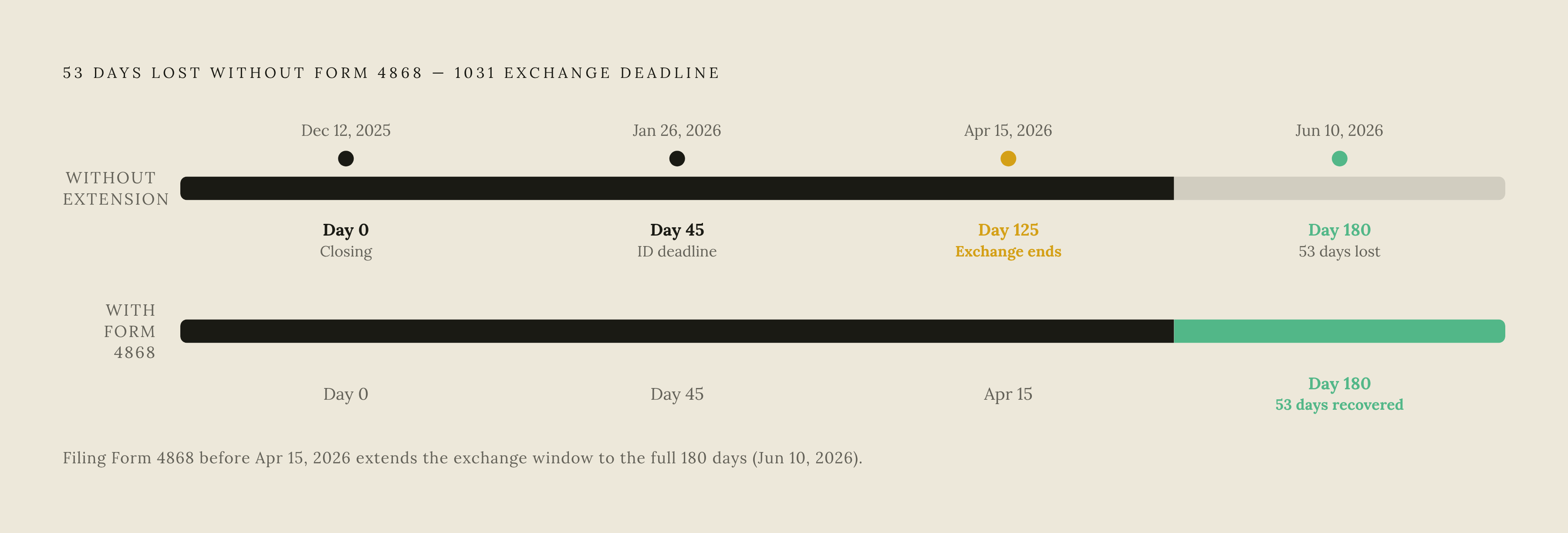
The exchange period actually ends at the earlier of 180 days or the due date of the tax return, including extensions, for the year the relinquished property transferred. For exchanges starting between October 17 and December 31, 2025, that return due date, April 15, 2026, arrives before the full 180 days would otherwise run out.
Take an investor closing on a relinquished property on December 12, 2025. The 45-day identification deadline lands on January 26, 2026, unremarkable on its own. The full 180-day period would run through June 10, 2026. But without a filed extension, the exchange period actually ends April 15, 2026, the individual tax filing deadline. That shaves 53 calendar days off the acquisition window the investor thought they had.
The fix is simple, and it has to happen before the shortened deadline arrives, not after: file Form 4868 to extend the 2025 return, and the full 180 days comes back, pushing the deadline out to June 10, 2026. Investors who close in the fall and skip this step lose real time to close on replacement property, time nobody gets back once April 15 has passed. Filing the extension costs nothing and takes minutes. Skipping it, purely out of habit or oversight, is the single most avoidable error in the entire calendar.
How boot arises and why it is the primary drag on compounding
Boot is anything of value the investor receives in the exchange that isn't like-kind real property, and it gets taxed immediately, in the year of the exchange, even while the rest of the gain stays deferred. It occurs in three forms, and most investors only learn which one caught them after the fact, usually at the closing table.
Cash boot happens when the replacement property costs less than the net proceeds from the sale, leaving money that comes back to the investor as taxable cash. Mortgage boot, or debt relief, is subtler: take on less debt on the replacement property than was carried on the relinquished one, and the IRS treats that net reduction as boot, even with no cash changing hands. Personal property boot comes from non-like-kind items bundled into the deal, appliances, fixtures, that sort of thing. Incidental property with a value under 15% of the total value of the real estate being acquired doesn't need separate identification, but anything above that threshold creates taxable boot.
None of this is exotic. Transaction expenses touch net equity in ways that can affect the exchange outcome if nobody models them before the contract gets signed.
Boot is a permanent subtraction from the capital base. Money extracted as boot never compounds inside the portfolio again. Every dollar of it shrinks the base that future appreciation and rental income would otherwise grow from, and that shrinkage works a... Money extracted as boot never compounds inside the portfolio again. Every dollar of it shrinks the base that future appreciation and rental income would otherwise grow from, and that shrinkage works against the investor the same way an undeferred gain would. The exchange still defers most of the tax, but boot quietly claws back a piece of the exact advantage the exchange was built to create.
What happens to the exchange funds between closing and acquisition
From the moment the relinquished property closes, exchange proceeds sit parked with the QI, sometimes for days, sometimes for months, before moving into the replacement property. That stretch is forced inactivity for capital that would otherwise be earning something, somewhere.
The money is held by the QI under strict constructive receipt rules that limit how it can be used during the exchange period. It can't be touched at all without blowing up the exchange and triggering the tax bill. Whatever that capital could be earning elsewhere, it isn't earning it during this window, and that dead time is baked into the process, not an accident of any one deal.
What it does earn, if it earns anything, depends on how the QI holds the funds and what the client agreement says about interest. Depending on the QI agreement, exchange funds may sit in an interest-bearing account with interest terms that favor the QI rather than the investor. On a large exchange, that retained interest is not a rounding error: over a full 180-day hold on a large transaction, the amount withheld can be substantial. A meaningful share of a traditional QI's revenue comes from exactly this, interest on client funds sitting idle, rather than from the fees charged upfront.
Under that arrangement, the investor's capital sits frozen, earning nothing for the portfolio, while the QI earns on it instead. The drag on velocity happens inside the very transaction built to protect velocity, which is the part of this structure that gets the least scrutiny and deserves the most.
The true cost of the traditional QI fee model across a multi-exchange portfolio
Base QI fees for a standard forward exchange run somewhere between $750 and $1,500, based on published fee schedules. For a straightforward, single-property exchange, that may be the whole bill, and most investors stop looking there.
Complex structures cost meaningfully more. Reverse exchanges and improvement exchanges, where the replacement property closes before the relinquished one sells, or where exchange funds finance construction, run anywhere from $3,000 to $15,000 or more, depending on structure. On top of the base fee, most QIs add roughly $300 to $400 per additional property identified, around $50 per wire transfer, about $250 for rush setup, and another $300 or so for a separate interest-bearing escrow account.
None of these individual line items looks dramatic in isolation. But an investor running multiple exchanges over a decade pays the base fee, plus every add-on, every single time, and that drag scales directly with transaction count. A portfolio built on frequent exchanges accumulates fee costs that deserve the same scrutiny an investor would give a fund's expense ratio, yet almost nobody runs that comparison. That gap between what gets scrutinized and what gets paid without question is the whole problem with the traditional fee model.
Evaluating and selecting a Qualified Intermediary as a portfolio decision, not a commodity choice
Treating QI selection like picking a title company, whoever's convenient, whoever the broker happens to recommend, is the most common mistake in the entire process, and it ignores something structural about how thinly the industry gets regulated.
Unlike banks, brokerages, or insurance companies, QIs are not federally licensed or supervised. Nevada is the only state that requires a QI to hold a license. In nearly every other state, a QI can hold client funds, sometimes millions of dollars, sometimes for months at a stretch, without any state or federal body actively supervising how those funds get managed or safeguarded. That gap means the burden of due diligence sits entirely with the investor, since no regulator stands behind the transaction the way a deposit insurer stands behind a bank deposit.
Given that gap, QI selection belongs in the same category as manager selection or custodian selection: a portfolio-level decision that should not be delegated to whoever closes the deal fastest. Fee structure matters, but so does what happens to interest earned on parked funds, how the QI documents fund security, and how total cost holds up across a multi-exchange portfolio rather than a sing... Fee structure matters, but so does what happens to interest earned on parked funds, how the QI documents fund security, and how total cost holds up across a multi-exchange portfolio rather than a single transaction. An investor running one exchange in a lifetime can get away with treating the choice casually. An investor running exchanges every few years for decades cannot, because fee drag and interest drag compound in the same direction taxes do: quietly, and against the investor, unless someone is actually watching the numbers.