Inflation's Effect on Deferred Tax Liability Over Time
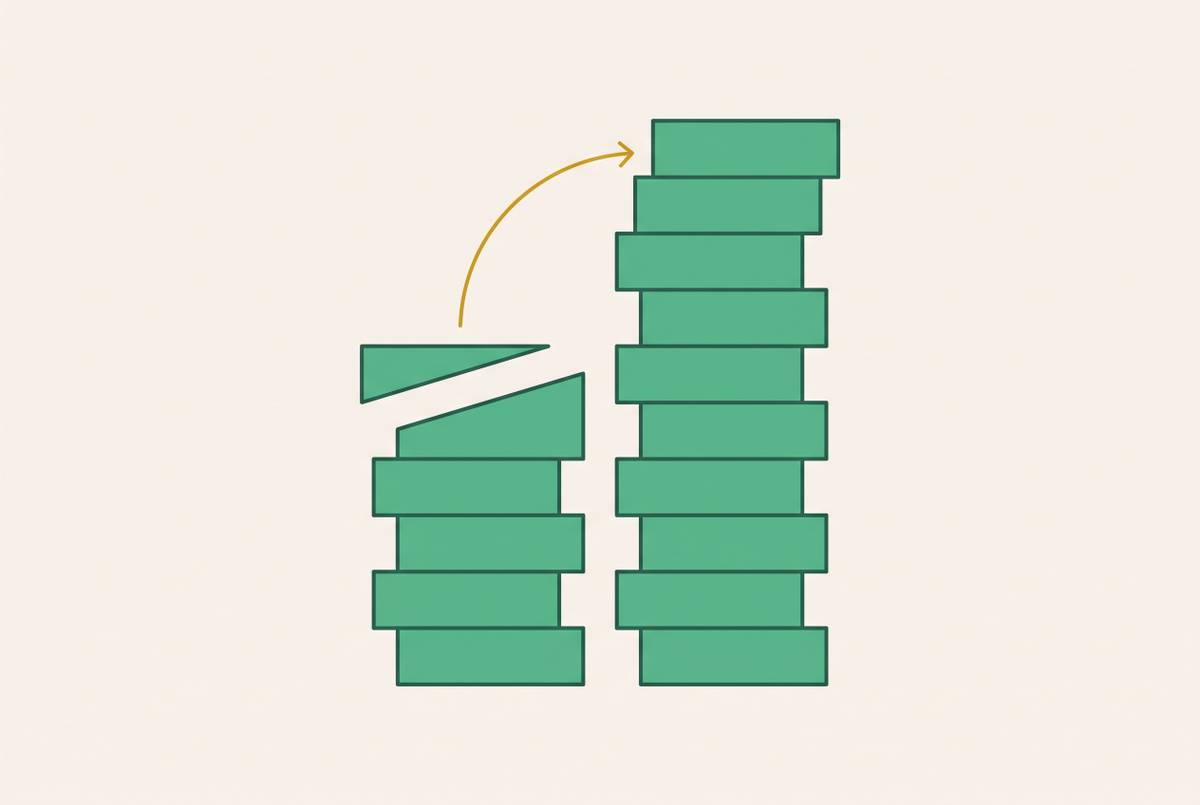
Inflation silently shrinks the real cost of a deferred tax bill across multiple 1031 exchanges.

A deferred capital gains tax liability from a 1031 exchange is not a static number sitting on a ledger somewhere, waiting patiently to be paid. It is a dollar-denominated obligation, and dollars lose value over time. That single fact, mostly ignored in how investors talk about 1031 exchanges, changes the real economics of deferral.
The real cost of a fixed future obligation under inflation
Start with what a 1031 exchange actually does. It defers capital gains tax rather than eliminating it. The gain that would normally trigger a tax bill at sale instead gets preserved inside the replacement property's adjusted tax basis, carried forward, untaxed, until some future disposition. Depreciation recapture, taxed at 25%, gets deferred the same way when the exchange meets all requirements. Add in the 3.8% net investment income tax and, depending on the state, a state capital gains bill, and the total liability being deferred can run well past a substantial share of the gain.
Think of it as a tab. The investor doesn't pay at the bar tonight, the tab follows to the next property, and the next, and it doesn't vanish. But most discussions of the mechanism leave out that the tab is denominated in nominal dollars, and the purchasing power of a nominal dollar isn't fixed. A liability owed today and the same amount owed fifteen years from now are not economically identical obligations, even though the number on paper hasn't moved. Inflation erodes what that future payment actually costs in real terms, the same way it erodes the value of a fixed-rate bond's principal or a 30-year mortgage's remaining balance.
This is the time value of money, applied to a liability rather than an asset. Everyone accepts that a dollar promised in ten years is worth less than a dollar in hand today. Fewer people apply that same logic to a tax bill sitting on the horizon. The mechanism is identical: the deferred investor isn't just benefiting from reinvesting the capital that would have gone to the IRS, but they're also benefiting because the eventual bill, however large it grows in nominal terms, shrinks in real terms every year inflation runs above zero.
Why the 1031 structure is unusually well suited to capturing the inflation benefit
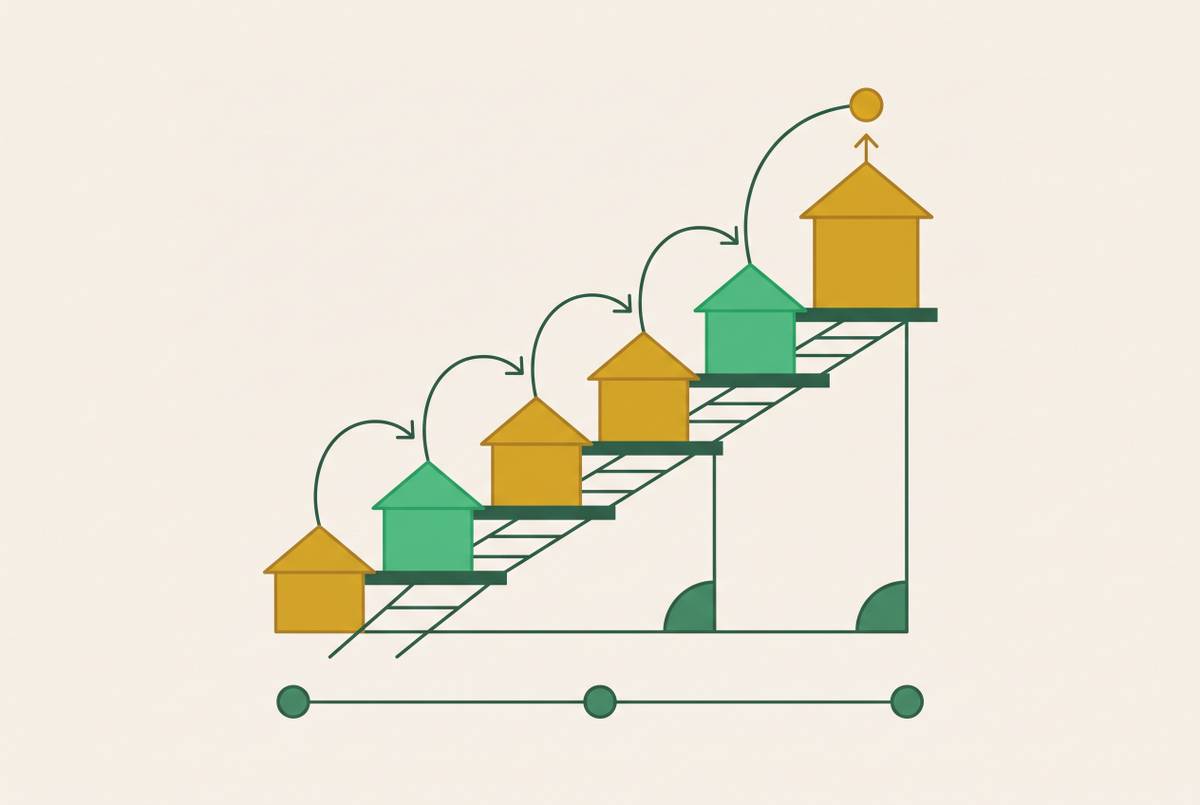
An installment sale defers tax too, but only for a fixed, contractually limited period. A single deferral, one time, capped in duration. Section 1031 works differently. There's no statutory limit on how many times an investor can exchange, and no limit on how long the chain can run. Sell, exchange, sell again, exchange again, for twenty years, thirty years, as long as each transaction meets the requirements. Every exchange restarts the clock without triggering the tax. The deferral period, and the inflation effect acting on it, can compound across an entire investing lifetime.
That compounding runs on two tracks simultaneously. First, the capital that would have left the deal as a tax payment stays invested instead, redeployed into the next property, working alongside the investor's other equity rather than sitting on the sideline. Preserving that equity lets it be redeployed into better performing assets, which is a return-on-capital story. Second, and less discussed, the liability that eventually comes due keeps losing real value the longer the chain runs. A liability deferred for five years faces a modest inflation discount. A liability deferred for twenty-five years, through several exchanges, faces a substantial one. Chain long enough, and the two effects reinforce each other: more capital working, for longer, against a shrinking real obligation.
The mechanics an investor must execute correctly for the strategy to hold
None of this works if the exchange itself falls apart, and 1031 exchanges fall apart on deadlines more often than on strategy. Two dates matter, both counted from the closing of the relinquished property. The investor has 45 calendar days to identify replacement property in writing, and 180 calendar days to close on it, or the due date of the tax return including extensions, whichever comes first. There's no grace period. Missing either deadline by a day makes the entire gain taxable that year, full stop, no partial credit for having gotten most of the way there.
Late-year sales carry a specific trap. An investor selling after mid-October may end up with far fewer than 180 effective days to close, because the tax filing deadline arrives first. A sale closing December 12, 2025, for instance, would require the replacement to close by April 15, 2026 without a tax return extension, which is nowhere near 180 days. Filing a tax extension restores the full window, pushing the effective deadline out to June 10, 2026. Investors selling in the fourth quarter who skip the extension conversation with their tax preparer are giving away weeks of runway for no reason.
Identification itself follows one of three rules, and they're mutually exclusive: pick one and it governs the entire exchange. The three-property rule lets the investor name up to three replacement properties regardless of value, and it's the one used in the overwhelming majority of exchanges. The 200% rule allows naming any number of properties, as long as their combined fair market value doesn't exceed twice the sale price of the relinquished property. The 95% exception permits naming any number of properties of any value, but the investor then has to actually close on at least 95% of that total identified value, a threshold so hard to hit in practice that it's rarely used. Fall short of 95%, and the exchange treats none of the identified properties as validly identified at all, not even partial credit for the ones that did close.
The "buy-borrow-die" end-game and how it eliminates the liability rather than just deferring it
Chain enough exchanges together and a logical endpoint emerges: never sell. Hold the final replacement property until death. At that point, heirs inherit at a stepped-up basis, reset to fair market value as of the date of death, and the entire accumulated deferred gain, no matter how many exchanges built it up or how large it grew, simply disappears. Not deferred again. Eliminated.
This is the "buy-borrow-die" pattern, and it's a well-established strategy in estate and tax planning, not a loophole discovered recently. Acquire appreciating property, borrow against the equity tax-free when liquidity is needed (loan proceeds aren't income), and let the step-up at death erase the deferred liability rather than settle it. The 1031 exchange is the mechanism that keeps the gain unrecognized and growing along the way; the step-up is what closes the loop.
A federal tax law raised the federal estate tax exemption to $15 million, permanently indexed for inflation starting in 2027. That threshold change preserves the step-up in basis at death for all but the largest portfolios, so the buy-exchange-die sequence isn't a strategy reserved for family offices and nine-figure estates. For a meaningful majority of real estate investors running multi-property portfolios, the step-up exit is genuinely available, not theoretical.
The 2026 legislative context that changes the math for some investors
Bonus depreciation adds another layer to this picture, and the rules just shifted underneath it. The OBBBA restored 100% bonus depreciation permanently for qualifying property acquired and placed in service after January 19, 2025, reversing what had been a scheduled phase-down toward zero. That's a meaningful change: it lets an investor front-load a large share of a replacement property's depreciable basis into year one rather than spreading it across decades.
The catch sits on the other side of the ledger. Bonus depreciation accelerates deductions today, but it also builds up accumulated depreciation faster, and accumulated depreciation is what gets recaptured, at a flat 25% rate, if the property is ever sold outright instead of exchanged. So the more aggressively an investor uses bonus depreciation, the larger the recapture exposure waiting on the other end of a taxable sale, and the stronger the incentive to keep exchanging rather than cash out. It's a structural push toward chaining, built into the interaction between two separate provisions rather than into either one alone.
1031 treatment still applies only to real property. Personal property, equipment, vehicles, and similar assets have been excluded since the Tax Cuts and Jobs Act of 2017, and nothing in the current legislative environment brings that back.
Implications for how investors should choose and use a Qualified Intermediary
Every benefit described above depends on the exchange actually working, every single time, across every link in the chain. One failed exchange, one blown deadline, one QI error, and the entire accumulated gain snaps back into recognition in a single tax year. That's the central operational risk of the entire strategy. It's the central operational risk of the entire strategy.
And the industry holding that risk is lightly regulated. There is no national standard or federal supervision of qualified intermediaries. No license required in most states, no bonding requirement in most states, nothing stopping someone with no real estate or tax background from opening a QI shop tomorrow. A handful of states have registration or insurance requirements on the books, but only Nevada actually requires licensure to operate.
Given that gap, credentials and operational habits matter more than marketing copy. A relatively small number of professionals nationally hold the Certified Exchange Specialist (CES) designation, a credential that requires, at minimum, three years of full-time exchange work before sitting for the exam; five years or more is a stronger bar to look for in practice. Ask how funds are held. Segregated, FDIC-insured accounts with online visibility and regular statements are the standard worth insisting on; commingled accounts, where client funds mix together, introduce fraud and insolvency risk that has nothing to do with tax law and everything to do with basic custody practice. Ask about fidelity bonding and errors-and-omissions coverage, which is what actually protects an investor if a QI mishandles funds or blows a procedural step.
Beyond that, look at how the relationship is staffed. A file that changes hands repeatedly across a multi-exchange relationship loses context every time it moves, and a dedicated senior contact who stays with the file start to finish closes that gap. Speed matters too: the exchange agreement has to be in place before the relinquished property closes, so a QI that can open an exchange same-day removes a deadline risk that has nothing to do with the 45- or 180-day clocks and everything to do with paperwork lag. Exchange deadlines don't observe business hours, so support availability on evenings and weekends is not a luxury feature, it's operational necessity for anyone racing an end-of-week closing.
Fee structure varies more than investors expect. Funds held during an exchange earn interest while they sit, and that interest goes somewhere: either it stays with the QI, or some portion of it flows back to the investor. Traditional QI fees run $600 to $1,500 or more per exchange, with the QI keeping the interest earned on held funds as an additional, less visible source of revenue. Some firms, including at least one operating a no-fee, interest-sharing model, charge nothing upfront and instead share a portion of the interest earned with the client, while still holding funds in segregated, FDIC-insured accounts (in that case, with coverage well into the hundreds of millions). A QI publishing its interest rates openly, rather than negotiating them privately deal by deal, is treating the investor as a partner in the transaction rather than a counterparty to be worked around.
When deferral's real-cost advantage is strongest and when it isn't
None of this is an argument that deferral always wins. The inflation-erosion benefit is conditional, and pretending otherwise does investors no favors.
It's strongest under a specific combination of circumstances: a long holding period, ideally decades, giving inflation real time to work on the liability's real value; a clear path to a step-up at death rather than an eventual taxable sale, since a liability that gets erased at death makes its nominal size irrelevant; and a reinvestment return on the preserved capital that beats what the investor would have earned paying the tax now and reinvesting a smaller, after-tax amount.
It weakens under the opposite conditions. A short deferral, just a few years, doesn't give moderate inflation enough time to meaningfully shrink the real cost of the obligation. An investor planning a taxable exit eventually has to pay the bill in full, and if property values and the underlying gain have both grown substantially in nominal terms, the gross check written to the IRS can be larger in absolute dollars even though its real cost, adjusted for inflation, is lower than it would have been at the original sale date. And exchanging into an underperforming replacement property defeats the entire premise: the strategy depends on the preserved capital actually earning a return, and a 1031 exchange guarantees tax deferral, not investment quality.
Two structural facts don't move regardless of strategy. Depreciation recapture is taxed at a flat 25%, a rate that applies regardless of how long the investor has held the property. Inflation still erodes recapture's real cost over time, the same as it does for the capital gains portion, but it does nothing to the rate itself. State tax treatment isn't uniform: some states don't conform to federal 1031 rules. An investor can execute a flawless federal exchange, defer every dollar of federal gain, and still owe state tax in the year of the transaction. For investors holding property in a non-conforming state, that partial, unavoidable state tax bill needs to be part of the math from the outset.