Transitioning From Active Landlord to Passive DST Investor via 1031 Exchange
How a 1031 exchange lets landlords shift rental duties to passive DST sponsors.

A 1031 exchange lets an active landlord move into a passive Delaware Statutory Trust investment and defer tax on the property sale if the exchange is set up before closing. The transition depends on disciplined sequencing and a qualified intermediary with segregated accounts, adequate funds protection, DST closing experience, and clear fee and interest terms. Passive ownership is the destination, but a properly executed exchange is what preserves the capital available to reach it.
Why active landlords are turning to DSTs — and why the 1031 exchange makes the transition tax-efficient
For retirement-minded landlords, tenant disputes, maintenance, and vacancies can become a burden that outweighs the income a rental produces. Selling removes those duties, but an outright sale can also expose accumulated equity to federal capital gains tax, depreciation recapture, the 3.8% net investment income tax, and state capital gains tax. The combined liability depends on the state and how long the property has been depreciated.
The 1031 exchange and the Delaware Statutory Trust address different sides of that problem. The exchange defers the tax, while the DST transfers property-level management to a sponsor. Together, they allow a change in the investor’s role without requiring a taxable liquidation of the real estate investment.
What the 1031 exchange actually does — and what it does not do
A 1031 exchange defers tax. The deferred gain carries into the replacement property’s basis and remains relevant if the investor later sells without another exchange. In the meantime, money that would have gone to pay tax stays invested. This gives deferral economic value beyond the closing date, because the investor can reposition a portfolio without paying tax on the deferred gain at each qualifying exchange.
The Tax Cuts and Jobs Act limited Section 1031 to real property held for investment or business use. Personal property, equipment, vehicles, fix-and-flip inventory, and primary residences do not qualify. Within qualifying real estate, however, “like-kind” does not require matching property types. An apartment building can be exchanged for raw land, and a rental condo can be exchanged for a qualifying share of commercial property. A long exchange strategy can also serve estate planning because a stepped-up basis at death may eliminate the deferred gain for heirs.
The two clocks and the traps that kill a valid exchange
Both exchange deadlines begin when the relinquished property transfers. The investor has 45 days to identify replacement property, with weekends and holidays included. The investor must put the identification in writing, sign it, and send it to the qualified intermediary or the seller of the replacement property, with a legal description or street address for each candidate. After Day 45, the list cannot be expanded or revised. If an identified transaction fails after that point, a newly found property cannot take its place.
The closing deadline is the earlier of 180 calendar days after the sale or the investor’s tax return due date, including extensions. The identification period is part of that total. For a November or December sale, the tax return may be due before the full exchange period ends, which can create a year-end filing trap. Filing an extension preserves the full 180 days. Financing delays, inspection issues, and seller problems do not ordinarily provide relief, and extensions are almost never available outside federally declared disaster relief.
Constructive receipt creates a separate failure point. Taking possession of the proceeds, even briefly, disqualifies the exchange, so funds must pass through the qualified intermediary. That makes transfer controls and timely support material selection criteria. For example, Deferred.com logs every transfer, segregates funds in FDIC-insured commercial accounts, and provides support seven days a week until midnight ET. Those features address operational risks, but they do not relax either deadline.
Why DSTs qualify as like-kind replacement property and what that means for a passive investor
IRS Revenue Ruling 2004-86 established that a beneficial interest in a properly structured DST qualifies as like-kind real property for a 1031 exchange. The trust has title to the real estate, and the investors own fractional beneficial interests. Each investor gets a share of the income in proportion to their interest, without having to manage the property.
The sponsor controls leasing, maintenance, capital expenditures, financing, and eventual disposition. DSTs usually hold institutional-quality commercial, multifamily, or industrial assets, so individual investors can invest in types and sizes of property they could not buy on their own. A qualifying DST interest can also be exchanged in a future 1031 transaction, so passive ownership does not end the possibility of further deferral.
DST interests are illiquid, investors cannot refinance or direct major property decisions, and the sponsor determines the investment horizon. The transition therefore exchanges responsibility for dependence on the sponsor’s decisions and timetable. Before putting money in, the investor needs to be sure these limits fit their retirement plans.
The step-by-step transition from active rental property to DST interest
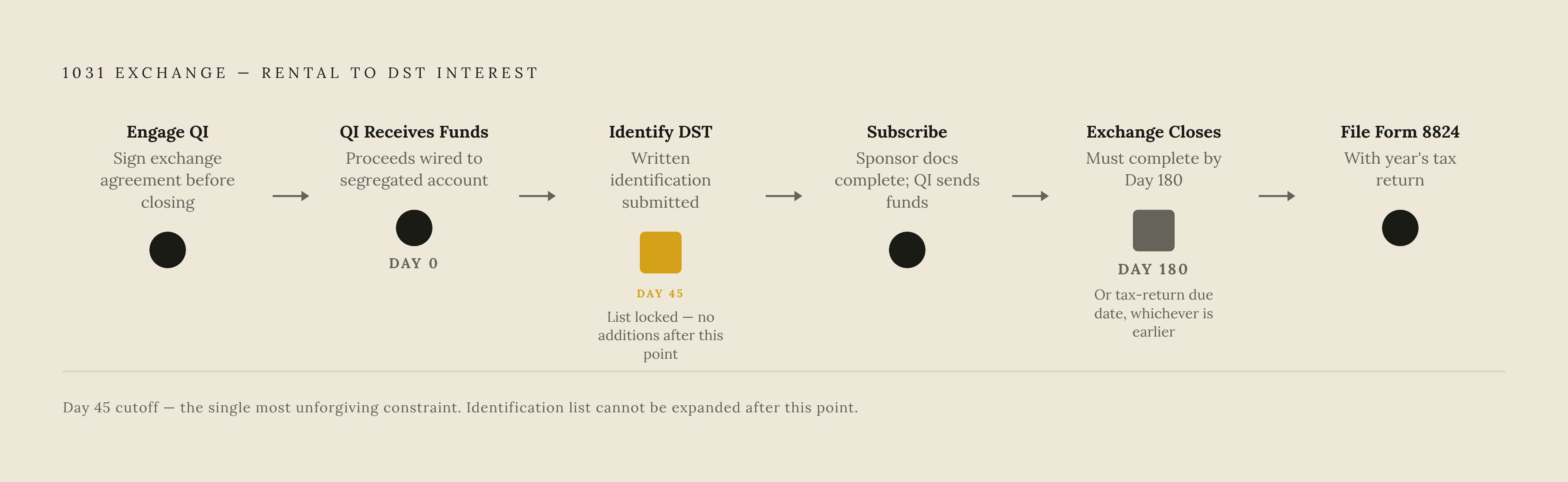
The transition begins by engaging the qualified intermediary before listing the rental property. Before the sale closes, the exchange agreement must be signed and assignment language incorporated into the sale contract. Establishing the exchange after closing is too late. At closing, the title company sends the proceeds straight to the QI’s segregated exchange account, and the day of the transfer is Day 0.
The next stage is to identify DST offerings within the 45-day window. The investor now uses the earlier research to make a formal identification of replacement property and end the open-ended search. Once an offering is selected, the investor completes the sponsor’s subscription documents and the QI sends the exchange funds to acquire the interest. The subscription must account for both invested equity and the investor’s share of trust debt. DSTs typically allocate non-recourse debt proportionally, which can help replace the mortgage retired on the rental sale.
The acquisition must then close within the applicable exchange deadline. DST subscriptions usually close faster than traditional property purchases, but the trust must already be operating the underlying property, and the parties still need to coordinate funding. Same-day closings and closing-table openings, both offered by Deferred.com, are relevant capabilities when that coordination is time-sensitive. At closing, the investor becomes a beneficial interest holder, and the QI’s funding role ends with the wire.
Reporting completes the sequence. The investor files IRS Form 8824 with the tax return for the year the relinquished property transferred. The CPA calculates the DST interest’s carryover basis, incorporating deferred gain and remaining depreciation. That calculation records the tax position carried forward into a later sale or exchange.
The equal-or-greater-value rule and how boot erodes the tax deferral
Full deferral requires more than reinvesting the cash received after a mortgage payoff. The replacement property’s purchase price must equal or exceed the relinquished property’s sale price, and the investor must reinvest the equity and replace the retired debt or contribute additional cash. A shortfall can create taxable boot in the year of the exchange. That can happen even when the investor receives no cash directly.
Consider a rental sale that pays off a large mortgage, followed by a DST subscription with a smaller allocated debt amount. Reinvesting all the remaining proceeds does not, by itself, cover the debt reduction. The investor must make up the missing debt through the DST allocation or put in more cash. Before closing, the transaction model should compare the sale price, net equity, and debt still owed with the subscription price and the share of financing assigned to the investor. Any gap must be found and filled before Day 180, well before the tax return is being prepared.
What should investors look for in a qualified intermediary for a DST exchange
For a high-value commercial property exchange into a DST, the appropriate QI combines exchange expertise with funds protection proportionate to the deposit. QIs are largely unregulated at the federal level, so the title alone is not a credential. Look for the Certified Exchange Specialist (CES®) designation and membership in the Federation of Exchange Accommodators (FEA). The FEA is the only national association representing QIs and should be a minimum threshold. The intermediary must also be eligible, rather than a disqualified related party or an attorney, accountant, or investment banker who acted as the investor’s agent within the prior two years.
Account protection requires more than the phrase “FDIC-insured.” Standard FDIC coverage of $250,000 per depositor is much less than the proceeds from many property sales, so investors should check that coverage extends to the full deposit. Funds should be segregated from operating money in a qualified trust account or qualified escrow account with dual authorization for disbursements. Investors should also check for Fidelity bonding and Errors & Omissions insurance and whether the bond is large enough to cover the funds on deposit. Nationwide capability is important when the DST owns property in another jurisdiction.
Execution capacity belongs in the same review as credentials and insurance. Deferred.com assigns a single senior Exchange Officer from first call through closing and can open an exchange in as little as five minutes. It is one option to evaluate against the full set of criteria. A dedicated officer reduces handoff risk during a deadline-driven transaction. Reluctance to provide references, missing fidelity bonding, unexplained low fees, and inconsistent communication are warning signs.
The fee and interest question most investors never think to ask
The quoted exchange fee does not reveal the full economic cost of an intermediary. Investors must also consider what happens to the interest earned while the QI holds the proceeds. Traditional QIs commonly retain that interest, and the arrangement may receive less attention at engagement than the base fee. For a large DST exchange, proceeds held for as long as 180 days can generate a meaningful sum. The duration of custody therefore affects the comparison as much as the amount deposited.
Investors should ask for both the fee and the interest treatment in clear terms. A no-fee arrangement that retains all interest may cost more than a moderate-fee arrangement that shares interest. Deferred.com offers a no-fee model that shares interest, making it another structure to compare on those same terms. An intermediary that cannot explain both clearly leaves the investor unable to make a sound comparison.
State tax considerations and clawback rules that can follow a DST investor across state lines
State tax obligations can remain after the federal exchange is complete. California, Oregon, Montana, and Massachusetts have clawback provisions that track deferred gain when replacement property is outside the original state. These rules can require notice and payment of the deferred state-level gain when the replacement property is ultimately sold or disposed of.
For example, a California landlord who exchanges into a DST holding Texas industrial properties may still owe California tax when the DST eventually sells its assets. The federal deferral and the continuing state claim are separate parts of the same transaction. Filing Form 8824 therefore does not mean the investor can disregard the original state. The appropriate response is to work with a CPA who understands multistate exchange rules before closing, rather than waiting for a later distribution of sale proceeds.
Building the transition plan before the sale — why sequencing is everything
Preparation should begin with the equity position before the property goes on the market. Calculating expected net sale price, remaining mortgage, and deferred gain establishes both the replacement requirement and the tax exposure without an exchange. The next step is to engage the QI so the agreement and assignment language are ready before closing. This places the funds-handling arrangement ahead of the event that makes it indispensable.
DST due diligence should proceed during that same pre-sale period. Offerings close on sponsor timelines, so screening sponsors and properties early allows the identification window to serve as a confirmation period. Expected proceeds and debt should then be matched against available offerings to establish that a compliant replacement is feasible. A CPA should address state clawback exposure and, for a year-end sale, the need for an extension before the return is prepared.
Account setup, property research, financial modeling, and tax planning all become harder when postponed until the sale has started the clocks. Completing them before listing turns the exchange into a managed process with defined responsibilities. The investor can then leave property management with capital still invested and a clear understanding of the control, liquidity, and tax obligations that remain.