State-Level 1031 Exchange Conformity and Non-Conforming States
States track deferred gains differently, creating hidden tax bills.
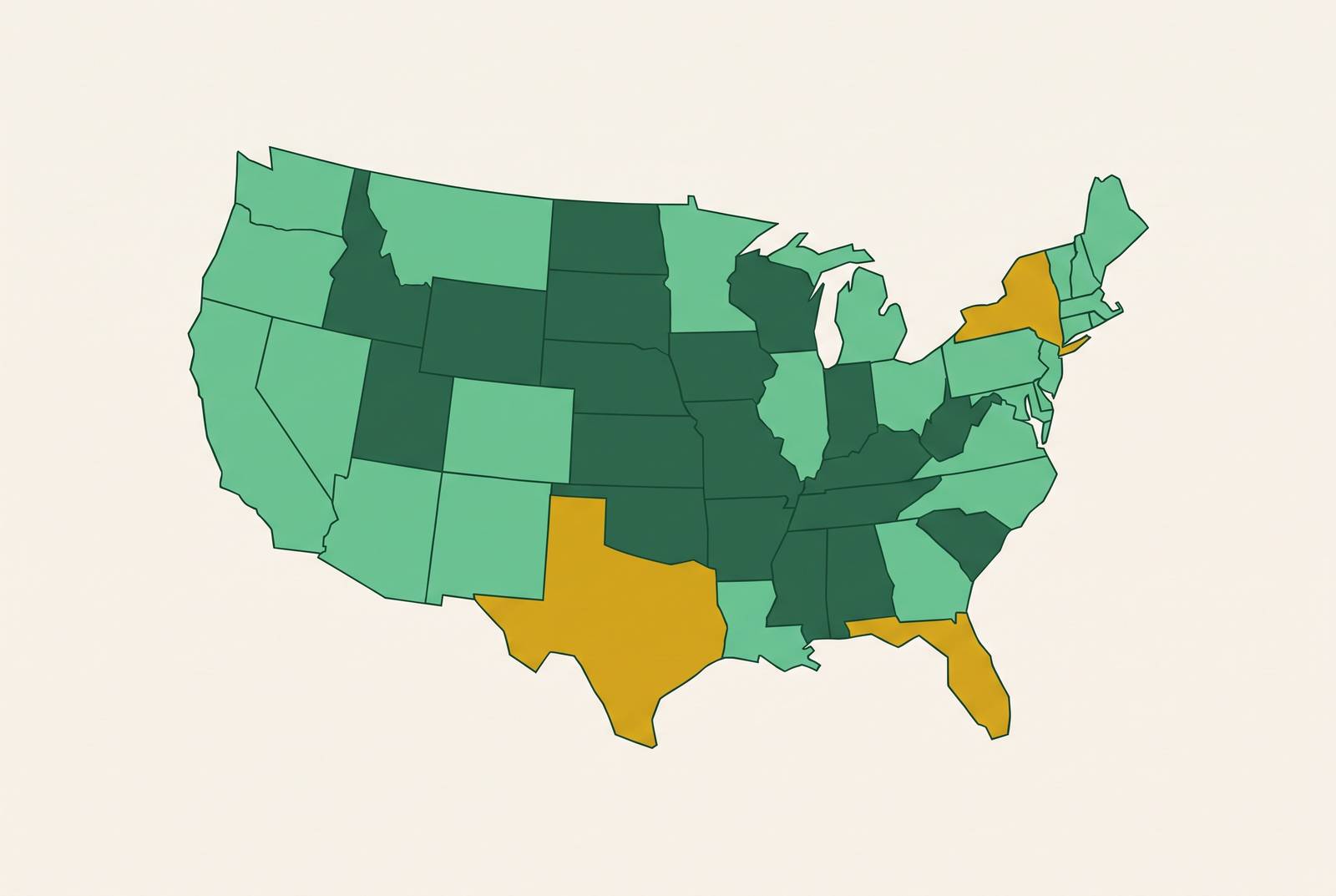
A 1031 exchange runs on one federal rulebook no matter where the property is. The state tax bill that follows it does not. The 45-day identification window, the 180-day closing deadline, the qualified intermediary requirement, and the boot rules apply the same way in every state, and no state legislature can rewrite them. What each state controls instead is whether it honors the federal deferral at all, whether it takes money off the top at the closing table, and whether it keeps a file open on the deferred gain for years, or decades, after the exchange closes. An investor can follow every federal rule to the letter and still end up owing a state tax bill nobody warned them about, simply because they never mapped the state-level landscape before listing the relinquished property. That risk is sharpest for anyone selling in one state and buying in another, though even investors who stay within a single state's borders can inherit compliance work that outlasts the closing by years.
How state conformity works
Most states with a broad income tax build their own taxable income number by starting with the federal number, so a gain deferred under federal law is deferred on the state return too. As of 2026, every state that imposes a broad income tax conforms to Section 1031 for real estate. Conformity reaching all 50 of those states is a genuinely recent development, and it closes a gap that used to trip up investors who assumed every state treated exchanges the same way from the start.
Conformity is a timing rule, not a pardon. When a state conforms, it agrees to defer taxing the gain at the moment of the exchange and to track that deferred amount through the lower basis carried into the replacement property. It does not mean the state has given up its claim on that gain forever. A handful of states, covered later, go further and build a formal tracking system to make sure that right survives even if the investor and the property both leave the state. Investors exchanging out of high-tax states need to hold that distinction in mind well before they list a property, because the deferral they're counting on is a postponement with the state's name still on the invoice.
Pennsylvania's pre-2023 non-conformity and the Pearlstein ruling
Pennsylvania spent years as the clearest exception to the conformity story, and a 2024 ruling from the state's Supreme Court confirmed just how costly that exception could be. Pennsylvania, the court ruled that Pennsylvania's Tax Reform Code never expressly or implicitly adopted the Internal Revenue Code for personal income tax purposes, and that the code contained no provision allowing gain from like-kind exchanges to be deferred before 2023.
The taxpayers in that case held interests in five limited partnerships that completed like-kind exchanges of real property in 2013 and 2014. The Department of Revenue audited those returns anyway and assessed tax on the full gain, setting up the fight that reached the state's highest court. The controlling authority, the court held, was the code itself along with the regulation requiring accounting methods that clearly reflect income, and the 2023 conformity law, Act 53 of 2022, could not reach back to cover years before it took effect.
For investors, the practical message is narrow but serious. Anyone who completed a like-kind exchange in Pennsylvania roughly between 2013 and 2022, and who didn't pay Pennsylvania personal income tax in the year of that exchange, should review those filings for exposure. The good news sits on the other side of that line: for tax years beginning in 2023, Pennsylvania conforms fully, and an exchange closing there today works the way an investor would expect it to.
The four clawback states pursuing deferred gain across state lines
Four states don't stop at deferring the tax. California, Oregon, Montana, and Massachusetts each track gain that built up on property located within their borders and claim the right to tax it whenever that gain is finally recognized, no matter where the investor has since moved or where the replacement property sits.
California runs the most demanding version of this regime. Exchange California property for a replacement property somewhere else, and the seller has to file FTB Form 3840 every year until the deferred gain is recognized. When that recognition finally happens, whether through a straight sale or a later exchange that falls apart, California taxes its share of the gain at rates up to 13.3%, regardless of where the investor lives by that point or where the replacement property is located. There are only two ways to close California's file for good: sell the replacement property and pay California's share of the tax, or exchange back into California property. Non-resident sellers of California property face a separate obligation at closing too, under Form 593, which withholds either a percentage of the gross sales price or an elected gain-based amount unless a 1031 exemption has been filed in advance.
Oregon runs a parallel system under ORS Section 316.738 for individuals and ORS 317.327 for corporations, requiring annual reporting on Form OR-24 whenever Oregon property is exchanged for an out-of-state replacement.
Montana asserts the same kind of claim under its own tax law: deferred Montana-source gain is taxed when the replacement property is eventually sold, even if the investor relocated years earlier.
Massachusetts tracks deferred Massachusetts-source gain under 830 CMR and taxes it when it's later recognized, the same source-based claim the other three states make. Massachusetts also layers a surtax on high investment income on top of that, which can push up the effective rate on large exchange gains once they're finally recognized.
All four states are doing the same thing from different statute books: enforcing a right to tax gain that accrued inside their borders, a right that an investor's move to another state, or a replacement property located somewhere else, doesn't erase. Each state simply keeps following the gain until it's taxed. That distinction compounds when both properties in an exchange sit in clawback states. An Oregon-to-California exchange, for instance, puts both states' tracking regimes on the investor at once, each watching its own slice of the gain, with annual reporting obligations in both states running indefinitely until the gain is recognized.
Withholding at closing, the cash-flow trap in more than a dozen states
Separate from any clawback regime, a long list of states require the closing agent to withhold estimated tax whenever a nonresident sells property located in that state. If the paperwork exempting the transaction from that withholding isn't filed correctly and on time, the withheld funds sit with the state rather than with the qualified intermediary, and the investor can find themselves short on cash exactly when they need every dollar to close on the replacement property.
States running nonresident withholding programs include California (Form 593, withholding 3.33% of the gross sales price or an elected gain amount), New York (Form IT-2663), New Jersey (an estimated payment due at closing), Maryland, Georgia, South Carolina, Hawaii (through its HARPTA program), Colorado, Rhode Island, Vermont, and Maine, among others. Missing the window doesn't kill the exchange, but it can tie up capital until the state processes a refund.
Withheld money is a prepayment against the eventual state tax liability, recoverable on the state return. The complication inside an exchange is that those withheld funds never reach the qualified intermediary's segregated account, and that gap can leave the investor short of the net proceeds needed to meet the equal-or-greater-value requirement that keeps the exchange fully tax-deferred. Treating the exemption filing as exchange preparation rather than a closing-day errand is the only way around this. The qualified intermediary and the closing agent in the relinquished-property state need to coordinate on that state's specific withholding requirements before the property is even listed, not the week the deal is set to close.
The four-category breakdown of the 50-state picture

Every state an investor might exchange into or out of falls into one of four practical categories, and knowing which one applies tells an investor almost everything about how much state-level work the exchange will require.
The second category is conformity without any special obligations attached, and it covers the majority of states in the country. The federal exchange works exactly as expected, state tax defers alongside federal tax, and there's no filing beyond the standard state return. States in the 50-state table that fall here include Alabama, Arizona (which taxes at a flat rate), Illinois (also flat-rate), Indiana, Iowa, Kansas, Kentucky, Michigan, Missouri, and Nebraska, among many others, each conforming with no clawback exposure and no nonresident withholding program to navigate.
The third category layers nonresident withholding on top of conformity: California, New York, New Jersey, Maryland, Georgia, South Carolina, Hawaii, Colorado, Rhode Island, Vermont, and Maine. Each of these states makes a 1031 exemption available, but the paperwork has to be filed on time. That requirement adds coordination work to the transaction rather than a real tax barrier, so long as someone is handling it early.
The fourth category is clawback tracking, the ongoing obligation carried by California, Oregon, Montana, and Massachusetts. California sits in both the third and fourth categories at once, which is part of why it carries the heaviest compliance load of any state in the country.
Before initiating any exchange, mapping the relinquished-property state and the target replacement-property state to these four categories tells an investor what filings are needed, what cash-flow risk exists at closing, and what reporting obligations will still be open years after the deal is done.
Multi-state exchanges and the layered obligations investors inherit
When an exchange crosses state lines and both states impose their own rules, the investor doesn't get to pick which regime governs the deal. Both regimes apply at once, and the obligations stack in ways that call for planning long before the relinquished property closes.
Take a California-to-Texas exchange. California withholding applies at closing on the relinquished sale, so an exemption form is required there, and California's clawback tracking begins the moment the exchange closes, regardless of the fact that the replacement property sits in Texas. The Texas side of the deal generates no state capital gains obligation on its own, but the Form 3840 filing obligation in California runs every year until the gain is eventually recognized. An Oregon-to-California exchange works differently but stacks just as heavily: Oregon's clawback applies to the Oregon-source portion of the gain, and California's clawback applies separately to any California-source gain that accrues on the replacement property if it's later exchanged again out of state. Both tracking regimes run at the same time, independent of each other.
The federal government treats all U.S. investment real estate as like-kind to all other U.S. investment real estate, which is what makes the federal side of a 1031 exchange so flexible. State rules don't share that simplicity, and nothing about the federal match-up tells an investor what either state will do with its slice of the gain. That makes basis and gain-sourcing records essential in any multi-state exchange. An investor has to be able to show, potentially years later, what portion of the eventual recognized gain is sourced to each clawback state, and sloppy record-keeping at the time of the exchange becomes an audit vulnerability at the time of the eventual sale. Working with a tax advisor experienced in multi-state investment property, brought in before the exchange is structured rather than after replacement property has already been identified, is the only reliable way to keep these obligations from compounding into surprises. The scenarios that most often trigger this complexity are familiar ones: moving capital out of an appreciated California or New York property into a growth market like Texas or Florida, aligning a portfolio with a planned retirement state, or diversifying across regions after a major liquidity event.
What to do before the relinquished property closes
The sequence starts with mapping both states. Before listing the relinquished property, identify its category, whether that's clawback, withholding, or clean, and do the same for the state where the replacement property will sit. That single step determines the full compliance picture before any binding decision gets made.
Next, the qualified intermediary needs to be engaged before closing, not at the closing table. Once sale proceeds reach the investor or come under the investor's control, constructive receipt has occurred and the exchange fails. No qualified intermediary can repair that after the fact. Engaging early also gives the intermediary time to coordinate state-specific exemption filings with the closing agent well in advance.
Nonresident withholding exemptions need to be filed with whatever lead time the relinquished-property state requires. Confirming the specific requirement with the closing agent and the qualified intermediary early in the listing process avoids a last-minute scramble.
The first Form 3840, OR-24, or equivalent filing comes due with the tax return for the year of the exchange, and investors who don't know this obligation exists often miss that first filing, which is also the one most likely to draw scrutiny from a state tax authority.
A qualified intermediary with real experience in interstate exchanges, one who stays on a single file from the first call through closing rather than handing it off across a team, is positioned to catch state-specific withholding requirements early and coordinate directly with closing agents in both states. That kind of coordination is what separates a clean exchange from one that runs into a state tax problem nobody saw coming.