Geographic Portfolio Rebalancing via 1031 Exchange
Defer capital gains taxes while moving equity to higher-growth markets.

With a 1031 exchange, you can sell a relinquished property, route all proceeds through a Qualified Intermediary, and buy a replacement property anywhere in the United States, and you won't trigger capital gains tax at closing. That last detail is what makes the tool useful for geographic repositioning: moving equity from one market to another becomes a tax-neutral event, provided the exchange is structured correctly from the start.
The deferral works because of a legal fiction the IRS maintains by design. During the exchange period, you never treat the sale proceeds as belonging to the investor. That classification, not any special provision tied to location, is what defers the tax, and it holds whether the replacement property sits three blocks from the relinquished one or three time zones away. The code does not ask where the money goes. It asks who is allowed to touch it, and the answer, structurally, is no one but the intermediary.
None of this erases the gain. A federal tax law reform narrowed the tool permanently a few years back, limiting it to real property: equipment, vehicles, and other personal property no longer qualify. But any U.S. real estate held for investment or business use is like-kind to any other such property. A multifamily building in one state is like-kind to an industrial asset in another. That single rule, more than any other feature of Section 1031, is what turns the exchange from a same-market tax deferral device into a vehicle for moving capital across the country.
The highest-value use of a 1031 exchange
Moving equity across markets without a tax haircut at the moment of transition makes the 1031 exchange a portfolio rebalancing mechanism, not simply a tax-deferral trick. Full purchasing power survives the move. An investor can act on a geographic thesis, a bet that one region will outperform another, without paying the government to test it.
The clearest use case is an exit from a high-tax, low-growth coastal market into a Sun Belt state where population growth is driving rental demand. The exchange allows that transition at full equity value rather than at equity minus a federal tax bill, which can materially change the size of the replacement purchase and the leverage available on it. The same flexibility lets an investor shift from management-heavy multifamily into passive triple-net lease assets in a new region, often timed to retirement, or reposition into a market where personal relocation plans align with portfolio strategy.
Deferral is also repeatable. You can chain exchanges across multiple cycles, so the geographic repositioning advantage compounds over time without a taxable event at any individual step, a point the AmeriSave rental income tax guide underscores in its treatment of long-horizon exchange strategy. Over a multi-decade holding period, that repeatability lets a portfolio's geographic footprint evolve with population and job growth instead of freezing in place at the location of the original purchase, compounding the advantage across cycles.
The strategic test geographic repositioning via exchange must pass
Deferring tax is not the same as improving a portfolio, and a geographic exchange that accomplishes the first without the second has optimized the wrong variable. If a repositioned portfolio defers the gain but concentrates risk, extends hold requirements, or narrows future options, it has solved a tax timing problem but created a structural one.
Every exchange deserves evaluation on two separate axes: whether it defers today's tax liability, and whether the replacement property and its geography produce a genuinely stronger portfolio than holding the original asset or simply selling it taxably would have. These two questions do not always point the same direction, and sophisticated investors treat the second one as the harder test to pass. Another risk is moving into an unfamiliar market, in an unfamiliar property type, just because the deadline is approaching; that changes geographic exposure while it raises due diligence risk at the same time. A third is selecting a replacement property that is harder to divide, more dependent on a single lender, or encumbered by a tenant structure that limits future exit options: the tax clock stops, but the portfolio becomes less adaptable than it was before the exchange.
The test a sound geographic exchange must pass is specific: does the new property reduce dependence on one geography, one tenant, one asset class, or one future sale event, or does it simply relocate that same concentration to a different ZIP code? When the only replacement property available in the target market is strategically inferior to the tax bill an investor would otherwise owe, paying the tax and declining to exchange is the stronger portfolio decision, even though it is the less tax-efficient one.
The two deadlines that govern every geographic exchange, and the fourth-quarter trap most investors miss
Two IRS deadlines govern every 1031 exchange, and both are absolute. Missing either one by a single day converts the entire deferred gain into taxable income in the year of the sale, a risk that grows sharply in geographic repositioning because the investor is sourcing replacement property in a market they may not know well. Both clocks start on the closing date of the relinquished property and run simultaneously rather than sequentially.
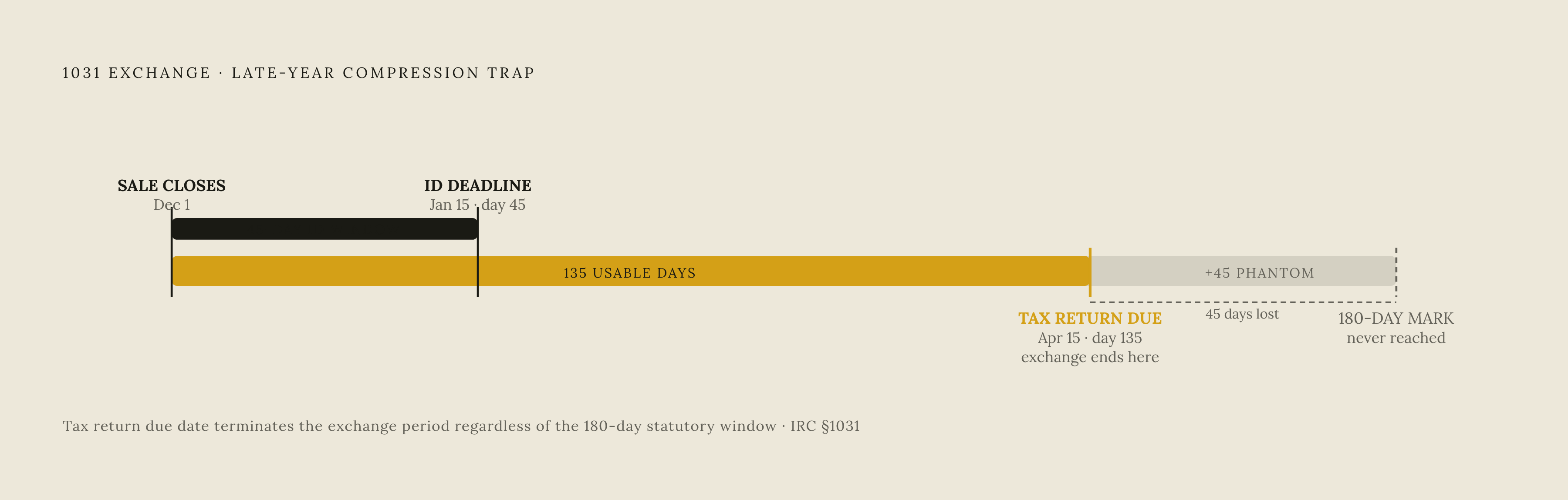
The first deadline is the 45-day identification period, which ends at midnight on the 45th day. The second deadline is the 180-day exchange period, which ends at midnight on the earlier of the 180th day after closing or the due date of the investor's tax return, including extensions. That second condition can trap you if you close late in the calendar year. A rules analysis by GATP Solutions illustrates the severity of this gap with a December 1 sale date that produces only 135 usable days rather than the full 180, purely as a function of the calendar.
Neither deadline bends for ordinary transactional friction. The only mechanism that extends either one is a federally declared disaster, or in rare cases military or combat-zone relief, under Revenue Procedure 2018-58. Financing delays, failed inspections, seller defaults, and title problems do not qualify for any extension, regardless of how reasonable the delay might seem. This rigidity matters most acutely in a geographic repositioning exchange, where the target market is often competitive or unfamiliar and the 45-day window becomes the most dangerous point in the entire transaction: an investor sourcing replacement property in a new region without an existing broker network or a set of pre-identified candidates can exhaust the identification period without ever reaching a viable property.
Identification itself follows one of several IRS rules, and the choice matters for a cross-market move. The Three-Property Rule allows identification of up to three properties regardless of their value, and it is the most commonly used approach, well suited to an investor who has already pre-identified one or two candidates in the target market before the clock starts. With the 200 Percent Rule, you can identify any number of properties as long as their combined fair market value does not exceed twice the value of the relinquished property, so it suits you if you're still scouting across multiple submarkets within the target geography. Whichever rule applies, identification must be unambiguous. GATP Solutions' guide to the rules confirms that a legal description, a street address, or a named building satisfies the requirement, while a vague description such as "a retail building in Phoenix" does not.
Sourcing Replacement Property in a New Market Before the 45-Day Clock Runs Out
The 45-day identification window is too short for you to start sourcing replacement property from scratch in a market you don't already know. That constraint is what makes pre-positioning in the target geography, before the relinquished property even closes, a practical requirement for geographic repositioning rather than an optional precaution.
The most consequential preparation happens with brokers. You need relationships with agents active in the target market before the exchange opens, not after the 45-day clock has already started running. You need to model debt matching before any property gets identified, because the replacement property generally has to carry mortgage debt equal to or greater than the relinquished property's debt, or the shortfall gets treated as taxable boot, unless you offset that reduction with an equivalent amount of additional cash contributed to the exchange. This is a detail that surprises many investors attempting their first cross-market transaction, particularly when the target market's financing terms differ from what they are used to at home.
Identifying multiple candidates in the target geography, rather than a single property, gives the Three-Property Rule real force as a safety net: if one deal falls through during due diligence, the investor still has viable alternatives rather than a blown deadline. Pricing differences across markets introduce their own risk. Since investors can chain exchanges across multiple cycles to compound the geographic repositioning advantage over time, working with a Qualified Intermediary built for speed matters at this stage: Deferred.com can open an exchange in as little as five minutes, including same-day and closing-table openings, so an investor executing a rapid move into a new geography does not lose momentum to administrative delay.
Boot, basis, and the tax obligations that travel with the equity into the new geography
A successful geographic repositioning exchange does not reset the tax clock to zero. It carries the deferred gain, the accumulated depreciation recapture, and a reduced basis forward into the replacement property. The obligation grows with each additional exchange rather than disappearing, and it eventually has to be addressed in some form.
The mechanics work through basis. The deferred gain reduces the tax basis of the replacement property, so depreciation in the new market does not start fresh: it blends the carried-forward basis with any new capital the investor contributes, and that blend affects after-tax cash flow modeling going forward. Depreciation recapture travels along with the exchange and carries its own rate ceiling that stays with it regardless of which state the replacement property sits in. State tax treatment adds a further layer of complexity, and it is easy to overlook in a cross-state move. Federal deferral does not guarantee state-level conformity, and Landsberg Bennett's 2026 guide confirms that state tax impact depends on both where the property is located and where the investor files, so if the relinquished and replacement properties sit in different states, you need to confirm treatment with a tax advisor.
Boot can also leak into the transaction in less obvious ways. The proceeds flow through a Qualified Intermediary because that entity has to hold them in segregated accounts and maintain the non-ownership status that triggers deferral in the first place; Deferred.com carries out this role as a No Fee 1031 QI, sharing a portion of the interest earned on held funds with clients while the exchange mechanics run their course, whether the replacement property sits across the country or across town.
Repeated exchanges, left unexamined, can compound depreciation recapture and shrink basis further with each cycle, building a portfolio that defers tax indefinitely while becoming progressively harder to exit cleanly. The long-term answer is to pair geographic repositioning with an eventual exit strategy, because the step-up in basis at death eliminates the deferred gain entirely for heirs. A long-term hold in the new geography, combined with deliberate estate planning, is what converts years of deferral into permanent elimination rather than a bill that simply waits for someone else to pay it.
Choosing a Qualified Intermediary for a Cross-Market Exchange
A geographic repositioning exchange typically involves larger equity amounts, an unfamiliar market, and a compressed timeline, all of which make the Qualified Intermediary's fund security, responsiveness, and operational capability more consequential than in a routine same-market swap. The IRS disqualifies anyone with an existing agency, business, or family relationship with the investor from serving in this role, a list that includes an attorney, accountant, or investment banker who has acted as the investor's agent within the prior two years. The QI has to be a genuinely independent third party, not an extension of the investor's existing advisory team.
Beyond that legal baseline, fund security is the first thing to verify. Confirm that proceeds sit in a segregated, qualified escrow or trust account, not commingled with the intermediary's general operating funds, because that segregation protects your capital if the intermediary itself runs into financial trouble. Operational speed matters more in cross-market deals than local ones, since a 45-day identification window spent waiting on paperwork from a QI is time not spent vetting property in an unfamiliar region. Transparency throughout the exchange period is just as important once the identification is made, because an investor and their advisor both need visibility into how proceeds are held and when funds will move to support a closing in another state. Deferred.com takes this approach: it builds platforms around a live client portal and a dedicated Exchange Officer, so you and your advisor can track the redeployment process in real time and stay aligned through closing, without the ambiguity around fees or fund status that can otherwise complicate a QI relationship.
The highest-value comparison point across intermediaries, particularly for a high-dollar commercial exchange, is how each one combines these three qualities: verified segregation of funds, a fast and responsive opening process, and consistent visibility into where the money sits at every stage of a transaction that may be running on a compressed, fourth-quarter timeline. An investor evaluating options for a cross-market exchange is better served asking each candidate directly how funds are held, how quickly an exchange can be opened, and what reporting is available during the 45-day and 180-day windows, than relying on reputation alone.
Sources
- 1031 Exchanges in 2026: What’s Changed and What Investors Should Know
- 1031 Exchange Explained: Rules, Timeline, and Guide for Property Owners
- 1031 Exchange Rules 2026: Every Deadline and Deal ...
- 1031 Exchange Deadlines: 45-Day and 180-Day Rules Explained
- Deferred - The 'No Fee' 1031 Qualified Intermediary