Adjusted Basis Tracking Across Sequential 1031 Exchanges
Each sequential exchange inherits the tax history of every deal before it.

Every investor who runs a 1031 exchange expects a clean break: sell the old property, buy the new one, and start fresh with a basis that reflects what was actually paid, but that is not what happens. The IRS treats the exchange as a continuation of the same investment, so the replacement property inherits the relinquished property's adjusted basis rather than stepping up to the new purchase price. This single structural fact is the reason sequential exchanges do not reset anything. They accumulate.
Why each 1031 exchange inherits the tax history of every exchange before it
The replacement property's basis carries over from the relinquished property, adjusted for boot, additional cash put in, and any gain that had to be recognized along the way, and it keeps the old depreciation history running on that carryover portion instead of starting a new depreciation clock at fair market value. The common shorthand for this rule, that the replacement property's basis is the same as the relinquished property's basis "subject to certain adjustments," sounds simple enough to gloss over. That phrase, subject to certain adjustments, is where all the real work happens, because it is where every prior boot payment, every recognized gain, and every dollar of depreciation gets folded into a single number that travels forward into the next deal.
An exchange does not make a gain disappear. It defers recognition of that gain by carrying it forward inside the adjusted tax basis of the new property, and that deferred amount sits quietly in the background until some future sale forces it into the open. For an investor who has only exchanged once, this is a manageable concept: one deferral, one adjusted basis, one history to track. The picture changes once the chain runs three or four exchanges deep. At that point, the investor is no longer working with the basis of whatever property they most recently acquired. They are working with a number that has been shaped by every depreciation deduction taken across every property in the chain, every capital improvement made along the way, every boot payment made or received at each exchange, and every partial recognition event that occurred when an exchange wasn't perfectly matched in value. The basis an investor holds today is, in effect, a ledger of the entire investment history.
Calculating Adjusted Basis in a Single Exchange
Before any of that layering can be understood, the single-exchange calculation needs to be clear, because it supplies every variable that will later multiply.
The calculation starts with cost basis: the original purchase price of the relinquished property plus the costs of acquiring it, things like title insurance, an appraisal, and legal and escrow fees. From there, basis moves in two directions during the holding period. Capital improvements made while the investor owns the property add to basis. Consider a property purchased with its acquisition costs rolled in, then improved substantially during ownership; in a worked example, those improvements push the adjusted basis up to $540,000. Depreciation deductions work the other way, reducing basis year by year. On that same property, three years of depreciation deductions would reduce the adjusted basis further, leaving a figure meaningfully below the original cost.
That net number, after improvements and depreciation, is what actually crosses into the exchange. At the moment of the trade, the figure gets adjusted once more: boot paid (extra cash or other value put in beyond what the relinquished property covered) increases basis, boot received decreases it, and any gain recognized in a partial exchange adjusts the number as well. Cash or other non-like-kind value received in an exchange can be taxable as boot, generally up to the amount of recognized gain, and when that recognition happens, it pushes the replacement property's basis back up somewhat, partially offsetting the reduction boot would otherwise cause. The realized gain on the original sale, the sale price minus selling costs and minus adjusted basis, is the figure that gets deferred rather than taxed, and it shows up as a replacement property basis that sits below the property's market value. That gap between basis and market value is exactly the mechanism that compounds across every exchange that follows.
Even in a single transaction, this calculation has several moving parts that all have to be tracked with precision: purchase price, acquisition costs, improvements, accumulated depreciation, boot paid or received, and recognized gain.
Layering Adjustments onto a Carried-Over Basis
The replacement property from the first exchange becomes the relinquished property in the second exchange, and the basis it carries into that second trade is already compressed by deferred gain and years of depreciation. It is not a clean slate, but the starting point for an entirely new round of the same adjustments.
That compression has a direct mechanical effect: because the carried-over basis is low relative to the new property's market value, the depreciable base for the new property is also low, which shrinks the annual depreciation deduction available even though the investor now holds a more valuable asset. The deferred gain itself functions as a deduction from the cost basis, and ongoing depreciation deductions reduce basis further on top of that. Both forces push in the same direction at the same time, compressing the basis further with every passing year and every additional exchange.
New money put into the replacement property, a larger down payment, closing costs on the new acquisition, improvements made after the purchase, does add to basis and offsets some of that compression. But it only offsets the amount actually invested above the carried-over figure; the deferred gain component underneath it never resets. Debt levels complicate the picture further. If the replacement property carries more mortgage debt than the relinquished property did, the investor has effectively paid boot, since increased debt counts as boot paid and raises basis. If debt goes down instead, the investor has received boot, which lowers basis and can trigger partial gain recognition right there in the exchange.
By the time an investor reaches a third or fourth exchange, the adjusted basis they are carrying is the product of the original acquisition cost, several rounds of capital improvements, several rounds of depreciation, at least two prior exchange-day adjustments, whatever boot was paid or received at each step, and any gain recognized along the way, with every one of those variables interacting with every other one. Depreciation itself often has to be tracked in separate tranches, since the carried-over basis and any newly invested capital typically depreciate on different schedules. An investor several exchanges deep may be running multiple depreciation calculations in parallel on a single property. An investor who cannot reconstruct that full history for every property in the chain cannot calculate a reliable adjusted basis today, and without that number, there is no way to project the tax bill on a future sale or to plan the next exchange with any real confidence.
Depreciation Recapture in a Multi-Exchange Chain
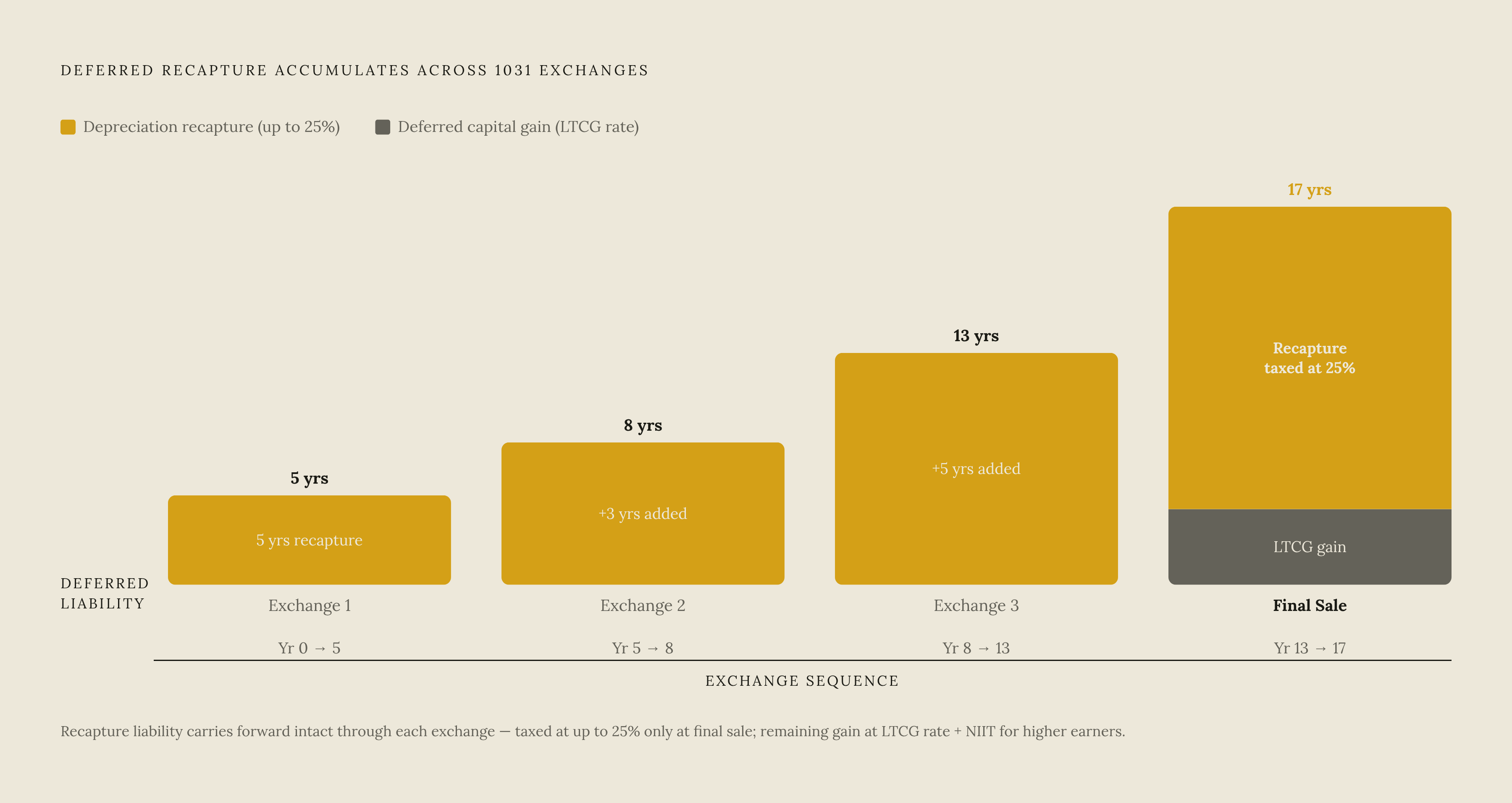
Most investors treat a 1031 exchange as a single deferral: one gain, pushed down the road, growing or shrinking with the market until it eventually gets taxed. Depreciation recapture, not a single deferred gain, is what is actually accumulating. Depreciation recapture does not vanish in an exchange. It carries forward into the replacement property's basis and grows with each additional exchange, building a liability that compounds quietly while the investor's attention stays fixed on the deferred capital gain.
An exchange does not eliminate depreciation recapture: the exchange defers the recapture, and that deferred amount carries into the replacement property's basis, where future depreciation deductions reduce basis again and expand the recapture pool a second time. A property that is nearly or fully depreciated already carries a large recapture exposure, and exchanging out of it defers that exposure rather than eliminating it. The investor has not escaped the recapture. They have carried it forward into a new asset and started accumulating fresh recapture on top of the old balance.
The rate structure makes this more than an academic distinction. Recapture is taxed at a rate up to 25%, often higher than the long-term capital gains rate applied to the rest of the deferred gain, so the composition of the liability matters as much as its size. An investor several exchanges into a chain may be sitting on a liability split between capital gain and recapture that has never been modeled separately. If that investor sold outright instead of exchanging, a long-held, heavily depreciated property could trigger long-term capital gains tax, the Net Investment Income Tax for higher earners, and depreciation recapture tax, three separate layers calculated on three different bases, all of which have been building across the length of the exchange chain.
The arithmetic of the compounding is straightforward even if the final number rarely is. Say the first exchange defers five years' worth of accumulated depreciation recapture. The second exchange adds three more years on top of that carried-over balance. By a fourth exchange, the recapture liability can run larger than the investor expects, and when the property finally sells in a taxable transaction, that portion gets taxed at the highest rate anywhere in the stack. Recapture deserves to be modeled as its own line item across a multi-exchange chain rather than folded into a general "deferred gain" estimate, because the eventual tax bill depends on knowing precisely how much of that deferred figure will be taxed at recapture rates versus capital gains rates.
Form 8824 as the Chain of Title for Deferred Gain
Form 8824, the IRS's like-kind exchange filing, looks at first like a routine piece of paperwork attached to a single year's return. Across a sequential exchange chain, it is something closer to a title record: a cumulative account of every deferred gain, every basis adjustment, and every boot event in the chain, and a missing or incorrect filing from an earlier year can corrupt every calculation that comes after it.
In any single exchange, the form does three jobs at once. It confirms the transaction qualifies as a like-kind exchange, it calculates the realized gain and the portion of that gain being deferred, and it records the adjusted basis being carried into the replacement property. In a sequential chain, each year's filing depends entirely on the accuracy of the filing before it. The basis entered on the second exchange's Form 8824 comes directly from the first one; if that earlier figure was wrong, because boot was categorized incorrectly, depreciation was applied incorrectly, or an improvement was left out, the error does not stay contained. It travels forward into every filing that follows.
The form itself has limits: it does not capture the full depreciation schedule for the property, which has to be maintained separately and reconciled at each exchange alongside the form. That separation creates a specific, practical risk whenever an investor changes tax preparers between exchanges. A new preparer who does not have every prior Form 8824 and the complete depreciation schedules for each relinquished property in the chain is forced to reconstruct the basis from incomplete information, and that reconstruction error stays hidden until the investor eventually sells in a taxable transaction, when the IRS examines the full basis history. Because the IRS treats each exchange as a continuation of the original investment rather than a new one, an audit of the current property's basis can reach back to documentation from the very first acquisition in the chain, not merely the most recent exchange. Losing or mishandling one year's paperwork does not just create a gap in that year's record. It breaks the chain of title for every dollar of gain deferred since.
The estate planning endgame that makes sequential exchanges rational despite accumulated complexity
All of this accumulated liability, the compounding depreciation, the carried-over recapture, the layered boot adjustments, has a clean resolution if the investor holds the final property in the chain until death. The stepped-up basis rule resets the property's basis to fair market value in the hands of the heir, and every layer of deferred gain built up across every prior exchange is eliminated in that moment.
If an investor keeps running sequential exchanges until the final asset passes to an heir, that heir receives the property at its stepped-up value and the deferred tax is eliminated. This is not a loophole being exploited against the design of the tax code; it is the intended interaction between Section 1031 and the stepped-up basis rules. For an investor who genuinely intends to hold property until death, that stepped-up basis makes sequential exchanging a coherent, long-term wealth strategy rather than a series of short-term tax deferrals stacked on top of each other. Viewed from this endpoint, the basis compression and the growing recapture exposure that make the chain so hard to administer are not simply costs to be minimized. They are the price of a strategy that, carried through to its conclusion, delivers the full appreciated value of the property to the next generation without a tax event.
The strategy's failure mode is just as clear as its payoff. If the investor is forced into a taxable sale before death, whether from financial pressure, an estate's liquidity needs, or an exchange that falls through, the entire accumulated liability comes due at once, often measured against a basis that has been compressed far below the property's current market value. That makes the planning conversation for a multi-exchange investor about more than the mechanics of the next trade. It has to include whether the broader estate plan is actually built to reach the stepped-up basis endpoint, and whether the investor's liquidity, health, and real holding-period intentions make that endpoint realistic.
Not every investor running sequential exchanges intends to hold until death, and for those who don't, the same basis-compounding analysis still has a use. The deferred gain figure sitting in the Form 8824 chain gives a precise basis for projecting what a future taxable sale will actually cost, rather than guessing at it once the chain has grown too long to easily unwind.