Estate Tax Exposure on Large Exchanged Property Portfolios
Repeated exchanges build hidden tax liabilities that collide with estate taxes at death.

A 1031 exchange does not erase capital gains tax. It postpones it, and for investors who exchange repeatedly over decades, that postponed liability builds up quietly inside the replacement property's basis, growing in step with the portfolio's market value rather than shrinking against it. The mechanism is simple enough on a single transaction: sell an investment property, roll the proceeds into a replacement property through a qualified intermediary, and the gain that would otherwise be taxed gets rolled into the new property's adjusted basis instead. The basis is reduced by the amount of gain not recognized at sale, so the deferred tax does not vanish. It sits in the background, waiting, and it comes due if the investor sells without doing another exchange.
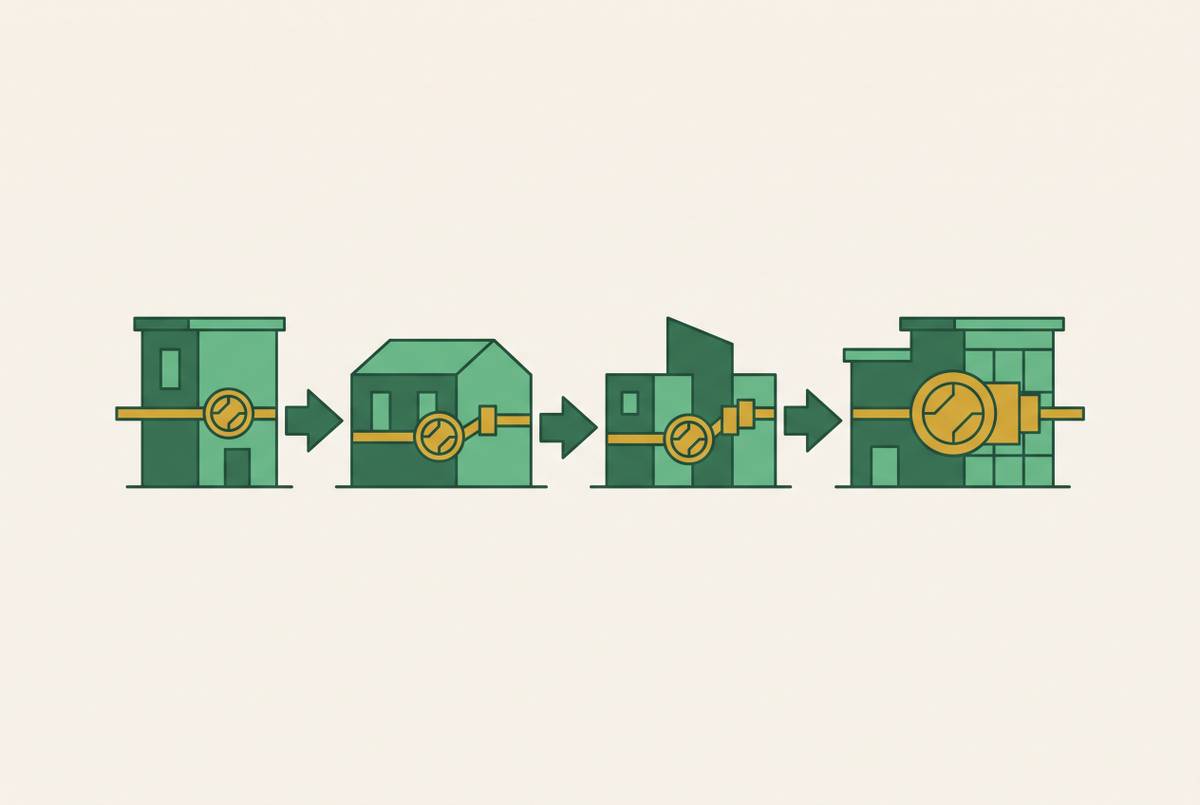
The arithmetic compounds with repetition. An investor who exchanges three or four times across twenty or thirty years carries forward a basis that has been reduced repeatedly, with each round folding in the original purchase price, the depreciation claimed along the way, and the appreciation earned during each hold period. Depreciation recapture travels with that basis too, and when it comes due, it is taxed at its own rate, capped at 25 percent, separate from capital gains tax, so an advisor thinking in portfolio terms rather than line-item terms can easily miss it. This gap appears at the portfolio level: a collection of properties with a large gross market value may represent far less actual equity than it appears to, once the embedded deferred gain is subtracted out. The portfolio looks larger on paper than the owner's real after-tax position would show on sale. That gap between gross value and net equity is what drives everything you see next at the estate level.
The Estate: Where Deferred Gain and Property Value Collide
Death forces two separate tax questions to be answered on the same day, using the same asset. The gross value of a real estate portfolio determines estate tax exposure, and the deferred gain built up inside that portfolio's basis determines income tax exposure, and these are not the same calculation even though they are triggered by the same event and measured against the same property.
The step-up in basis is what makes this collision survivable for most investors. At death, the cost basis of inherited property resets to fair market value, and this can wipe out decades of deferred capital gains and depreciation recapture in a single stroke. The gain that had been rolled forward through exchange after exchange, carried in the adjusted basis, simply disappears for income tax purposes, and heirs who sell inherited property soon after receiving it may owe little or nothing on gains the original investor spent a lifetime deferring. That is a genuine and powerful benefit, and it is the reason "swap till you drop" has functioned for decades as a coherent strategy rather than a trick.
But the step-up solves only the income tax liability. It does nothing to shrink the gross value of the estate, and a large portfolio is a large estate for tax purposes whether it carries five dollars of deferred gain or five million. For investors whose holdings sit below the federal exemption, the two issues resolve together: the deferred income tax disappears through the step-up, no estate tax applies, and the gain is eliminated without ever being recognized by anyone. For investors above the exemption, the picture splits. The step-up still clears the income tax side, but the estate owes tax on the value that exceeds the exemption, and that tax is owed on an asset, real estate, that cannot easily be converted to cash on short notice. An investor who built a large portfolio specifically by exchanging into progressively bigger and fewer properties has, in the process, concentrated wealth into exactly the kind of illiquid holding that creates the sharpest mismatch between what the estate owes and what it can quickly pay.
Where the federal estate tax exemption draws the exposure boundary in 2026
The One Big Beautiful Bill Act left 1031 exchange rules fully intact. Investors can still identify replacement property within 45 days and close within 180, so they can defer gain and carry basis forward just as before. What the legislation changed was the estate tax exemption, and that change is what redraws the line between portfolios that pass to heirs cleanly and portfolios that create a cash problem at death.
Under the OBBBA, the federal estate tax exemption rose to $30 million for married couples filing jointly, with permanent inflation indexing starting in 2027. Below that figure, the strategy works as intended; above it, the estate owes tax regardless of the portfolio's composition. Below it, an investor who has exchanged repeatedly into a growing portfolio can pass that portfolio to heirs owing neither income tax, because the step-up clears the deferred gain, nor estate tax, because the estate's value falls under the exemption. The strategy works exactly as intended. Above it, the gross estate value in excess of $30 million is subject to federal estate tax regardless of how the portfolio was assembled or how much of its value consists of deferred gain sitting inside the basis. The deferred gain does not offset the taxable estate. The step-up still clears the income tax exposure, but it has no bearing on the estate tax bill.
State law adds another layer, and the federal exemption does not touch it. Five states, Kentucky, Maryland, Nebraska, New Jersey, and Pennsylvania, impose their own inheritance tax on beneficiaries in 2026. A portfolio can create tax exposure for heirs in those states even when its value falls comfortably under the federal threshold. The exposure boundary is also not fixed in place over time. Portfolio values grow, especially for investors who continue to exchange into larger assets, and while the federal exemption is indexed for inflation starting in 2027, that indexing is not guaranteed to track real estate appreciation in strong markets. An investor sitting well under $30 million today can cross that line years before death without any change in strategy, simply because the portfolio kept doing what it was built to do.
What happens to an exchange mid-stream when an investor dies
Death during an active exchange creates a legal situation that most investors never plan for, because it requires the estate itself to step into a transaction it did not start. An estate can complete a 1031 exchange after the investor's death, provided the same-taxpayer rule is satisfied. The estate acts as the decedent's representative and can finish the exchange during probate, and the IRS grants a specific exception to the same-taxpayer requirement to allow this, since the estate and the decedent are not, strictly speaking, the same tax entity.
What the estate cannot do is pause the clock. The 45-day identification period and the 180-day closing period both continue running from the date the original property was transferred, regardless of when death occurs within that window. Treasury Regulation 1.1031(k)-1(b)(2)(i) fixes the identification period at midnight on the 45th day after the relinquished property transfers, and weekends and federal holidays do not extend it. An estate administrator who is slow to engage with the exchange timeline, whether because of grief, probate delays, or simple unfamiliarity with the file, risks losing the deferral. If the estate misses the identification deadline or the closing deadline, the exchange fails, so the full deferred gain becomes taxable in the year of the original sale, and that lands an income tax bill on an estate that is likely already navigating its own estate tax exposure.
One further detail matters for heirs specifically. The step-up in basis applies to property the decedent owned at death, not to property the estate acquires afterward by completing an exchange already in motion. A replacement property the estate picks up during probate does not get the same automatic step-up treatment, and that carries consequences for the basis heirs eventually inherit. The interaction between exchange deadlines and estate administration is intricate enough that it calls for coordination between the estate's counsel and the party overseeing the exchange rather than a general assumption that things will sort themselves out in probate.
The liquidity problem that real estate concentration creates for taxable estates
The legal mechanics above point to a practical problem: an estate that owes tax on real estate has to produce cash, and the real estate itself is usually the only large asset on hand. Federal estate tax is due nine months after the date of death. The IRS will not extend that deadline for a well-timed sale, a thorough search for qualified buyers, or a 1031 exchange that might otherwise let the estate reposition the portfolio without triggering gain.
The concentration built by years of exchanging works against the estate here. Each exchange typically moves capital into a larger or more institutional-grade property, which reduces the number of assets in the portfolio while increasing the value of each one that remains, the opposite of the liquidity profile an estate needs when a tax bill comes due on a nine-month clock. Selling under that kind of deadline is a forced sale in practice, and a forced sale of commercial real estate or a large net-lease portfolio rarely brings in what a patient, market-timed sale would. Worse, any appreciation between the date of death and the date of the forced sale is taxable, because the step-up resets basis to fair market value as of the date of death, not the date the estate finally sells. An estate that has to sell quickly can end up paying capital gains tax on top of estate tax, compounding the very cash shortfall it was trying to solve.
The concentration of value into fewer, larger properties is the real cause: each exchange builds the deferred gain that later collides with estate value. The exact strategy that built the portfolio efficiently, exchanging repeatedly into fewer, larger, more valuable properties, is the strategy that leaves the estate with the worst possible liquidity position the moment the tax bill arrives. The concentration that made the portfolio grow is the same concentration that makes it hard to pay for.
Planning approaches that address the collision before it arrives
The problem described above is solvable, but only with lead time. Investors whose portfolios are approaching or have crossed the $30 million exemption have real options for restructuring ownership, creating liquidity, or reducing the taxable estate, and none of these options can be set up after death.
You can use charitable remainder trusts and qualified opportunity zone funds alongside ongoing exchange activity to reposition assets, generate income, and pull value out of the taxable estate, but integrating either one with an active exchange timeline takes planning well in advance and cannot be improvised later. Annual gifting of fractional interests in exchange-eligible property offers another route to gradually shrink the gross estate, but fractional ownership of real estate is administratively complex, so estate counsel and whoever is managing the exchange need to coordinate closely. If you hold life insurance inside an irrevocable life insurance trust and size it to cover the projected estate tax bill, you keep the real estate portfolio whole while still having cash on hand to pay the IRS, because properly structured policy proceeds pass outside the estate. Delaware Statutory Trust interests, which qualify as replacement property in a 1031 exchange, offer a way to convert a single large, concentrated property into a diversified, professionally managed structure, spreading value across more underlying assets and improving the estate's liquidity position relative to holding one large commercial building. For investors who have not yet reached the exemption threshold, continuing to exchange with discipline remains the simplest path: keep deferring gain, let the step-up handle the income tax side at death, and manage portfolio sizing so the estate stays under the federal threshold.
None of these are substitutes for advice from qualified tax and estate counsel, and the right combination depends on circumstances specific to each investor. What matters is timing. Portfolio values grow, health can change without warning, and the longer you wait, the more complicated it gets to restructure a large real estate portfolio. Investors who start this conversation in their fifties or early sixties generally have far more room to work with than those who wait until their late seventies.
How the choice of Qualified Intermediary affects planning at portfolio scale
Everything above assumes the exchanges underneath a large portfolio close on time and without error, and that depends on the qualified intermediary handling them. At the scale where estate tax exposure becomes a real planning concern, the QI is not a vendor chosen on price. Service model, fund security, and the experience of the people handling the file all have direct consequences for whether a strategy built over decades actually executes when it matters.
Exchange proceeds on a large property can represent a meaningful share of an investor's entire net worth, so whether those funds sit in a segregated, insured account or get commingled with other clients' money is not a minor detail at this level. Funds held in segregated accounts are generally protected from a QI's creditors; commingled funds may not be. The identification period still ends at midnight on the 45th day no matter how large the transaction is, and the IRS grants no discretionary extensions, so an investor managing a portfolio worth tens of millions of dollars cannot afford a QI that fails mid-exchange.
The people handling the file matter as much as where the money sits. A large exchange routed through a generalist salesperson who hands the file off to a back-office clerk once the contract is signed carries a different risk profile than one handled start to finish by a single senior Exchange Officer with a decade or more of direct experience. Deadline enforcement, precision in the identification notice, and coordination with title companies and counsel all call for expertise built on repetition, not general familiarity with how exchanges work in theory. For investors whose portfolios have reached the size where estate tax, liquidity, and exchange mechanics all intersect, the choice of intermediary belongs in the same planning conversation as the trust structure, the insurance policy, and the gifting strategy, not treated as a back-office detail settled after everything else is decided.