Section 1245 vs Section 1250 Recapture in Exchanged Commercial Properties
Understanding how 1031 exchanges defer but don't erase depreciation recapture taxes.
Depreciation recapture exists to close a loophole that would otherwise let a property owner double-dip on tax benefits. When that asset sells, the IRS requires that some or all of those claimed deductions be recaptured and taxed at higher rates rather than at the preferential rates that apply to long-term capital gains. That mechanism makes the depreciation benefit temporary. It ensures a taxpayer cannot take the upfront deduction and then also convert those same dollars into capital gain taxed at a lower rate on the same property.
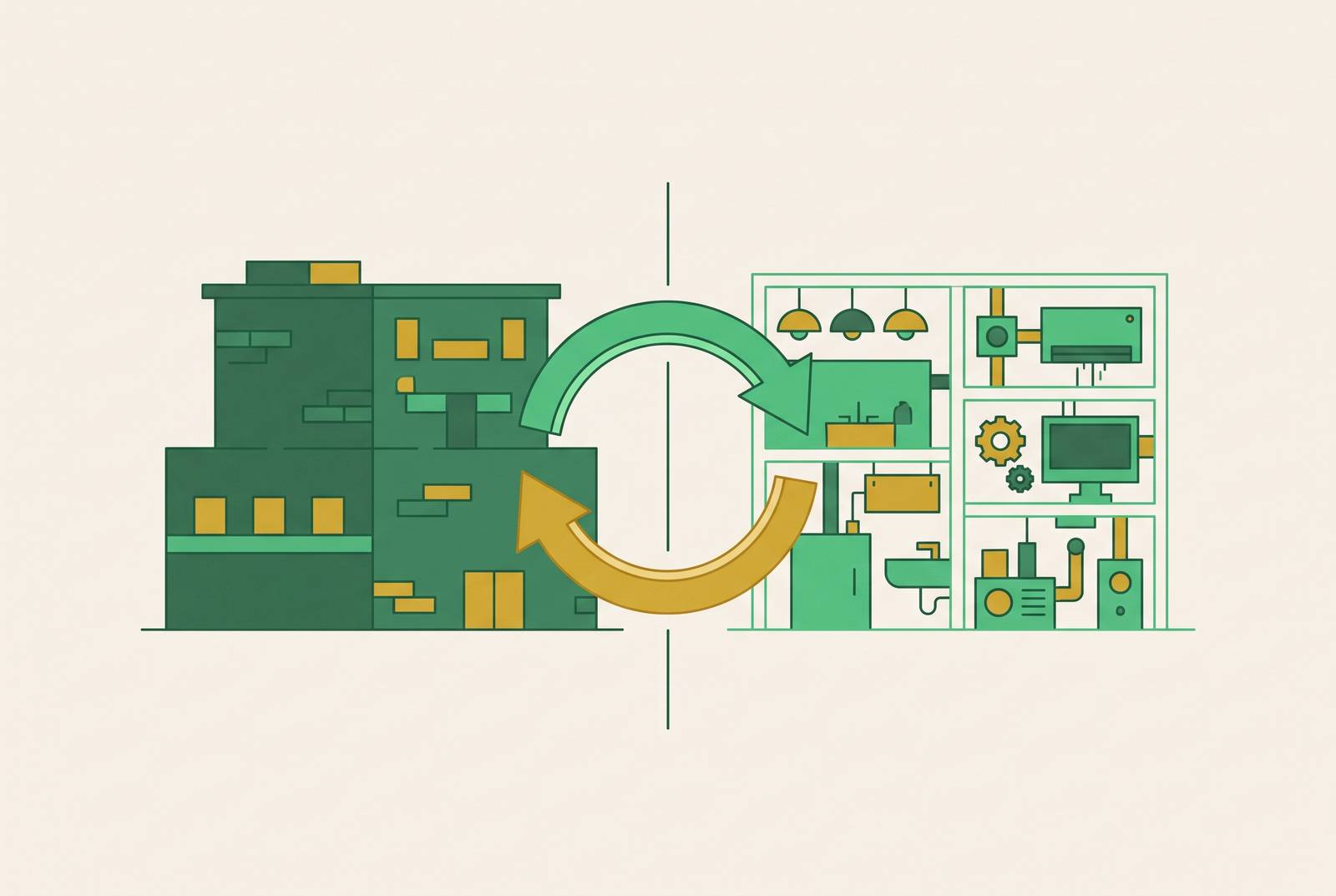
The recapture regime splits into two Internal Revenue Code sections, 1245 and 1250, because the underlying assets differ in kind. The other governs immovable real structures that depreciate slowly, over decades. That division sets up the classification questions, rate differences, and exchange mechanics that follow, and understanding it is the necessary starting point before any discussion of how a 1031 exchange interacts with recapture.
Section 1245 and Section 1250 coverage, rate, and scope
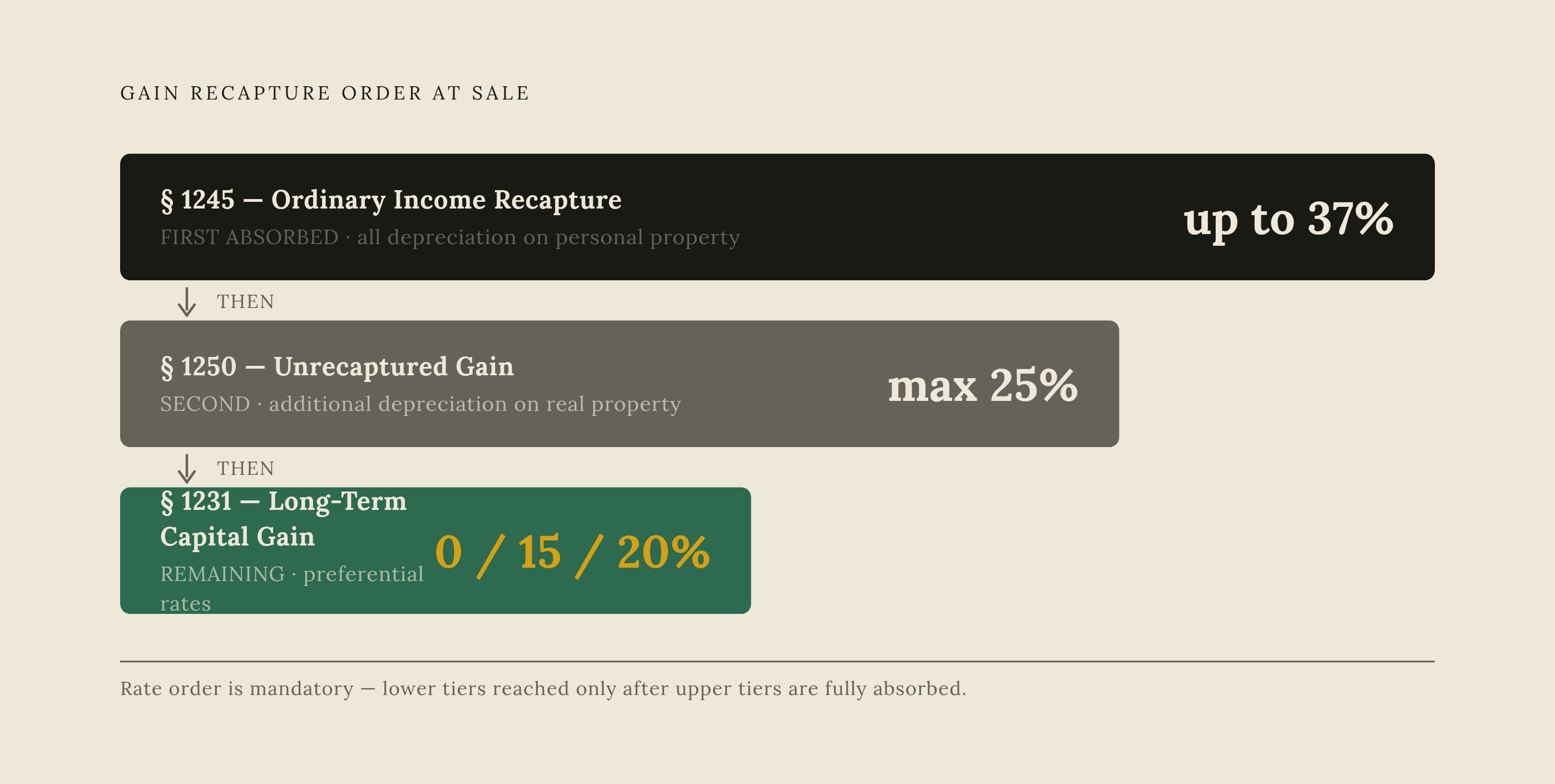
Section 1245 and Section 1250 impose meaningfully different recapture burdens because they apply to different categories of asset, follow different depreciation schedules, and cap out at different maximum rates. Any gain above the recaptured amount counts as Section 1231 gain, so it is taxed at preferential capital gains rates. Section 179 expensing and bonus depreciation elections taken on personal property are treated as Section 1245 depreciation for recapture purposes, so both tools accelerate the deduction during ownership and expand the recapture exposure at disposition.
Section 1250 covers real property itself: commercial buildings depreciated over 39 years, residential rental structures depreciated over 27.5 years, and structural components such as walls, roofs, foundations, structural plumbing, and structural electrical systems. For property placed in service after 1986, depreciation on these assets runs on a straight-line schedule, and Section 1250 recapture in its strict legal sense applies only to "additional depreciation," meaning any amount claimed above straight-line. What remains instead is unrecaptured Section 1250 gain: the portion of the gain equal to the straight-line depreciation actually taken, capped at a maximum rate of 25%. That rate sits above the long-term capital gains rate but below ordinary income treatment, and any gain beyond that unrecaptured amount qualifies for standard long-term capital gains rates.
If you hold commercial property with a mix of asset types, the gap between these two outcomes matters to you. Ordinary income treatment under Section 1245 costs more per dollar of recapture than the 25% ceiling on unrecaptured Section 1250 gain, so the classification of an asset, not just its value, shapes the eventual tax bill. The factors that determine this classification include whether a component can be removed without structural damage, its functional relationship to the real property, its installation requirements, its expected useful life, and the IRS's own safe harbor guidance. That reclassification is a deliberate and common planning choice during ownership, and it raises the stakes when the property is later sold or exchanged.
How a 1031 exchange defers recapture
A 1031 exchange does not erase Section 1245 or Section 1250 recapture. It postpones the tax event by carrying the liability forward into the adjusted basis of the replacement property rather than triggering recognition at the moment the relinquished property transfers. Under Sections 1031 and 1033, recapture can be deferred in this way, but any gain that does get recognized during the exchange remains fully subject to the recapture rules. So the liability survives the transaction even when the transaction itself produces no tax due right now.
That deferral is not automatic or guaranteed to cover the full amount. Nor does deferral end with a single exchange. The one event that permanently resolves it is death: an heir who inherits the property receives a basis equal to its fair market value as of the date of death, which extinguishes the embedded recapture exposure. Flagging that estate-planning dimension belongs to a different conversation than the mechanics covered here.
Reporting and calculating recapture liability in an exchange
The IRS requires two forms to work together whenever a 1031 exchange intersects with recapture: Form 8824 for the exchange itself, and Form 4797 for the disposition of business property. Part III of the form calculates both the gain that must be reported in the current year, when cash or non-like-kind property changes hands, and the basis of the like-kind property received, treating those two outputs as inseparable parts of the same computation. If like-kind Section 1252, 1254, or 1255 property was received as part of the exchange, its basis has to be included as well, and recapture-category tracking is built directly into the exchange reporting. Form 4797 then carries the recapture itself: the Section 1245 ordinary income portion flows to the main return, while the unrecaptured Section 1250 gain portion flows to Schedule D. If a taxpayer disposed of Section 1245, 1250, 1252, 1254, or 1255 property, part or all of the realized gain may need to be recaptured as ordinary income, calculated according to the Form 8824 instructions, with the two forms operating as a single integrated system.
The underlying calculation follows a fixed sequence, and a commercial investor working through a sale or exchange with recapture exposure moves through it in order. Fifth, apply the recapture layers against that gain in a strict order: Section 1245 ordinary income recapture first, unrecaptured Section 1250 gain at the 25% maximum rate second, and any remaining gain treated as Section 1231 or standard capital gain third. That layering sequence is the mechanical expression of the rate differential described earlier, and an investor's accountant or the exchange's Qualified Intermediary needs accurate records to reproduce it.
Cost segregation, bonus depreciation, and recapture stakes before an exchange
An investor who used cost segregation to accelerate depreciation during ownership carries a larger Section 1245 recapture liability into any exchange than one who depreciated the same building on a straight-line basis over its full MACRS life. Cost segregation works by reclassifying building components, specialty systems, removable fixtures, certain land improvements, out of 39-year or 27.5-year Section 1250 treatment and into 5-, 7-, or 15-year Section 1245 treatment. Bonus depreciation taken on Qualified Improvement Property adds to Section 1250 recapture on top of this, and Section 179 elections, whether applied to real or personal property, are treated as Section 1245 depreciation for recapture purposes, producing full ordinary income recapture regardless of what the underlying asset would otherwise have been classified as.
The One Big Beautiful Bill Act, signed in July 2025, made 100% bonus depreciation permanent for qualified property acquired and placed in service after January 19, 2025, eliminating the phasedown schedule that had been reducing the bonus percentage year over year (property acquired under a binding contract signed before that date remains subject to the prior phasedown rules). If it does not, the shortfall is recognized as ordinary income immediately, regardless of how cleanly the rest of the exchange is structured. This asset mix mismatch is a real and recurring risk: a multifamily property with heavy personal property components exchanged into a bare-land-heavy or structurally simple replacement can trigger recapture the investor never modeled for.
The four exchange mechanics that interact with recapture and can accelerate the tax if handled wrong
A 1031 exchange has four structural features, and each one can turn deferred recapture into immediately recognized income in its own way, so each deserves separate attention. Timing comes first: the IRS sets a 45-day identification window and a 180-day exchange period, both running in calendar days from the moment the relinquished property transfers, and both run simultaneously. The exchange period can also be shortened to the due date of the taxpayer's return for the year of sale, including extensions, so a closing late in the fourth quarter compresses the available window and multiplies the risk, since a failed exchange on a large gain produces a single concentrated tax hit.
Boot is the second mechanic. Taxpayer identity is the third mechanic, and it is unforgiving: the taxpayer that sells the relinquished property must be the same taxpayer that buys the replacement property. An LLC selling while an individual buys, one spouse selling while both spouses buy, or a partnership selling while partners buy individually, all disqualify the exchange outright and trigger immediate recognition of all deferred recapture, with no opportunity to restructure after the fact.
The fourth mechanic is the personal property limitation that the Tax Cuts and Jobs Act of 2017 introduced, and it restricted Section 1031 treatment to real property only. The 2025 Form 8824 instructions confirm this remains settled law for 2018 and later years: like-kind exchange treatment applies only to real property held for business or investment use. Only the real property components qualify for deferral.
The replacement property's basis after the exchange
The replacement property's adjusted basis after a 1031 exchange is calculated on Form 8824 starting from the replacement property's fair market value and then reduced by the amount of gain deferred in the exchange, producing an adjusted basis lower than what a cash buyer of the identical property would carry. At the eventual sale of the replacement property, the recapture calculation layers directly on top of this reduced basis, taxing accumulated depreciation from both the original property carried forward through the exchange and the new depreciation taken on the replacement property itself. So the ordinary income and unrecaptured Section 1250 gain exposure compounds over time with each transaction.
The "swap till you drop" approach manages this compounding by deferring recognition indefinitely across successive exchanges, with the step-up in basis at death serving as the final resolution for qualifying estates; the OBBBA's permanent increase in the estate tax exemption strengthens that long-term strategy for investors whose estates fall under the higher threshold. You and your advisors need to track the carryover basis and its embedded recapture separately from the replacement property's fair market value. These are not the same number, and treating them as interchangeable is a planning error that appears when the next sale or exchange forces the calculation.
What to look for in a Qualified Intermediary
Once an exchange involves meaningful Section 1245 exposure, cost-segregated assets, or a replacement property with a complicated structure, the Qualified Intermediary's experience, fund security, and communication practices shape whether the exchange closes correctly and on schedule. Federal rules disqualify certain people from serving in this role: an employee, a family member, or any agent who has had a direct financial relationship with the taxpayer within the past two years, including attorneys, accountants, and investment bankers who have acted as the taxpayer's agent, cannot act as QI. Those safe harbors against actual and constructive receipt of funds are what make the deferred exchange structure work.
The QI industry carries no federal licensing requirement, so investors have to evaluate prospective intermediaries on fund safety, experience, communication, and fee structure rather than relying on a regulatory credential that does not exist. Exchange proceeds should sit in segregated qualified trust or escrow accounts, not pooled with other clients' funds, FDIC coverage should match the scale of the exchange, and fidelity bond coverage along with Errors and Omissions insurance should be treated as baseline protections. On experience, the Certified Exchange Specialist designation from the Federation of Exchange Accommodators is a meaningful differentiator, since only a handful of states, including California, Colorado, Connecticut, Idaho, Maine, Nevada, Oregon, Virginia, and Washington, impose any legal requirements on QIs.
Deferred.com has handled 1031 exchanges since 2024, its team carries more than 100 years of collective exchange experience, and it assigns every file to a single Exchange Officer with at least three years of experience, from first call through closing, with no commissioned salespeople and no handoffs between team members. Its exchange funds are held in segregated, FDIC-insured accounts with coverage up to $175 million, well above the standard per-depositor limit many traditional intermediaries rely on. The length of the 180-day exchange period is why fee structure and interest handling deserve scrutiny: interest earned on exchange funds during that period belongs economically to the investor, and a QI that keeps it is extracting value on top of whatever fee it charges. Because a QI must be formally in place before the relinquished property closes, speed matters: missing that moment disqualifies the exchange and makes all deferred recapture due immediately. If you work on a compressed timeline, a QI that can open an exchange at the closing table, with support available seven days a week until midnight ET and a real-time portal for both clients and their advisors, a capability Deferred.com offers, gives you room to align the exchange mechanics with the property swap without procedural delay complicating the basis tracking that follows.
The pre-exchange planning steps that reduce recapture exposure before it becomes unavoidable
Most Section 1245 and Section 1250 recapture exposure is knowable well before an exchange closes, and the investors best positioned going into a transaction complete a structured review beforehand. The taxpayer identity structure needs confirmation before the relinquished property closes as well, since the selling entity or individual must match the buying entity or individual exactly, and no restructuring after closing can repair a disqualified exchange.
Where a closing falls late in the fourth quarter and compresses the 180-day exchange period, filing for a tax return extension preserves the full window, since the exchange period runs to the earlier of 180 days or the return's due date including extensions. Knowing that number, precisely and in advance, is what separates an investor who planned the outcome from one who is surprised by it at the next sale.