Tenant-in-Common DSTs for Investors Who Miss the 45-Day Window
Investors who miss the 45-day window can preserve their exchange using Delaware Statutory Trusts.

The 45-day identification deadline is the single most common reason a 1031 exchange fails, and the mechanics behind that failure matter before anyone relies on the strategy to defer a real capital gain. The clock starts the day the relinquished property closes, not after some grace period, and it runs alongside a second clock: the 180-day window within which the entire exchange must close. Both deadlines begin on the same date. The 180-day outer limit is not a separate countdown that starts once identification ends; identification has to happen inside it, and in certain cases the 180 days are shortened further, to the due date of the investor's federal tax return for the year of the sale, if no extension has been filed. Investors who assume they have a full six months sometimes find the window is narrower because of their own filing status.
There is no flexibility built into Day 45. Missing it by a single calendar day, for any reason, including a weekend, a holiday, a financing delay, or a title problem that has nothing to do with the investor's diligence, turns the entire transaction into a fully taxable sale. Federal capital gains tax applies, depreciation recapture applies, and depending on the state, so does state tax and the net investment income tax. The identification itself has to meet a formal standard: it must be in writing, signed, unambiguous enough to point to a specific street address or legal description rather than a general description of a neighborhood or city, and delivered to the Qualified Intermediary, not to the investor's broker or attorney, by midnight on Day 45. Once that clock runs out, the list the investor has filed is locked. No properties can be added, and none can be swapped out for something better.
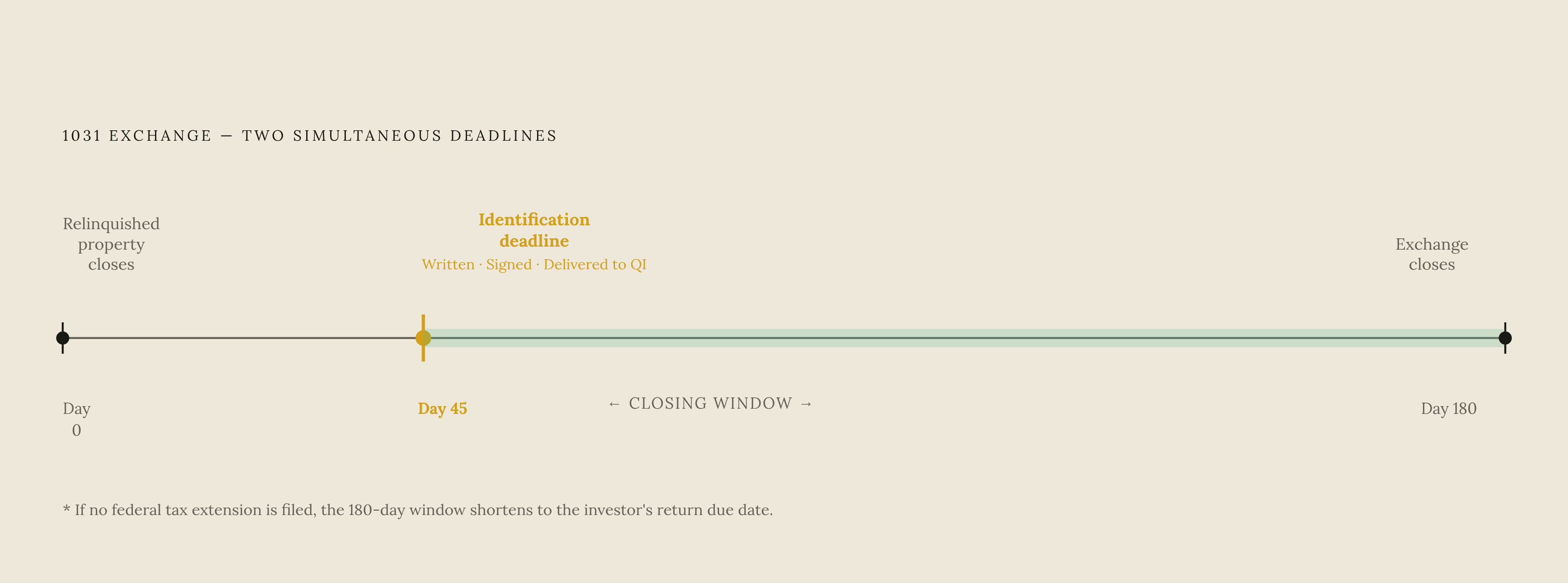
Why finding a direct replacement property within 45 days is harder than it looks
The deadline is unforgiving, and the market the deadline operates in moves at its own pace, which is slower than 45 days almost by nature. Real estate transactions require sourcing a property, underwriting it, negotiating price and terms, and clearing title, and none of that process bends to accommodate an exchange calendar. An investor who closes on the relinquished property and only then starts searching for a replacement is running due diligence, negotiation, and identification at the same time, all while the sale of the original property may still have loose ends. That is a hard way to do a real estate deal under any circumstances, let alone one with a hard deadline attached.
The standard advice is to have a replacement property under contract before Day 45 even arrives, so identification is a formality rather than a scramble and due diligence can happen after the list is locked. That advice is sound, but it assumes a replacement can be sourced and put under contract before the exchange itself is complete, which is often not realistic when the timeline for the original sale shifts, as sale timelines frequently do. Compounding the problem, the universe of qualifying replacements is narrower than it used to be. Section 1031 survived the One Big Beautiful Bill Act intact, carrying forward the limitation the Tax Cuts and Jobs Act imposed in 2018: the exchange only works for real property, meaning domestic real estate held for investment or for use in a trade or business. Personal property, equipment, and other asset classes that once qualified no longer do. The investor's search is confined to real estate, and real estate does not transact on a 45-day schedule.
The Delaware Statutory Trust as Qualifying Replacement Property
A Delaware Statutory Trust is a legal entity, formed under Delaware law, through which a sponsor acquires one or more properties and then sells fractional beneficial interests in that trust to investors. Each investor who buys in holds a proportional ownership stake in the trust's underlying real estate, not a share in a fund that merely owns real estate as one of its assets. That distinction is what gives the DST its standing under Section 1031.
The IRS settled the question of whether a DST interest counts as real property for exchange purposes in Revenue Ruling 2004-86. That ruling established that a properly structured DST interest is treated as a direct interest in real property, with the investor treated as owning a pro-rata share of the underlying real estate itself rather than a security issued by an investment vehicle. A separate Revenue Procedure provides the comparable authority for tenant-in-common interests, deeded fractional ownership arrangements distinct from trust interests. Both structures rest on IRS guidance that blesses their use in a like-kind exchange, even though they operate in materially different ways, a difference taken up later in this piece.
DSTs are sold as private placements, typically under Regulation D Rule 506(b) or 506(c), and that means they're only available to accredited investors, those meeting the net worth or income thresholds a financial regulator sets for that status. That limits who can use a DST, but for the investors who qualify, the structure solves a problem the open market cannot: the properties inside a DST have already been found, underwritten, and purchased by the sponsor before any investor interest is ever sold. That pre-acquisition is the detail that makes everything else in this article possible.
How DSTs Close in Days Rather Than Months
Because the sponsor has already done the work of finding, underwriting, and closing on the underlying property, an investor who identifies a DST interest is not buying raw real estate. The investor is buying a beneficial interest in an asset the sponsor already owns. There's no property search to run, no seller to negotiate with, no title contingency hanging over the deal, and no loan underwriting tied to the investor's personal credit or balance sheet. All of that happened before the DST interest was ever offered.
That difference changes the entire timeline. A direct acquisition can take months from first contact to closing table. A DST interest, once identified, can close in a matter of days, which puts it comfortably inside even a tight 180-day exchange window, even when the identification happens close to Day 45 itself. That speed is what makes the DST useful as a planning tool, not just an emergency option. An investor who has not locked down a direct replacement by Day 30 or Day 35 can identify a portfolio of DST interests on the same identification list as any direct-property candidates still in play, preserving every option without giving up on the direct purchase if it still comes together before the deadline. Identifying a DST alongside a direct property is a deliberate hedge that the identification rules were built to allow.
The scenario plays out in practice when an investor reaches Day 44 with no direct replacement under contract. At that point, the investor can identify DST offerings that are available that day, complete due diligence on a portfolio the sponsor already owns, and close the DST investment within what remains of the 180-day window. The exchange that looked lost on Day 43 is preserved on Day 44 because the DST's structure was built for exactly this kind of timing pressure.
Where DSTs and TICs differ, and which one works when time is short
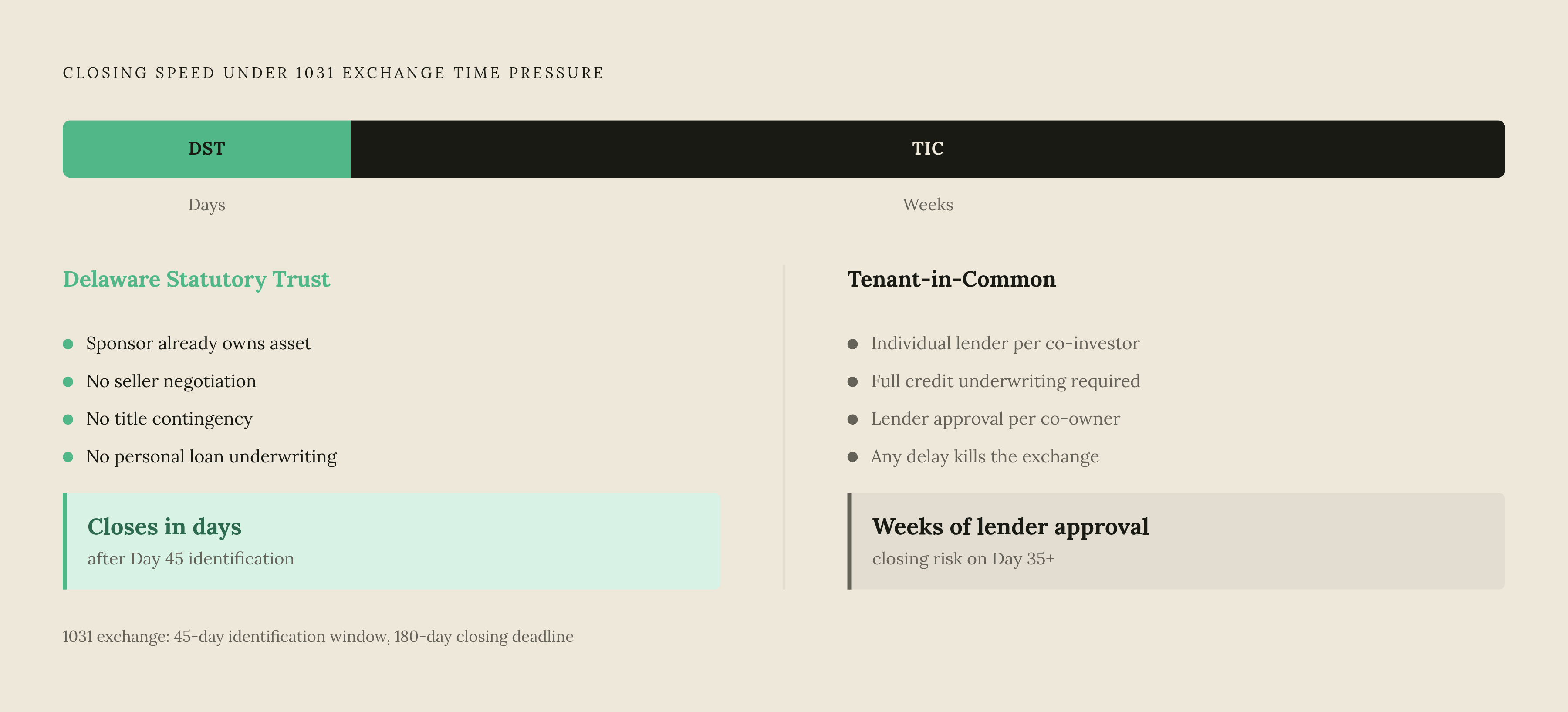
DSTs and tenant-in-common interests share the same IRS authority and the same like-kind status, but they are not interchangeable, and the differences matter most when the 45-day clock is the thing driving the decision. A TIC arrangement gives a limited number of co-investors deeded fractional interests in a single property. Each investor appears on title, and depending on the governing agreement, each may have a direct voice in decisions like capital calls, refinancing, or a future sale. A DST works differently: up to 499 beneficial interest holders can participate, governance sits with the sponsor acting as trustee, and investors hold trust interests. The sponsor runs the asset, and the investor's role is passive.
That governance difference has practical consequences beyond philosophy. A TIC with dozens of co-investors needs those investors to agree on major decisions, which can slow down or complicate how the asset gets managed over time. A DST concentrates that authority in the sponsor, which is a cleaner arrangement for an investor who wants income without operational involvement. The sharper difference, for the purposes of a time-pressured exchange, is how each structure closes. TIC investments typically require a lender to approve and underwrite each individual co-investor, a process that takes considerably longer than closing a DST interest. That makes a TIC a poor fit for an investor whose exchange is running out of runway, even though TICs remain a reasonable structure in other contexts, including certain institutional arrangements where the co-investors are known to each other and lender relationships are already established.
For an investor at Day 35 or later still searching for a qualifying replacement, the DST's passive structure and its already-owned assets make it the structurally sound choice. The TIC's dependence on individual lender approval introduces a closing risk the DST simply does not carry.
What owning a DST interest means for the investor
Completing an exchange into a DST does two things at once: it preserves the tax deferral the investor was trying to protect, and it converts what may have been an actively managed property into a passive income stream. The sponsor runs the asset, and the investor receives distributions in proportion to the size of the beneficial interest purchased.
That passivity is often the point, not a side effect. An investor who steps out of a DST exchange takes on no landlord responsibilities: no tenant calls, no maintenance decisions, no votes on capital calls. For someone who was actively managing the relinquished property and exchanged out of it partly to be free of those obligations, the DST delivers exactly that outcome. The like-kind qualification also runs in both directions. An investor holding a DST interest can, in a later exchange, trade out of it and into a directly owned property, so stepping into a DST now does not foreclose a return to active ownership down the road if circumstances or preferences change.
The estate planning consequence deserves its own attention because it's frequently overlooked. Under IRC Section 1014, heirs who inherit a DST interest, or any real property carried forward through a chain of 1031 exchanges, receive a stepped-up basis at the original owner's death. That step-up can eliminate every dollar of gain that was deferred across however many exchanges preceded it. The deferral that began as a temporary postponement of tax can become, for the investor's estate, permanent.
The Qualified Intermediary's role in a DST exchange
None of the DST rescue strategy works unless a Qualified Intermediary is already in place before the relinquished property closes. The QI has to be engaged in advance, with the exchange agreement signed and assignment language written into the sale contract itself. If the investor receives the sale proceeds directly, even briefly, the exchange is void, and there is no way to fix that after the fact. The rule exists precisely because the IRS treats any access to the funds, however momentary, as receipt of the gain.
Treasury Regulation Section 1.1031(k)-1(k) disqualifies anyone who has served as the investor's agent in the two years before the exchange, a list that includes the investor's own attorney, CPA, real estate broker, and employees. An independent QI isn't a best practice here; the regulation requires one. What makes the choice of QI harder is that QIs are not regulated at the federal level, and most states impose no licensing, bonding, or solvency requirements on them. The safety of the investor's exchange funds rests entirely on how that specific QI chooses to operate. Before signing an exchange agreement, investors should confirm whether the funds sit in a segregated account rather than commingled with the QI's own operating capital, whether FDIC coverage extends to the full amount of the exchange proceeds, and whether the QI carries a fidelity bond and errors-and-omissions insurance. Standard FDIC coverage per depositor falls well short of what most real estate transactions involve, and QI insolvency has already cost investors millions of dollars in cases where proceeds sat in accounts that were not properly segregated. Asking how funds are held and what coverage limit applies is a basic condition of using the service, not an extra step.
Fee structure matters too. The traditional QI model charges an administrative fee when the exchange is set up and then keeps all the interest earned on the investor's funds for as long as the exchange is open. On a large exchange, that withheld interest can add up to a meaningful sum that economically belongs to the investor.
Responsiveness becomes especially important once a DST rescue is in motion, because the investor is often identifying and closing under real time pressure, sometimes outside normal business hours. A QI structure where a single Exchange Officer with real experience handles the file from the first call through closing, without commissioned salespeople or handoffs between departments, removes a layer of friction from a process that has none to spare. Support available seven days a week, from 8am to midnight ET, matters directly when an investor is finalizing a DST identification against a deadline that doesn't pause for a weekend. A real-time portal that keeps the investor's broker, wealth manager, and title company all working from the same information is similarly useful in a DST exchange, where the sponsor, the QI, the investor, and the title company all have to coordinate within a timeline that leaves little room for miscommunication.