Deferred Sales Trusts as an Alternative to 1031 Exchanges
Deferred Sales Trusts spread capital gains taxes across years for non-real-estate assets.

The letters "DST" carry two unrelated meanings in real estate and tax planning, and mixing them up sends investors down the wrong research path before they've even started. In the world of 1031 exchanges, "DST" almost always stands for Delaware Statutory Trust, a passive vehicle that lets investors own a fractional share of real estate and qualifies as replacement property inside a 1031 exchange. It's sold as a security, with all the disclosure and suitability requirements that implies.
This article is about something else entirely: the Deferred Sales Trust. It has no tie to Delaware, no relationship to the 1031 exchange rules, and no overlap with Reg D securities offerings. It operates under IRC Section 453, the installment sale provisions of the tax code, and it answers a different question than the one a 1031 exchange answers. Getting this distinction right at the outset matters, because the rest of this piece depends on it.
How a 1031 exchange defers taxes
A 1031 exchange lets an investor sell real property, reinvest the proceeds in other real property, and defer capital gains tax, depreciation recapture, and the net investment income tax, all at once, with no dollar cap. Done right and repeated across a career, it is one of the most complete tax deferral tools available to real estate investors. The deferral comes with strict conditions, though, and none of them bend for circumstance.
You can only use real estate you hold for investment or business use. The Tax Cuts and Jobs Act tightened this further by removing personal property from eligibility, so equipment, vehicles, and other non-real-estate assets that once qualified no longer do. Two deadlines then govern every exchange from the moment the original property closes: 45 days to identify replacement property, and a closing window that can end even sooner if the investor's tax return due date arrives first and no extension has been filed. The 45-day clock and the closing deadline leave no room for negotiation or delay, so you need a technology-powered Qualified Intermediary available seven days a week until midnight ET. Deferred.com, for instance, can open an exchange in as little as five minutes when a replacement property turns up unexpectedly, including for investors already sitting at the closing table for their sale.
Every dollar of the sale proceeds has to pass through a Qualified Intermediary first. The investor never takes possession of the funds at any point in the process, and the IRS offers no flexibility here: no extensions for financing that falls through, no grace period for a seller who defaults, no accommodation for title problems or natural disasters. If you miss the deadline for any reason, the full tax bill comes due. Held correctly over a career, the deferral can become permanent. If you keep exchanging and hold property until death, you pass it to heirs with a stepped-up basis, and that erases the deferred gain. No one ever pays that tax. As of 2026, this full, uncapped deferral is still on the books, though lawmakers have floated proposals to limit or eliminate it more than once.
What a 1031 exchange cannot do is just as important as what it can. It has no application to the sale of a business, no application to stocks or bonds or intellectual property, and no mechanism for letting an investor step out of the real estate market and wait for better conditions. Those gaps are exactly where the Deferred Sales Trust becomes relevant.
How a Deferred Sales Trust defers taxes
A Deferred Sales Trust uses the installment sale rules under IRC Section 453 to spread capital gains recognition across the years in which the seller receives payments. Each step in the mechanism follows in sequence, and each one carries legal weight.
The seller first sets up an irrevocable trust, and an independent third-party trustee administers it. That trustee cannot be the seller, a spouse, or any related party as defined under IRC 267. The seller then transfers the property, typically held inside an LLC, to the trust in exchange for a promissory note. The trust, not the seller, sells the property to the end buyer. Because the trust's basis in the property equals its sale value at the moment of that resale, no capital gains tax is triggered at the trust level. The trust holds the cash from the sale and reinvests it, and as it makes principal payments back to the seller under the note, the seller recognizes capital gains only on the profit portion of each payment. White Coat Investor lays out the arithmetic: a seller receiving payments over ten years pays tax only on the profit share of each year's principal, rather than facing the entire gain in the year of sale.
The note itself usually runs for ten years, interest-only with a balloon payment at the end, and it has to carry a minimum interest rate tied to the Applicable Federal Rate under the IRC provisions that govern below-market loans. The interest portion of each payment is taxed as ordinary income, separate from the capital gains spread out through the principal payments.
A Deferred Sales Trust is not bound to real estate the way a 1031 exchange is. It can hold businesses, stocks, bonds, intellectual property, and other appreciated assets, which makes it a tool entrepreneurs and investors with mixed portfolios can use in situations a 1031 exchange simply doesn't reach. Two categories stay off-limits regardless: publicly traded securities, barred under IRC 453(k)(2), and inventory, barred under IRC 453(b)(2)(A).
None of this comes free. Phoenix Strategy Group puts setup costs in the thousands of dollars, with ongoing annual fees on top of that, and a more detailed practitioner estimate points to an even higher one-time setup cost paired with an annual trustee fee. A 1031 exchange charges no fees and lets you keep any interest earned on funds held during the exchange, but a Deferred Sales Trust typically costs thousands to set up plus ongoing trustee fees year after year, so it tends to make sense only for large transactions where the tax deferral clearly outweighs what it costs to maintain. The trust also has to file its own tax return annually, adding a layer of administrative work that a 1031 exchange does not require.
The IRS has never issued a Revenue Ruling or a published Tax Court opinion that blesses or condemns the Deferred Sales Trust by name. The structure sits in a gray area of the tax code, used by practitioners but not formally endorsed or rejected by the agency that would ultimately audit it.
If you're a real estate seller, you need to understand one more limitation before choosing this route. Depreciation recapture is taxed in the year of sale no matter how the Deferred Sales Trust is structured. It does not spread across installment payments the way the capital gain does, which erodes much of the deferral benefit for anyone selling a heavily depreciated property.
Finally, the structure demands a real loss of control. The trust is irrevocable. You cannot revoke it, cannot direct how the trustee invests the proceeds, and cannot access a lump sum of the money early.
Flexibility, timing, and asset scope differences between the two structures
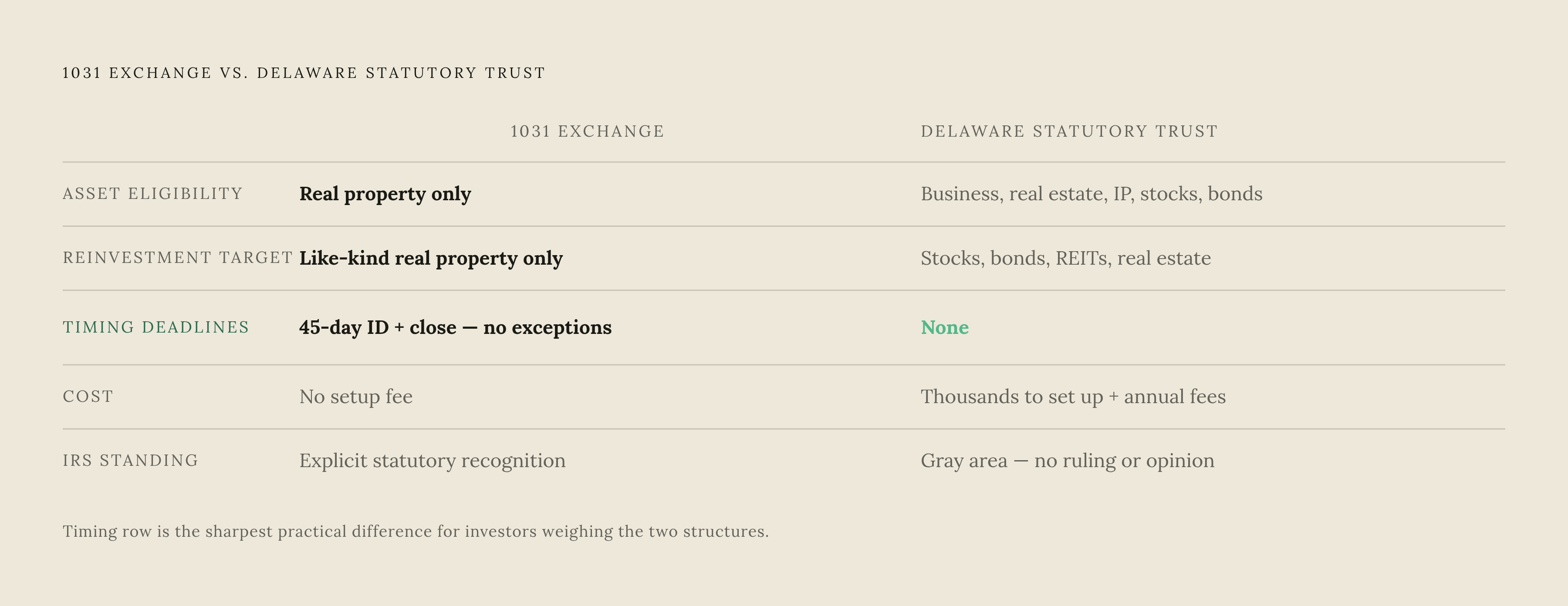
If you're a real estate investor ready to redeploy capital immediately, a 1031 exchange gives you the strongest, most certain deferral you can get. A Deferred Sales Trust gives up some of that certainty in exchange for flexibility on what the investor can hold next, where the money can go, and when the reinvestment has to happen, and that flexibility comes with a real cost in fees, control, and IRS exposure.
Asset eligibility marks the clearest line between them. A 1031 exchange only covers real property that you hold for investment or business use. A Deferred Sales Trust can cover businesses, real estate, intellectual property, stocks, and bonds, with only publicly traded securities and inventory excluded. For an investor who has no intention of leaving real estate, this flexibility adds nothing of value. For a business owner selling a company, or an investor holding a mix of asset types, it can be the entire reason to choose the DST over any alternative.
The reinvestment target follows the same divide. A 1031 exchange requires you to put proceeds into like-kind real property of equal or greater value, with no exceptions. A Deferred Sales Trust can hold stocks, bonds, mutual funds, REITs, or more real estate, so the investor isn't locked into the asset class they're exiting. Capital Gains Tax Solutions frames this as the structure's central appeal for investors ready to diversify out of real estate entirely: unlike a 1031-qualifying Delaware Statutory Trust, a Deferred Sales Trust permits reinvestment in stocks, bonds, mutual funds, and other assets that have nothing to do with real property.
Timing works differently too. The 1031's identification and closing clocks start the moment the relinquished property closes, and nothing pauses them, not financing delays, not market conditions, not personal circumstance. A Deferred Sales Trust has no identification deadline and no acquisition deadline. The seller can let the trust hold proceeds and wait for better market conditions before directing new investments, and some practitioners call this optimal timing. Pennington Law points out that this lets an investor step out of the real estate market for a while if a downturn looks likely, a move the 1031 exchange structurally forecloses.
Estate planning goals push the two structures in different directions as well. The 1031 exchange rewards an investor who keeps exchanging for life: continued deferral, then a stepped-up basis at death that erases the accumulated gain for good. That outcome has no real equivalent in the Deferred Sales Trust. The trust corpus sits outside the seller's estate, while the promissory note itself remains an estate asset, and the structured payments can serve wealth transfer planning in their own way, but nothing in the DST eliminates the deferred gain permanently the way the stepped-up basis does.
Income during the deferral period is another point of difference. A 1031 exchange produces no income by itself while the exchange is pending. A Deferred Sales Trust can be built to generate scheduled installment income from the start, which can suit an investor who needs cash flow from a property they've just sold.
The four investor situations where each tool is the clearer fit
Neither structure wins across the board. Which one fits depends on the asset being sold, what the investor plans to do with the proceeds, how much time pressure they're under, their estate planning goals, and how comfortable they are with a structure the IRS has never formally ruled on.
A real estate investor planning to stay in real estate should lean toward the 1031 exchange. It costs less, carries explicit IRS recognition, defers the full tax bill including depreciation recapture, and opens the door to eliminating the gain entirely at death through stepped-up basis. For real estate investors whose assets fit cleanly into the 1031 framework, with no depreciation recapture complications, the simplicity and cost structure of the exchange make it the more transparent choice. A no-fee intermediary that shares the interest earned on exchange funds and publishes its rates openly can run the exchange with institutional-grade security for those funds and a dedicated senior officer guiding you, cutting out the friction and hidden costs that come with a Deferred Sales Trust. Deferred.com is one such qualified intermediary, charging no fee and sharing interest with clients. If you're this investor, the DST adds cost and IRS uncertainty without buying you anything of real value in return.
A real estate investor ready to leave the asset class behind sits in a different position. A 1031 exchange requires you to reinvest in like-kind real property, so you have no path to diversify into stocks, bonds, or anything else while keeping the tax deferred. A Deferred Sales Trust allows the trust to reinvest in almost any asset class, which makes it the more workable tool for someone trying to wind down their real estate exposure for good.
If you're a business owner, or you hold appreciated assets outside of real estate, a 1031 exchange isn't available to you. The structure simply doesn't apply to the sale of a business, intellectual property, or most other asset categories. A Deferred Sales Trust is the only installment-based deferral option on the table for these sellers, aside from the standing exclusions for publicly traded securities and inventory.
If you're facing timing risk on a 1031 exchange, or watching one fall apart, you need to know the limits of each tool before it's too late to act. If you can't identify suitable replacement property inside the 45-day window, or you run into a seller default or title problem that will blow through the closing deadline, you face the full capital gains tax bill under the 1031 rules, and the IRS offers no relief. A Deferred Sales Trust set up before the relinquished property closes removes that clock entirely, so you get time to find the right reinvestment without a deadline forcing a decision. That timing matters enormously: the trust has to be in place before the original sale closes. It offers no way to rescue an exchange that has already failed.