Passing 1031 Exchange Property Through an LLC to Heirs
LLC members who inherit may not be able to exchange property the way the original owner could.

Passing 1031 exchange property through an LLC to heirs requires planning for both the ownership interest and the real estate. The structure must preserve both the step-up in basis at death and the heirs’ ability to exchange later. Those benefits do not necessarily travel together, and the decisions that protect them are best made before the inheritance occurs.
Why holding 1031 exchange property inside an LLC changes what heirs actually inherit
An LLC membership interest is a separate asset from the property the entity owns. When the owner dies, heirs receive that interest rather than direct title to the underlying real estate. The LLC changes what transfers, how the tax rules apply, and which decisions heirs can make independently.
The distinction between single-member and multi-member LLCs is particularly important. A single-member LLC is treated as a disregarded entity, so the IRS looks through it to the individual owner for tax purposes. A multi-member LLC introduces a separation between the membership interest and the real estate that matters for both basis and exchange eligibility. The legal form of the inheritance and its tax treatment must therefore be considered together.
That separation determines how the “swap till you drop” strategy works. A series of exchanges can defer gains while the investor is alive, and the step-up at death can wipe out the gains built up along the way. But the result depends on how the property is held when the owner dies. An estate plan based only on what the property is worth can miss the rules for the entity that owns it, which shape what heirs receive.
How the step-up in basis interacts with LLC-held exchange property
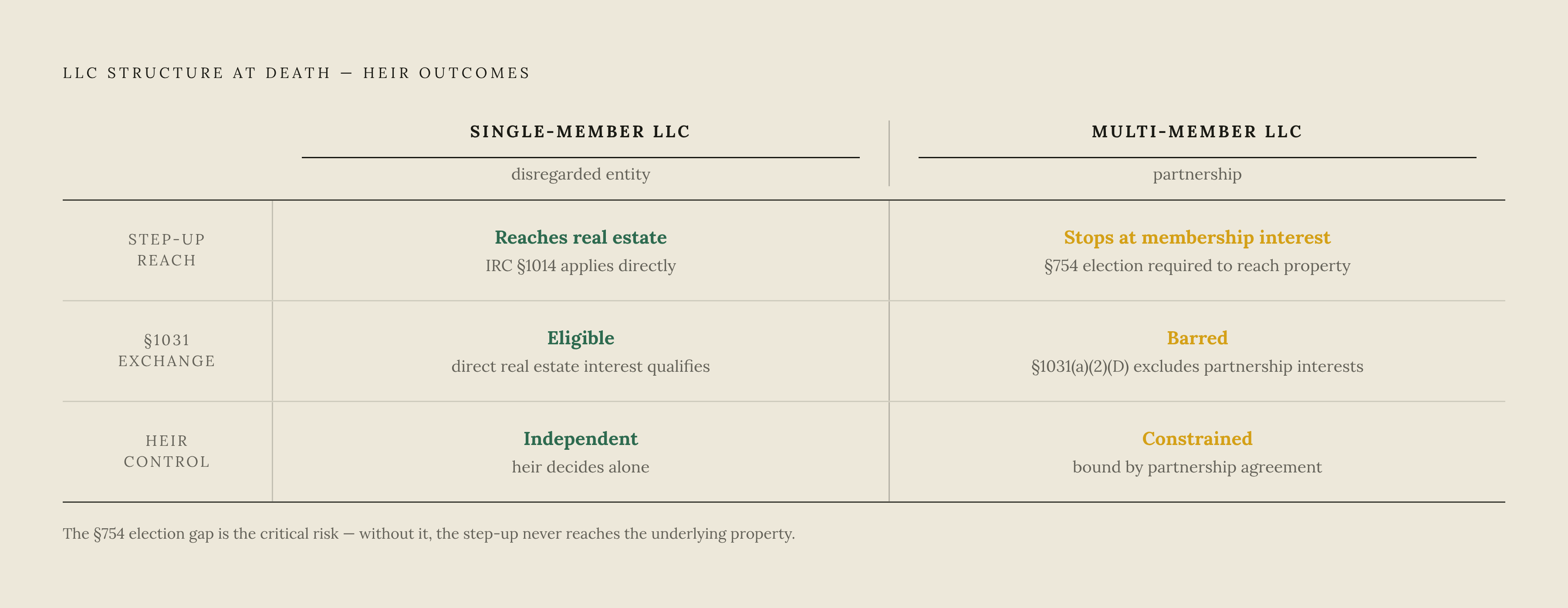
IRC Section 1014 supplies the tax benefit at the center of this strategy. In the clean case, inherited property takes a basis equal to its fair market value on the date of death. That reset can wipe out capital gains deferred through past exchanges, depreciation recapture built up from those properties, and state income tax on both. If heirs sell at that date-of-death value, there is no capital gain above the new basis.
Property owned individually or through a revocable living trust receives the step-up directly, and a disregarded single-member LLC avoids the separation between the owner and the property for this purpose. In a partnership or multi-member LLC, however, the inherited membership interest may step up without a corresponding adjustment to the underlying real estate. A Section 754 election allows the entity to adjust the basis of its assets to reflect the inherited interest’s step-up. Without that election, heirs may not receive a full basis reset on the property itself.
Community property treatment can increase the benefit. When one spouse dies, the survivor’s basis in qualifying community property steps up on the entire property, including both the survivor’s half and the deceased spouse’s half. The nine community property states are Arizona, California, Idaho, Louisiana, Nevada, New Mexico, Texas, Washington, and Wisconsin. The plan must account for both community property treatment and how the LLC is set up.
The step-up also remains dependent on tax law. The July 2025 tax law left Section 1014 unchanged, but an estate plan that relies on it should account for the possibility of congressional changes. The planning objective is therefore not merely to assume a future reset. It is to establish how that reset would reach the inherited asset under the structure in place.
Why multi-member LLCs create exchange compliance problems that survive the original owner's death
A basis adjustment does not convert an LLC membership interest into real estate. The partnership-interest exclusion under IRC §1031(a)(2)(D) remains a separate constraint on heirs who inherit interests in a multi-member LLC. Those interests are personal property rather than direct ownership of real estate and cannot be exchanged for replacement real estate on a like-kind basis.
If the property remains inside the entity, the entity must sell and exchange the real estate rather than the heirs exchanging their membership interests. An heir who wants cash and an heir who wants continued deferral cannot simply make separate exchange decisions about the same LLC-held property. They must reach agreement, buy each other out, or undertake a more complex restructuring.
Direct ownership as tenants-in-common presents a different decision structure. Each owner holds an undivided interest in the real estate and can decide independently whether to sell or hold. How the property is owned shapes the heirs’ choices even when each heir starts with the same share of its value.
A full step-up may reduce the immediate tax pressure to resolve those differences. It does not remove the exchange restriction if the property later appreciates above its stepped-up basis. At that point, an heir who wants to sell an LLC interest and reinvest faces the same exclusion as before the original owner’s death.
The drop and swap as the primary workaround for multi-member LLC owners planning ahead
The drop and swap addresses that restriction by changing what the members own before a sale. The LLC distributes the property to its members in proportion to their interests, and each member becomes a tenant-in-common holding direct real estate. That change allows the exchange decision to move from the entity to the individual owners.
Owners who exchange use their own qualified intermediary and seek replacement property on their own timeline. For estate planning, the value is the separation of decisions that would otherwise remain tied together inside the LLC. One heir can take cash while another defers gain into a new investment property.
The restructuring is viable, but it is not a guaranteed route around the partnership-interest exclusion. The IRS can invoke the step-transaction doctrine to treat the distribution and sale as one transaction when they occur close together. There is no federal safe harbor specifying how long the property must be held after the distribution. A particular interval therefore cannot be presented as automatic protection from a challenge.
A distribution made well before the sale, with careful attention to partnership tax rules, is generally more defensible than one arranged near closing. A rushed drop and swap is among the commonly challenged structures in the 1031 field. Its usefulness depends on preparation before the transaction becomes urgent.
What happens to a live 1031 exchange when the LLC owner dies mid-transaction
Death after the relinquished property sells but before the replacement closes does not necessarily end an exchange. Completion depends on satisfying the same-taxpayer rule through the estate or continuing entity structure, rather than shifting the transaction to heirs after distribution. The 45-day identification window and the 180-day closing window continue running from the original sale date.
The structure that began the exchange governs the succession analysis. A revocable living trust can generally complete a pending exchange, but its disregarded status during the grantor’s life does not settle every question after death. Where the estate must complete the exchange through probate, the heirs cannot simply finish it after receiving their interests. JTC Group notes that precedent in this situation is limited, making competent tax counsel and a qualified intermediary essential. If the estate cannot complete the exchange, the intermediary returns the funds to the estate and the original sale becomes taxable.
Advance document preparation preserves the chance to finish on time. Estate documents should expressly authorize the successor trustee or executor to complete a pending 1031 exchange. The estate representative should also be able to locate the intermediary’s contact details, identification letters, and exchange agreement quickly. Authority to act and access to the paperwork must be ready before a running deadline makes either problem decisive.
Delaware Statutory Trusts as an alternative structure for passing fractional interests cleanly to multiple heirs
A Delaware Statutory Trust offers a different approach to fractional ownership. Its beneficial interests are treated as direct ownership of real estate for federal tax purposes. Under current law, inherited DST interests get the same step-up in basis as real estate owned directly, without the complication that comes with a multi-member LLC. The partnership-interest exclusion does not apply in the same way because the tax treatment of the interest is different.
That treatment makes the DST relevant to both estate design and replacement-property selection. Fractional interests can divide cleanly among multiple heirs. Three children, for example, can inherit equal shares of everything rather than negotiate over which child receives which building. Each interest an heir receives gets its own step-up to fair market value.
DST investors are passive and cannot make management decisions about the underlying property. Their interests are also illiquid, with no established secondary market comparable to publicly traded assets.
A DST is consequently well suited to heirs who want a passive, income-producing real estate position. It is poorly suited to heirs who want operational control or near-term liquidity. Its estate planning advantage lies in how it treats and divides the inherited interests. That distinction keeps the comparison with an LLC grounded in both ownership rights and tax treatment.
Structural decisions investors should make now to preserve heirs' options later
Investors should first check whether the way they own the property fits what they want to leave their heirs. Direct ownership, a revocable living trust, and a single-member LLC preserve the cleanest path to a step-up with fewer entity complications. A multi-member LLC requires attention to the Section 754 election so that the adjustment to an inherited membership interest can reach the underlying real estate. That election and future exchange eligibility are separate questions, and both need an answer before the estate plan is treated as complete.
The documents must then reflect the chosen structure consistently. Trust language should be reviewed because some provisions can reduce the expected step-up. The exchange documents and trust documents must name the same entity as the holder of the replacement property. Estate documents should also grant the successor trustee or executor authority to complete an exchange already underway. These provisions connect the intended tax result to the person who must carry out the transaction.
Heirs need an explanation of the plan while there is still time to address conflicting goals. They should know which properties they will inherit, their approximate value, and how date-of-death fair market value affects their basis. Their choices may include holding, selling near the stepped-up basis with little or no tax, or pursuing a later exchange after meaningful appreciation, subject to the ownership structure.
Late-career investors also face a timing decision about further exchanges. Because the step-up can eliminate prior deferred gain without another exchange, a fresh transaction undertaken in poor health may not change what heirs owe. Holding the current property may allow the step-up to do the same work without another exchange’s complexity and cost. The appropriate decision follows from the estate objective.
These choices are manageable, but they require coordinated implementation. An estate attorney aligns succession authority and trust provisions, tax counsel addresses basis and entity treatment, and a qualified intermediary coordinates the exchange side. Bringing that team into the planning before death or a pending sale preserves time to resolve structural conflicts.