Economic Impact Studies on 1031 Exchange Elimination
Eliminating 1031 exchanges would raise short-term revenue but cost jobs and GDP long-term.

If you sell investment real estate and acquire replacement property through Section 1031 of the Internal Revenue Code, you can defer federal capital gains tax, depreciation recapture, state tax in conforming states, and the net investment income tax. The combined liability can be substantial relative to the proceeds available for reinvestment, which is why the provision shapes so many transaction decisions. Eliminating it is not a straightforward matter of collecting revenue sooner rather than later.
The mechanism operates under strict conditions. A qualified intermediary must hold all sale proceeds, and the replacement property must be identified in writing within a short window after the relinquished property closes. The replacement purchase must then close within a longer statutory deadline. Both clocks run from the sale date, so the exchange is a disciplined process rather than an open-ended option. It is common for qualified intermediaries to earn two-thirds of their income from realized interest on exchange funds, a detail that underscores how integral the holding period is to the structure.
The tax is deferred, not eliminated. The relinquished property's carryover basis transfers to the replacement property, embedding the deferred gain in the new asset. That gain becomes due on a future non-exchange sale, so the government collects eventually. If the government collects sooner instead, does it get more or less total revenue and economic activity? The recurring claim in budget proposals, that 1031 amounts to "indefinite deferral," sets up the central tension that the studies directly test. The research sections that follow resolve it.
How repeal proposals have been framed by the executive branch, and what revenue they claimed to raise
Budget proposals to restrict or eliminate Section 1031 have recurred across multiple fiscal years, consistently framing the provision as a "loophole" that lets real estate investors defer tax "indefinitely." The Biden administration's proposed 2025 budget included a cap on deferred gain at $500,000 per taxpayer per year, or $1,000,000 for married filers filing jointly, with the administration estimating that the change would raise revenue over ten years. The Treasury Department's Green Book stated that the change "would raise revenue while increasing the progressivity of the tax system."
That assertion, revenue gains alongside distributional fairness, is the specific claim the academic and industry research pushes back against on both counts. The framing matters because it has been the consistent thread across successive proposals. It positions 1031 as an escape hatch for sophisticated investors, and it implies that closing the hatch would be both fiscally responsible and equitable. The evidence tells a different story on each point.
JTC Group's FAQ on the 2024 budget proposal acknowledges that eliminating Section 1031 would likely raise revenues in the short term, and that is why the proposal fits alongside other budget measures. But the same analysis says that short-term gain is short-sighted when you weigh it against long-term economic consequences. The distinction between collecting revenue now and sustaining the conditions that generate revenue over time is the core of the dispute.
What the macroeconomic evidence shows about jobs, income, and GDP tied to 1031 activity
The Ernst & Young 2022 macroeconomic study provides the most comprehensive aggregate estimate of what Section 1031 activity supports. The study found that 1031 exchanges sustained nearly one million jobs and tens of billions of dollars in labor income in the United States during 2021, while generating tens of billions more in value added to U.S. GDP. Those figures establish the scale of economic activity that depends, directly or indirectly, on the deferral mechanism. They are not marginal numbers.
The Tax Foundation's analysis, cited by Sortis, projects that eliminating 1031 would produce a meaningful reduction in U.S. GDP, a reduction in wages, and the loss of hundreds of thousands of jobs over the long term. The analysis concludes that those losses would outpace the projected short-term revenue gain. The implication is that repeal trades a durable economic base for a one-time fiscal benefit, a trade that looks less attractive the longer the horizon.
The studies also make an implicit argument about the revenue arithmetic itself. The economic activity that 1031 facilitates generates its own tax revenue through income taxes, payroll taxes, and transaction-related levies. When that activity contracts, the tax base shrinks with it. The apparent revenue gain from repeal is therefore partly illusory, offset by the fiscal contribution that disappears alongside the exchanges. The macroeconomic case is not simply that 1031 supports jobs. It is that those jobs fund the very tax collections repeal is supposed to increase.
What the microeconomic research shows about how investors actually use 1031 — and what they do without it
The Ling and Petrova microeconomic studies, based on analysis of a large commercial real estate transaction dataset, directly test the claim that 1031 is a mechanism for indefinite deferral by the wealthy. The data contradicts that claim. A strong majority of exchangers completed one 1031 exchange and then sold the replacement property in a taxable sale. The same research overview establishes that nearly nine in ten exchanged replacement properties are eventually disposed of in a taxable transaction. The deferred tax is collected, not permanently avoided.
The behavioral findings are equally significant. If you remove the deferral mechanism, investors hold assets longer, and that reduces liquidity across the market. They take on more leverage to finance acquisitions without the equity that a clean, tax-deferred sale would have freed. And they make smaller follow-on investments. Each of these changes reduces economic activity in sectors where 1031 is commonly used, and they compound one another.
The lock-in effect is the microeconomic core of the argument. When a tax bill is triggered by sale, investors who cannot defer it are effectively trapped in assets that no longer fit their strategy or the market. Capital goes to suboptimal uses not because investors lack better options but because the cost of moving is artificially high. That misallocation across the economy is what the macroeconomic studies capture in aggregate. It is not a function of raw transaction volume alone. It is the result of capital staying where it should not be.
Why the revenue arithmetic from repeal is less favorable than the proposals claim
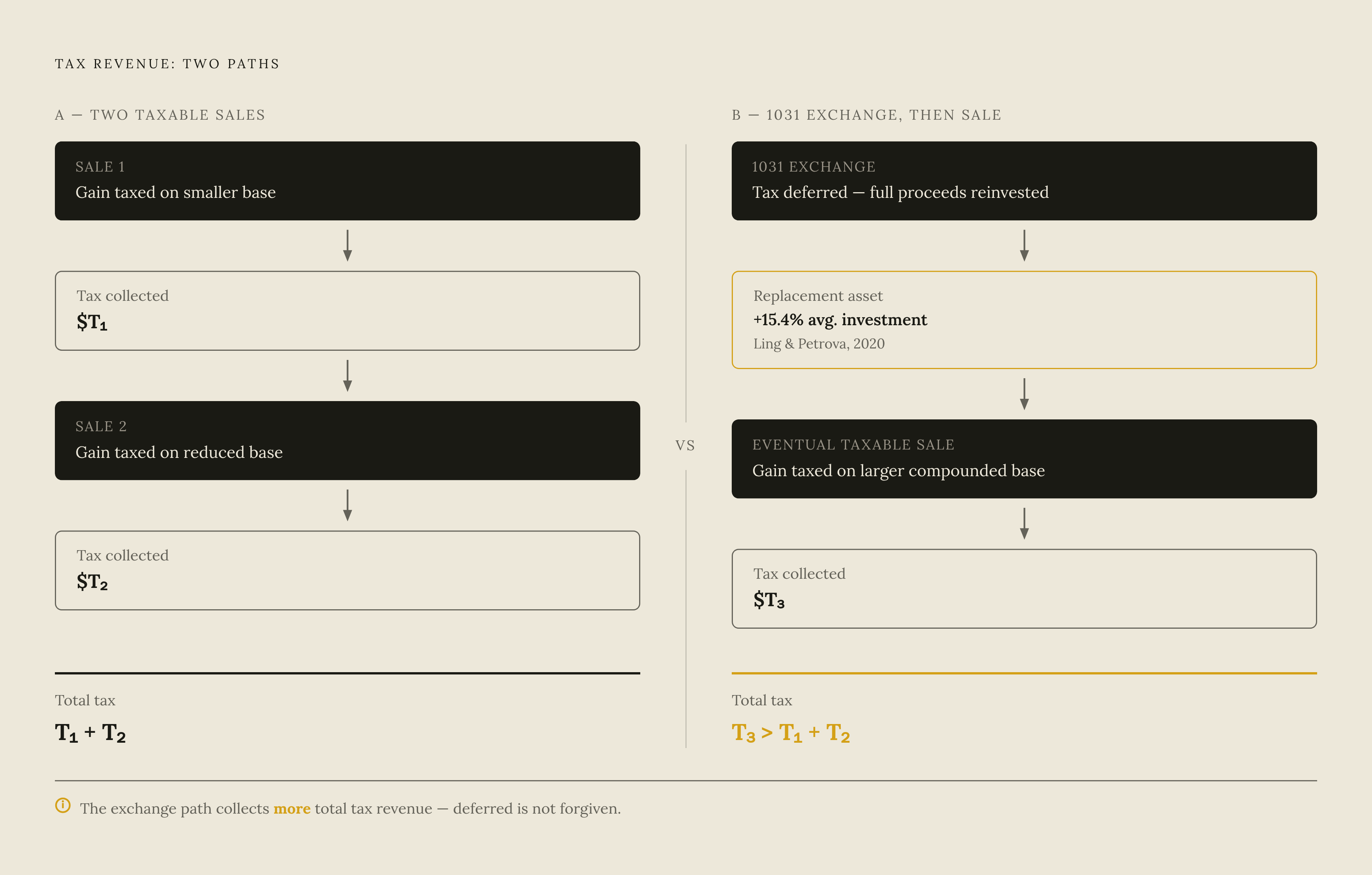
A study cited by JTC Group found that taxes paid from an exchange followed by an eventual taxable sale are higher than taxes collected from two ordinary sales conducted without a 1031 exchange. The reason is straightforward. Allowing reinvestment generates more wealth, and that wealth produces a larger taxable gain when the tax is ultimately collected.
The mechanism runs through compounding. Deferral lets the full pre-tax proceeds grow in the replacement asset. A larger asset base at the time of eventual sale means a larger taxable gain, and a higher absolute tax payment, even at the same rate. The government foregoes immediate revenue but collects on a bigger number later.
This reframes the policy choice. The short-term revenue gain from repeal is real but front-loaded. The government collects earlier, but collects less in total over the investor's holding cycle, and the economic activity that reinvestment would have generated does not occur. Repeal is not a revenue-positive decision over a long horizon. It is a decision to collect a smaller amount of tax sooner at the cost of economic activity and a larger future payment. The arithmetic that appears favorable in a ten-year budget window looks different when the full holding cycle is considered.
Who actually uses 1031 exchanges, and why the "tax break for the wealthy" framing does not hold up
Budget proposals have framed 1031 as a provision that "overwhelmingly benefits the rich." The Ling and Petrova transaction-level data shows a different pattern. The majority of 1031 users complete a single exchange before returning to taxable sales, which is inconsistent with a strategy of perpetual wealth concentration by a small elite. A tool used primarily for one-time repositioning, followed by a taxable sale, does not function as an indefinite accumulation mechanism for a narrow class of investors.
The distributional burden also cuts the other way. Small investors face a disproportionate impact from elimination because they typically lack the financial sophistication or the alternative structures, such as Delaware Statutory Trusts, opportunity zone investments, or installment sales with estate planning overlays, to replicate even part of the deferral that 1031 provides. Larger institutional investors are better positioned to absorb a tax hit, deploy alternative strategies, or structure transactions in ways that mitigate the impact. A cap or elimination therefore functionally advantages institutional capital over the individual investor that the proposals claim to protect.
JTC Group notes that 1031 can be an important component of retirement and estate planning for individuals, not only for large-scale commercial operators. That makes it a middle-class planning tool as much as an institutional one. The framing of 1031 as a giveaway to the wealthy mischaracterizes who actually uses it and who would bear the cost of repeal.
The broader economic activity that 1031 supports beyond the direct transaction
Exchanging buyers make significantly larger real estate investments than non-exchanging buyers, on average 15.4 percent more per the 2020 Ling and Petrova study. That finding means 1031 is not just a tax mechanism. It is a capital amplifier that produces larger and more economically significant transactions than would otherwise occur. The differential is not trivial. It represents real additional capital committed to property across the market.
The types of projects that depend most heavily on 1031 are precisely the ones that generate construction employment, neighborhood revitalization, and increased local tax base. Repurposing distressed retail, hotel, and office space, renovating aging commercial properties, and repositioning underperforming assets all require substantial upfront capital. These are also the projects that markets in a post-pandemic environment most need. Large-scale commercial repurposing requires the capital flexibility that only an unencumbered equity position, made possible by deferral, can support at scale.
Removing 1031 does not simply redirect those investment dollars into other channels. It reduces total investment. Investors who face an immediate tax bill reduce the equity available for the next transaction, and the leverage they take on to compensate increases risk without restoring the investment scale. The consequence flows through to construction, employment, and property improvement, effects that are invisible in a narrow revenue-focused analysis.
What the pattern of recurring repeal proposals tells investors about how to plan
Proposals to eliminate or cap 1031 have appeared in the 2022, 2023, 2024, and 2025 budget cycles without passing. That pattern reflects both the strength of the economic evidence against repeal and the political difficulty of eliminating a provision with broad use across investor classes. Post-election analysis published in January 2025 noted that shifts in the political landscape following the 2024 election reduced the near-term likelihood of elimination, but the underlying budget pressure that drives repeal proposals has not disappeared.
The practical implication is not that 1031 is permanently safe. It is that when repeal surfaces in any future budget cycle, the economic case against it is well-documented and has historically been persuasive enough to prevent passage. Investors who understand the studies are better positioned to evaluate any future proposal on its merits rather than reacting to the "loophole" framing that budget documents typically use. The data shows what is actually at stake in terms of liquidity, capital allocation, and long-term tax collection.
Executing exchanges cleanly is the practical complement to understanding the policy environment. A qualified intermediary who handles funds in segregated accounts, publishes interest rates openly, and assigns a single senior Exchange Officer to a file from opening through closing is the difference between capturing every dollar of deferral the law permits and losing part of it to a structural error. Deferred opens exchanges in just a few minutes, operates 8 a.m. to midnight ET seven days a week, charges no exchange fee, and shares a portion of the interest earned on held funds with the client. That service model is built around the reality that exchange timing is unpredictable and the cost of a last-minute failure is the entire tax bill. The investor who has structured the transaction correctly from the start is the one who can plan around the policy risks with confidence.