Improvement Exchanges When Replacement Property Needs Renovation to Match Relinquished Property Value
Renovations completed before closing let investors meet reinvestment requirements in 1031 exchanges.

An improvement exchange lets an investor use 1031 exchange funds to renovate a replacement property that costs less before taking title, so the finished improvements can close the reinvestment gap. For it to work, the ownership structure and identification must be right, and the work must be done by the exchange deadline. For exchanges with a lot of construction or a high value, the qualified intermediary must have experience with improvement exchanges, keep the funds safe, and work directly with the investor’s advisors and contractor.
The value-gap problem that improvement exchanges exist to solve
The right property is not always a finished property. An investor may find raw land suited to a medical office, a tired building that needs a gut renovation, or an ideal location where the intended asset has not yet been built. The commercial opportunity is clear, but the as-is purchase price falls below the value the investor needs to replace. In a standard exchange, a shortfall in reinvestment can leave taxable boot.
That mismatch can distort an otherwise sound acquisition decision. Without a way to include construction in the exchange, the investor may overpay for a finished asset, accept a taxable shortfall, or abandon the exchange. An improvement exchange, also called a build-to-suit or construction exchange, allows completed renovations to become part of the replacement property received. The opportunity is therefore not merely to spend the remaining proceeds, but to acquire the intended asset at a qualifying combined value.
Why the investor cannot simply buy, then renovate
Once the investor holds title, exchange funds spent on the building are simply funds spent improving property already owned. They do not become additional like-kind property received in the exchange. A purchase followed by a renovation may achieve the commercial objective while missing the tax objective.
The Tax Court established the prohibition in DeCleene v. Commissioner, 115 T.C. 457 (2000). For the improvements to count, they must be physically installed and paid for before title passes to the taxpayer. A signed contract, a construction deposit, or work substantially underway does not substitute for qualifying completed work.
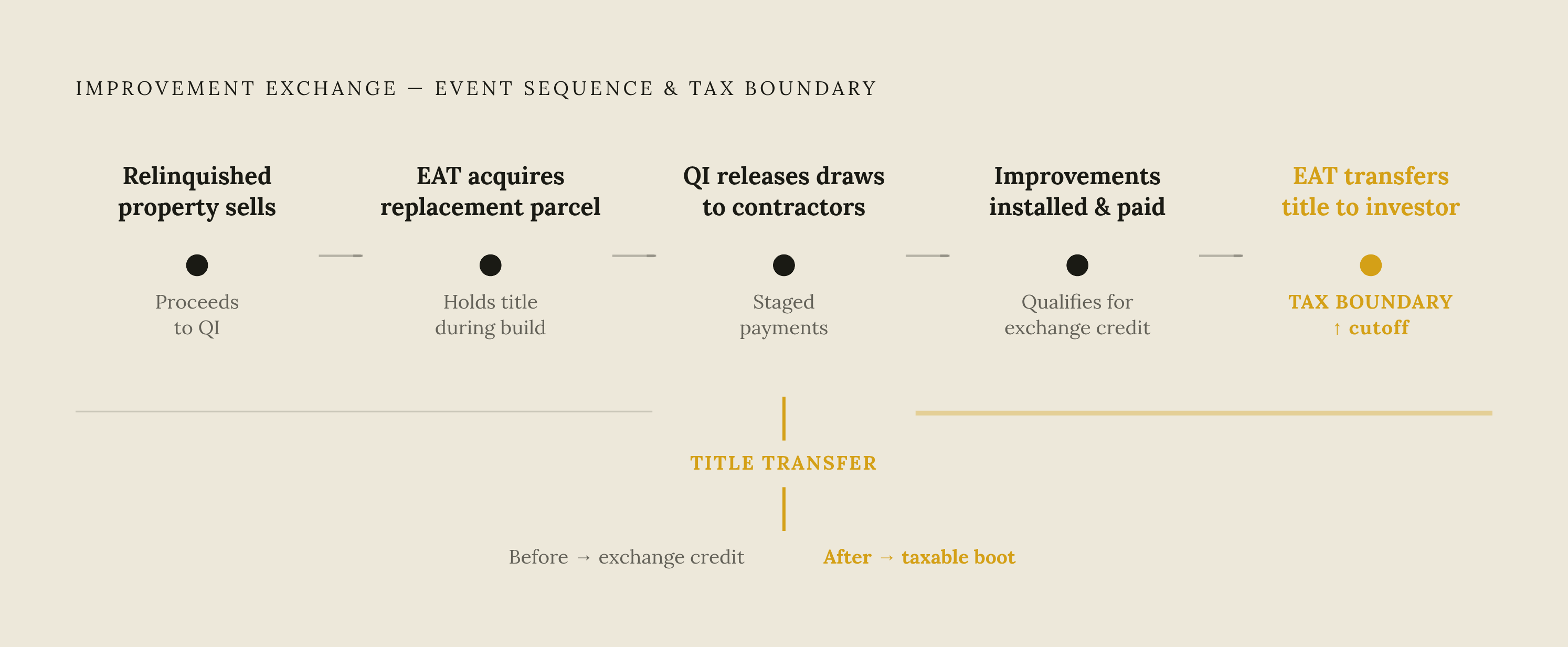
Someone other than the investor must hold the replacement property while the exchange-funded improvements are made. That temporary ownership creates the need for a structure more involved than an ordinary delayed exchange. It also makes the title-transfer date a tax boundary as well as a closing milestone.
The three-party structure that makes improvement exchanges work
The investor works with two intermediaries whose responsibilities differ. The Qualified Intermediary (QI) holds the exchange proceeds and manages the exchange documents. The Exchange Accommodation Titleholder (EAT) holds title to the replacement property during construction.
Revenue Procedure 2000-37 set up the IRS safe harbor for this parking arrangement, which Revenue Procedure 2004-51 later changed. The parties use a Qualified Exchange Accommodation Arrangement to put this in place. The EAT must be treated as the beneficial owner of the parked property for federal income tax purposes. Its role is not merely to appear on the deed while the investor is treated as the owner.
The sequence begins with pre-acquisition planning and the relinquished-property sale, whose proceeds go to the QI. The EAT then acquires the replacement parcel. During construction, the QI releases staged draws directly to contractors as work is completed. The EAT transfers title to the investor within the applicable deadline, with only qualifying completed improvements contributing to replacement value. Because this structure uses the same parking mechanism as a reverse exchange, its cost and complexity are closer to that structure than to a standard forward exchange.
The 45-day identification rule and what it demands for unbuilt improvements
Within 45 calendar days of the relinquished-property closing, the investor must identify both the underlying parcel and the planned improvements with reasonable specificity. Those details include the building footprint, square footage, and what the building will be used for. Plans or a written scope of work can provide the necessary description for property that does not yet exist.
Identifying only “the building to be constructed” leaves the parcel unidentified. Describing the work as “improvements to be determined” creates a different defect, because it leaves the replacement improvements undefined. Neither is a harmless paperwork omission. An inadequate identification can disqualify the exchange even if construction later finishes on schedule.
The property ultimately received must also be substantially the same as the property identified. That requirement restricts the investor’s ability to redesign the project after identification. The investor should have permits in progress, final drawings ready, and contractor selection substantially complete before or immediately after the sale closes. Due diligence does not pause the identification clock, so unresolved design decisions compete directly with the time available to make a valid identification.
The 180-day construction deadline and how it creates taxable boot
Improvements count toward replacement value only if they are physically installed and paid for within the applicable exchange period and before the investor takes title. Weather, contractor delays, failed inspections, and lender slippage do not extend that period. Revenue Procedure 2018-58 allows up to 120 additional days of disaster-related relief only in cases that qualify under a federally declared disaster.
Consider a renovation whose permitting process leaves only part of the planned work complete at the deadline. The completed, paid-for portion can contribute to replacement value. The unfinished portion cannot, even if the contractor expects to finish shortly afterward. If the QI still holds proceeds reserved for that work, those unspent proceeds become cash boot.
Debt can create a separate taxable shortfall. A net reduction in debt from the relinquished property to the replacement property creates mortgage boot unless additional equity offsets it. The acquisition’s financing must also satisfy the exchange requirements.
There is also a shorter deadline hidden in the tax calendar. IRC §1031(a)(3)(B) requires receipt of the replacement property by the earlier of 180 calendar days or the taxpayer’s return due date, including extensions. A seller who sells late in the year may therefore need to get a return extension on time to keep the full window for construction. Bartell v. Commissioner, 147 T.C. No. 5 (2016), addressed qualification of a reverse parking exchange involving construction.
What must be true at the finish line for full deferral
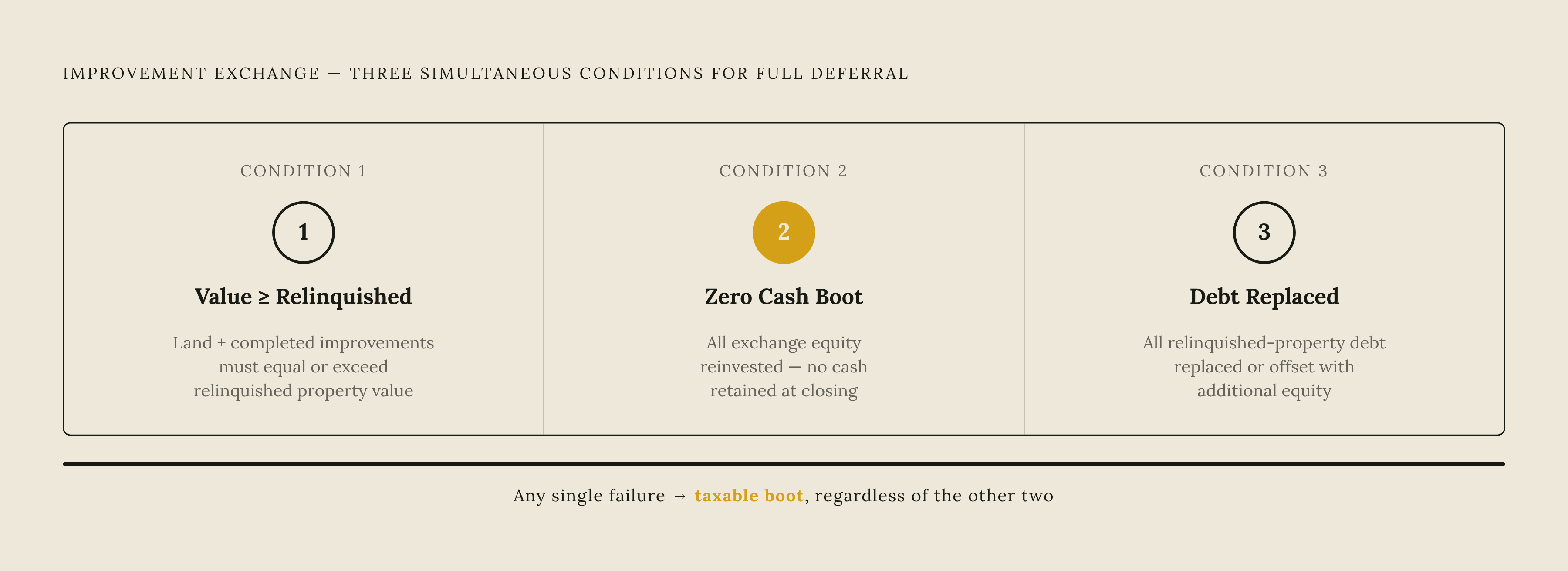
Before going ahead, the investor and advisors should check that the plan meets all three conditions. The combined value of land and qualifying completed improvements must equal or exceed the relinquished property’s value. All exchange equity must be reinvested. All relinquished-property debt must be replaced or offset with additional equity. A plan that satisfies only the value requirement can still produce taxable boot through retained cash or debt relief.
Prepaid improvements do not qualify merely because funds have left the exchange account, and work completed after the investor takes title does not count.
The investor must look ahead at financing needs as carefully as at the construction work. An all-cash purchase of a lower-priced parcel does not resolve debt replacement merely because no new mortgage is needed for the acquisition. The old debt must still be replaced or offset. This combined test favors renovations, tenant improvements, and site work on existing structures over ground-up construction, which rarely finishes within the exchange window.
The pitfalls that most often cause improvement exchanges to partially or fully fail
Permitting may consume a significant share of the available period, leaving a contractor’s otherwise reasonable schedule impossible to complete within the exchange. Investors can reach four months into the process before recognizing that unfinished work will not count. The failure is operational, even when the exchange documents are sound.
A project description that lacks a clear footprint, use, or scope may fail the identification requirement even if the contractor does the work efficiently. The risks of inadequate identification and material redesign make early design decisions part of tax compliance.
Using land the investor already owns runs into the DeCleene prohibition and the restrictions addressed by Revenue Procedure 2004-51. Related-party land is not governed by an identical blanket prohibition. The IRS left those arrangements undecided, so the investor needs tax counsel before signing to assess the use of related-party ownership as a workaround.
An individual seller who sells late in the year and fails to file Form 4868 on time may have less time for the exchange than expected. Combining reverse and improvement structures adds financing and deadline pressure of its own. Neither problem is solved by a contractor finishing on the originally assumed date if the legal exchange window has already closed.
When an improvement exchange is the right tool — and when it is not
An improvement exchange earns its complexity when the value gap is substantial, the scope is defined, and the work can finish within the exchange period. It is particularly useful when no viable finished alternative offers the intended asset at an equivalent price. Predictable renovations, tenant improvements, and site work fit that profile better than an aspirational ground-up development.
A reverse improvement exchange offers a different sequence. The EAT acquires the replacement property and construction begins before the relinquished property sells, which can provide lead time while the sale remains pending. That option also compounds financing needs and deadline pressure. It calls for planning well before closing because the construction period remains limited.
When the investor is unsure when construction will finish, a Delaware Statutory Trust (DST) can be another place to put leftover equity. It offers a passive like-kind investment without the same construction risk and may support full or partial deferral. A hybrid approach can therefore be more suitable than forcing every dollar into unfinished improvements. The choice turns on whether the investor wants a customized asset, less management responsibility, or consolidation for estate planning.
The One Big Beautiful Bill Act, signed July 4, 2025, kept Section 1031 in place. It imposed no dollar cap, income limit, or transaction limit, and left the 45-day and 180-day rules unchanged. Long-horizon deferral strategies therefore remain available under that framework. Their availability, however, does not make an unsuitable construction schedule workable.
What should investors look for in a QI when construction is involved?
For an improvement exchange, investors should evaluate operating capabilities as closely as credentials. The QI industry is largely unregulated at the federal level, so the title alone establishes little. The credential screen should include a Certified Exchange Specialist (CES®) designation, membership in the Federation of Exchange Accommodators (FEA), and a demonstrated record with improvement and reverse exchanges. Construction experience is essential to applying those qualifications under deadline pressure.
For high-value transactions, fund custody is the first thing to check. Exchange funds should sit in segregated qualified escrow or qualified trust accounts, separate from the QI’s operating capital. Fidelity bond and errors-and-omissions coverage should be scaled to the transaction. Standard per-depositor FDIC coverage may fall short when large balances are held during construction, so investors need to check excess or pass-through coverage.
A dedicated Exchange Officer working with the investor’s CPA, attorney, and contractor is better suited to construction draws, permit changes, and identification amendments than a rotating call center. Opening speed also deserves scrutiny because the exchange agreement and assignment language must be in place before the relinquished property closes. Availability at closing cannot repair documents that were never executed in time.
Improvement-exchange fees can be higher than standard forward-exchange fees, and the interest kept on held funds can add a large cost. Those terms belong in the selection decision with security, experience, and responsiveness. The appropriate QI is the one equipped to open an exchange account and administer the actual construction exchange.